
Table of contents: Removal ↓ Installation ↓
- Home
- BMW 3 Series
- E46
- Power unit
- Cooling system
- Removal and installation the thermostat — removing and installing
Removal and installation the thermostat — removing and installing (BMW 3 Series E46)
The thermostat opens a large circulation circuit when the coolant temperature rises. If the thermostat fails to open due to damage, the engine overheats. This can be determined by the coolant temperature gauge being in the emergency zone while the radiator remains cold. A damaged thermostat may also remain open after the coolant temperature has dropped. A sign of this is that the engine does not reach its operating temperature and that the temperature reading on the coolant gauge rises more slowly than usual or that the heating becomes weak in winter.
1. Drain the coolant, refer to Section Replacing the coolant.
Models 320i, 323i, 328i
2. Models with air conditioning: Disconnect the viscous coupling fan, refer to Section Removal and installation a fan with a viscous coupling.
3. Loosen the mounting bolts and remove the eye from the front of the engine.
Models 320d
4. Remove the AGR radiator from the end of the engine.
5. Disconnect the coolant line under the thermostat housing at the cylinder head and at the holder.
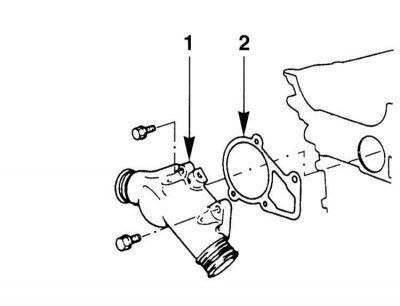
6. Disconnect the coolant hoses from the thermostat housing "1" on the front side of the cylinder block. To do this, pull the wire retainer upwards with a screwdriver, refer to Section Connecting and disconnecting the quick release coupling.
7. Disconnect the connector from the thermostat housing.
8. Unscrew the thermostat housing and remove it together with the sealing gasket "2".
9. Clean the sealing surfaces on the body and cover and wipe with a cloth soaked in alcohol.
10. Tighten the thermostat housing with the new sealing gasket evenly to a torque of 10 Nm.
11. If there are any deformations, replace the sealing rings on the quick-release couplings. Press in the wire clips. Put on the hoses, and the coupling should clearly lock into place.
12. Connect the connector to the thermostat housing.
13. Models 320i, 323i, 328i: Tighten the engine lug to a torque of 20 Nm.
14. Models 320i, 323i, 328i with air conditioning: Install a fan with a viscous coupling, refer to Section Removal and installation a fan with a viscous coupling.
15. Models 320d: Secure the coolant line under the thermostat housing with its sealing gasket. Secure the line to the bracket. Install the EGR radiator, refer to Section Removal and installation the intake manifold.
16. Fill the system with fluid and bleed air, refer to Section Replacing the coolant.
17. Start and warm up the engine. Check if the radiator is warm and if the thermostat housing is sealed. If there are leaks, tighten the mounting bolts.
Removal
The thermostat is firmly built into the housing and cannot be removed. If there is a defect, it must be replaced together with the housing.
1. Drain the coolant, refer to Section Replacing the coolant.
Models 320i, 323i, 328i
2. Models with air conditioning: Disconnect the viscous coupling fan, refer to Section Removal and installation a fan with a viscous coupling.
3. Loosen the mounting bolts and remove the eye from the front of the engine.
Models 320d
4. Remove the AGR radiator from the end of the engine.
5. Disconnect the coolant line under the thermostat housing at the cylinder head and at the holder.
6. Disconnect the coolant hoses from the thermostat housing "1" on the front side of the cylinder block. To do this, pull the wire retainer upwards with a screwdriver, refer to Section Connecting and disconnecting the quick release coupling.
7. Disconnect the connector from the thermostat housing.
8. Unscrew the thermostat housing and remove it together with the sealing gasket "2".
The thermostat cannot be tested in the usual way by immersing it in a container of hot water, since its opening temperature is above the boiling point and is 105°C.
Installation
9. Clean the sealing surfaces on the body and cover and wipe with a cloth soaked in alcohol.
10. Tighten the thermostat housing with the new sealing gasket evenly to a torque of 10 Nm.
11. If there are any deformations, replace the sealing rings on the quick-release couplings. Press in the wire clips. Put on the hoses, and the coupling should clearly lock into place.
12. Connect the connector to the thermostat housing.
13. Models 320i, 323i, 328i: Tighten the engine lug to a torque of 20 Nm.
14. Models 320i, 323i, 328i with air conditioning: Install a fan with a viscous coupling, refer to Section Removal and installation a fan with a viscous coupling.
15. Models 320d: Secure the coolant line under the thermostat housing with its sealing gasket. Secure the line to the bracket. Install the EGR radiator, refer to Section Removal and installation the intake manifold.
16. Fill the system with fluid and bleed air, refer to Section Replacing the coolant.
17. Start and warm up the engine. Check if the radiator is warm and if the thermostat housing is sealed. If there are leaks, tighten the mounting bolts.
This article is available at russian, bulgarian, belarusian, ukrainian, serbian, croatian, romanian, polish, slovak, hungarian
Article verified: Sevastyanov Nikolay
Share information:
Previous articles
БМВ E46: Cooling system
Next articles
Similar articles on other types of BMW cars:
Removal and installation, checking of the thermostat BMW 5 Series E34 (1988-1996)
Removal and installation / checking the thermostat BMW 5 Series E39 (1995-2003)
Thermostat — Removal, Installation and Checking BMW 7 Series E32 (1986-1994)
Removal and installation the thermostat BMW 7 Series E38 (1994-2001)
Pistons — removal and installation BMW X3 E83 (2003-2010)
Removal and installation the engine BMW X5 E53 (1999-2006)
Removal and installation, checking of the thermostat BMW 5 Series E34 (1988-1996)
Removal and installation / checking the thermostat BMW 5 Series E39 (1995-2003)
Thermostat — Removal, Installation and Checking BMW 7 Series E32 (1986-1994)
Removal and installation the thermostat BMW 7 Series E38 (1994-2001)
Pistons — removal and installation BMW X3 E83 (2003-2010)
Removal and installation the engine BMW X5 E53 (1999-2006)
Link in different formats to this page
Visitor comments
No comments yet
- General information
- Manual
- Maintenance
- Power unit
- Engine repair
- Cooling system
- Power system (gasoline)
- Injection system (gasoline)
- Fuel system (diesel)
- Exhaust system
- Ignition system
- Charge and launch systems
- Transmission
- Car gearbox
- Clutch and drive shafts
- Chassis
- Brake system
- Suspension front and rear
- Steering
- Body
- Body care and repair
- Exterior
- Interior
- Electrical equipment
- Troubleshooting
- Lighting and signaling
- Equipment and devices
- Heater and air conditioner
- Electrical circuits
- General information
- Manual
- Repair on the road
- Weekly checks
- Maintenance
- Troubleshooting
- Power unit
- 4 cylinder engines
- 6 cylinder engines
- Engine overhaul
- Cooling and heating
- Fuel and exhaust system
- Starting and charging system
- Ignition system
- Transmission
- Clutch
- Mechanical gearbox
- Automatic gearbox
- Cardan and drive shafts
- Chassis
- Brake system
- Wheel suspension
- Steering
- Body
- Exterior
- Interior
- Electrical equipment
- Equipment and devices
- Electrical circuits
- General information
- Maintenance
- Power unit
- Engine repair
- Cooling system
- Ignition system
- Supply system
- Fuel injection system
- Exhaust system
- Transmission
- Clutch
- Car gearbox
- Front and rear axle
- Chassis
- Steering
- Brake system
- Body
- Exterior
- Interior
- Electrical equipment
- Heating system
- Equipment and devices
- Power devices
- Electrical circuits
- Power unit
- M10/M20 engine
- M40 engine
- Ignition system
- Lubrication system
- Cooling system
- Supply system
- Fuel injection
- Exhaust system
- Transmission
- Clutch
- Manual gearbox
- Front axle
- Rear axle
- Chassis
- Steering
- Brake system
- Body
- Exterior
- Interior
- Electrical equipment
- Heating system
- Equipment and devices
- Electrical circuits
- General information
- Specifications
- Operation and maintenance
- 4-cylinder engine
- Engine repair
- Cooling and lubrication system
- Supply system
- Ignition system
- 6-cylinder engine
- Engine repair
- Cooling and lubrication system
- Supply system
- Fuel injection system
- Ignition system
- Transmission
- Clutch
- 4-speed manual gearbox
- 5-speed manual gearbox
- Automatic gearbox
- Cardan and rear axle
- Chassis
- Steering
- Front suspension
- Rear suspension
- Brake system
- Electrical equipment
- Equipment and devices
- Electrical circuits