
Table of contents: Removal ↓ Installation ↓
- Home
- BMW 3 Series
- E36
- Chassis
- Brake system
- Removal and installation front brake discs and brake calipers
Removal and installation front brake discs and brake calipers (BMW 3 Series E36)
Removal
Remove the decorative cap. Mark the position of the wheel disks on the wheel hubs with paint. Thanks to this, the balanced wheel is subsequently installed in the same position.
Loosen the wheel bolts.
Raise the front of the car and remove the wheel.
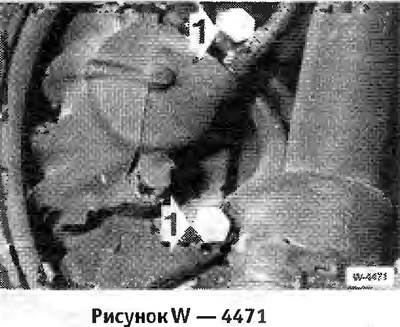
Loosen the mounting bolts "1" of the brake caliper and remove the brake caliper from the brake disc.
Hang the brake caliper on a wire so that the brake hose and wear sensor wire are not stretched or twisted.
Caution: Do not unscrew the brake hose, otherwise you will have to bleed the air from the brake system.
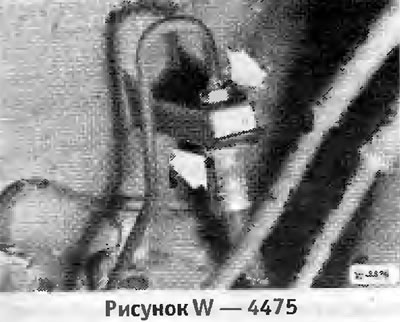
If complete removal of the brake caliper is required, the brake hose must first be unscrewed. In other cases, the brake hose may not be unscrewed.
Caution: Collect leaking brake fluid in a bottle intended exclusively for brake fluid. You can also suck out the brake fluid from the expansion tank.
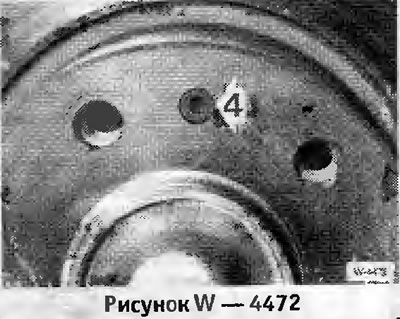
Unscrew bolt "4" with a 5 mm open-end wrench.
Remove the brake disc.
Installation
To ensure uniform braking on both sides, the surfaces of both discs must be identical in surface cleanliness and treatment. Therefore, both discs must be replaced or treated simultaneously.
The service station can check the disc runout. Maximum lateral runout (in the installed position): 0.2 mm.
Measure the thickness of the disc.
If present, remove rust from the brake disc flange and from the front wheel hub.
Remove varnish from the surface of the new disk with nitro solvent.
Place the brake disc on the wheel hub and secure with a bolt. First, turn the brake disc so that the holes for the bolt align.
Place the brake calipers with the brake pads inserted. Do not stretch or twist the brake hose. Check the freedom of movement of the brake hose when turning the steering wheel from lock to lock.
Secure the brake caliper with a bolt tightening torque of 120 Nm.
Caution: If the brake hose has come loose, it is necessary to bleed the air from the brake system.
Install the wheel observing the marking of the disk position on the hub. Lower the car and cross-tighten the wheel bolts to a torque of 110 Nm.
Caution: With the vehicle stationary, press the brake pedal several times until you feel a noticeable resistance.
Check the brake fluid level in the expansion tank and, if necessary, top up the fluid to the MAX mark.
This article is available at russian, bulgarian, belarusian, ukrainian, serbian, croatian, romanian, polish, slovak, hungarian
Article verified: Chebotarev Vladislav
Share information:
Previous articles
БМВ E36: Brake system
Next articles
Similar articles on other types of BMW cars:
Removal and installation front brake discs and brake calipers BMW 5 Series E34 (1988-1996)
Removal and installation the front wheel brake mechanism BMW 5 Series E12 (1972-1981)
Front brake pads — removal and installation BMW 7 Series E32 (1986-1994)
Removal and installation brake discs BMW 7 Series E38 (1994-2001)
Front brake discs BMW X3 E83 (2003-2010)
Removal and installation the parking brake lever BMW X5 E53 (1999-2006)
Removal and installation front brake discs and brake calipers BMW 5 Series E34 (1988-1996)
Removal and installation the front wheel brake mechanism BMW 5 Series E12 (1972-1981)
Front brake pads — removal and installation BMW 7 Series E32 (1986-1994)
Removal and installation brake discs BMW 7 Series E38 (1994-2001)
Front brake discs BMW X3 E83 (2003-2010)
Removal and installation the parking brake lever BMW X5 E53 (1999-2006)
Link in different formats to this page
Visitor comments
No comments yet
- General information
- Manual
- Maintenance
- Power unit
- Engine repair
- Cooling system
- Power system (gasoline)
- Injection system (gasoline)
- Fuel system (diesel)
- Exhaust system
- Ignition system
- Charge and launch systems
- Transmission
- Car gearbox
- Clutch and drive shafts
- Chassis
- Brake system
- Suspension front and rear
- Steering
- Body
- Body care and repair
- Exterior
- Interior
- Electrical equipment
- Troubleshooting
- Lighting and signaling
- Equipment and devices
- Heater and air conditioner
- Electrical circuits
- General information
- Manual
- Repair on the road
- Weekly checks
- Maintenance
- Troubleshooting
- Power unit
- 4 cylinder engines
- 6 cylinder engines
- Engine overhaul
- Cooling and heating
- Fuel and exhaust system
- Starting and charging system
- Ignition system
- Transmission
- Clutch
- Mechanical gearbox
- Automatic gearbox
- Cardan and drive shafts
- Chassis
- Brake system
- Wheel suspension
- Steering
- Body
- Exterior
- Interior
- Electrical equipment
- Equipment and devices
- Electrical circuits
- General information
- Maintenance
- Power unit
- Engine repair
- Cooling system
- Ignition system
- Supply system
- Fuel injection system
- Exhaust system
- Transmission
- Clutch
- Car gearbox
- Front and rear axle
- Chassis
- Steering
- Brake system
- Body
- Exterior
- Interior
- Electrical equipment
- Heating system
- Equipment and devices
- Power devices
- Electrical circuits
- Power unit
- M10/M20 engine
- M40 engine
- Ignition system
- Lubrication system
- Cooling system
- Supply system
- Fuel injection
- Exhaust system
- Transmission
- Clutch
- Manual gearbox
- Front axle
- Rear axle
- Chassis
- Steering
- Brake system
- Body
- Exterior
- Interior
- Electrical equipment
- Heating system
- Equipment and devices
- Electrical circuits
- General information
- Specifications
- Operation and maintenance
- 4-cylinder engine
- Engine repair
- Cooling and lubrication system
- Supply system
- Ignition system
- 6-cylinder engine
- Engine repair
- Cooling and lubrication system
- Supply system
- Fuel injection system
- Ignition system
- Transmission
- Clutch
- 4-speed manual gearbox
- 5-speed manual gearbox
- Automatic gearbox
- Cardan and rear axle
- Chassis
- Steering
- Front suspension
- Rear suspension
- Brake system
- Electrical equipment
- Equipment and devices
- Electrical circuits