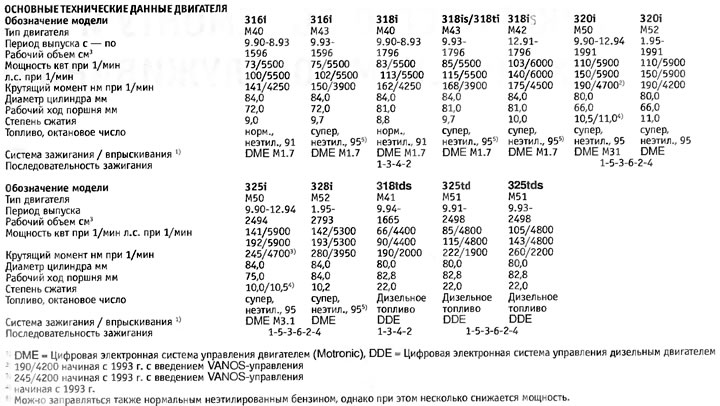
Depending on the model, the following power units are installed:
Model 316i/318ti:
- 4-cylinder engine M40 with a working volume of 1.6 and 1.8 liters. Since September 1990, it has been modified into the M43 engine (timing chain, ignition system, intake manifold).
Models 318i/318ti:
- 4-cylinder, 4-valve M42 engine with a displacement of 1.8 liters.
Models 320i/325i:
- 6-cylinder 4-valve engine M50 with a working volume of 2.0 l or 2.5 l. Since January 1995, an aluminum cylinder block has been installed. Engine designation M52.
Model 318tds:
- 4-cylinder turbodiesel engine M41 with a working volume of 1.8 liters.
Models 325td/325tds:
- 6-cylinder turbodiesel engine M51 with a working volume of 2.5 liters.
The engine block made of gray cast iron has cylinder holes. If there is significant wear or scratches on the cylinder walls, the cylinders can be honed, i.e. ground in a special workshop. After this, only pistons of increased dimensions should be installed. The lower part of the engine block contains a crankshaft mounted on its bearings. The connecting rods that connect with the pistons are mounted on the crankshaft on plain bearings. The lower part of the engine is completed by an oil sump, which collects oil needed for lubrication and cooling of the engine. The cylinder head made of light metal alloys is bolted on top of the engine block. It is aluminum, since this metal has higher thermal conductivity and lower specific gravity than cast iron.
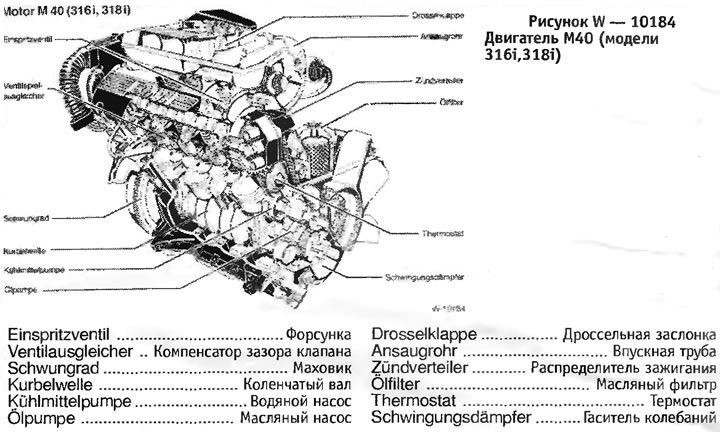
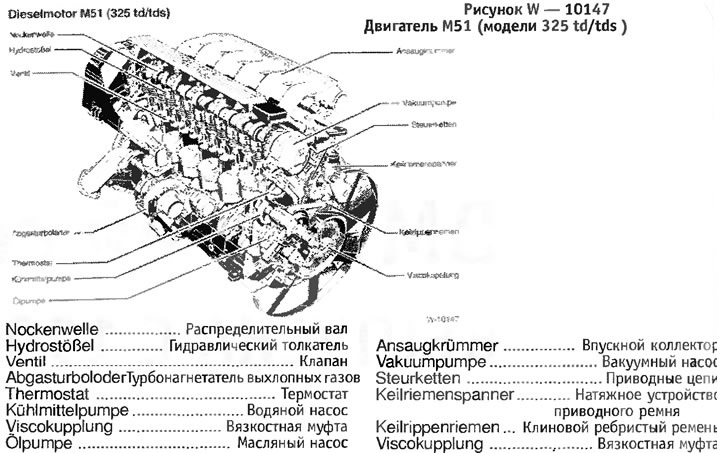
The cylinder head is designed according to the so-called cross-flow principle. This means that the freshly prepared air-fuel mixture enters the cylinder head on one side, while the burnt gases are expelled on the other side of the cylinder head. The cross-flow design ensures faster gas exchange. The camshaft is located in the upper part of the cylinder head. On M40 engines, the camshaft is driven from the crankshaft via a toothed belt. The camshaft controls the valves via rocker arms, which rest on the side opposite the valve, on the valve clearance compensators. 4-valve petrol engines have two camshafts, one of which controls the operation of the intake valves, and the other - the exhaust valves. As on diesel engines, the camshaft is also controlled via a roller chain. The intake and exhaust valves are controlled by hydraulic tappets, which do not require maintenance. On all engines, valve clearance adjustment is not required as part of maintenance.
Since September 1992, the 6-cylinder petrol engines have been further developed, including the introduction of a variable camshaft control system, abbreviated as VANOS. This is done by means of an adjusting element, which, depending on the engine speed, rotates the intake camshaft relative to the chain by a certain angle, thereby maintaining the optimum ignition timing. The adjusting element is controlled by the engine control unit. Other improvements have been made to ensure the smoothest possible engine operation, torque characteristics, exhaust gas composition and fuel consumption: an increase in the compression ratio in combination with selective detonation control, the installation of simple valve springs with low spring forces, lightweight pistons with extended connecting rods.
Engine lubrication is provided by an oil pump, which is mounted on a 6-cylinder petrol engine in the front part of the engine crankcase and driven by a chain transmission. On 4-cylinder and diesel engines, the oil pump is located in the timing case cover and the end of the crankshaft and is connected to the latter by a gear transmission. Oil from the oil sump gets through holes and channels to the bearings of the crankshaft and camshaft, as well as to the working surfaces of the cylinders.
The water pump is located at the front of the engine block; its shaft at the appropriate temperature is connected by a viscous coupling to the radiator fan. The water pump is driven on 4-valve engines and on diesel engines via a V-belt, which also serves as the generator drive, and on the M40 engine via a toothed belt of the camshaft. It should be borne in mind that the cooling system should be filled with a mixture of antifreeze and anti-corrosion concentrate with lime-free water throughout the year
An electronic ignition and fuel injection device is used to prepare the flammable air-fuel mixture, which guarantees a stable composition of exhaust gases.
On models 316i, 318i produced before August 1993, instead of the usual ignition distributor, a so-called high-voltage distributor is installed at the front of the cylinder head, which is driven directly by the camshaft. On all other petrol engines, the ignition system does not have a distributor at all, i.e. on these engines, there are no moving parts in the ignition system. On diesel engines, fuel dosing is also controlled electronically using the DDE system (Digital Diesel Engine Management System).