



The M62 power units have a V-shaped arrangement of cylinders at an angle of 90° and are equipped with automatic transmissions, which are installed in the engine compartment along the central axis of the car. The head and cylinder block of these engines are made of light alloy. The engine cylinder blocks have dry thin-walled cast iron liners. The cylinder head is 16-valve, the valves are located at an angle of 39.5°.
Cooling system – closed, liquid, forced. Combined pressure and spray lubrication system. Power supply system - injection (injection), with electronic control. The crankshaft rotates in the main plain bearings. All engines are equipped with a top-mounted camshaft distribution mechanism (dOHC systems) and hydraulic cylindrical tappets, chain driven from the engine crankshaft sprocket.
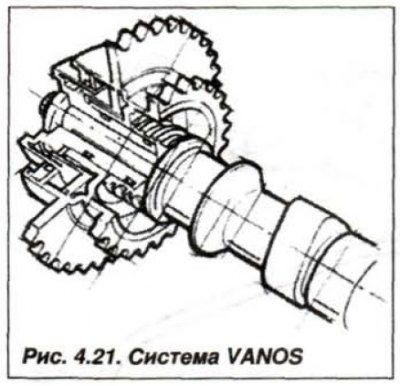
There is no need to adjust the valve clearances during maintenance (TO). The camshafts are connected to each other by a roller chain. The engine has an adjustable valve timing drive, which automatically changes the phase (moment) of opening and closing the intake valves by changing the initial position of the camshaft. This system has a brand name - "VANOS" (Variable Nockenwellensteuerung).
At the same time, the camshaft of the intake valves, depending on the engine crankshaft speed, by means of an adjustment mechanism, rotates relative to the drive sprocket in such a way that it provides the optimal valve opening moment, thereby achieving optimal valve timing, reducing fuel consumption and meeting the exhaust gas (exhaust gas) toxicity standards. Changing the position of the intake camshafts is carried out by signals from the electronic control unit (ECU), due to the opening and closing of the pressure oil supply valve in the adjustment mechanism of the system (see fig. 4.21).
The supply of oil under pressure to the engine is provided by a mechanical oil pump with internal gears. The oil pump has a chain drive from the crankshaft sprocket and is located in the oil pan of the crankcase. Oil is taken from the oil pan by the pump receiver and is supplied through channels and pipelines to the bearings of the crankshaft and camshafts, hydraulic tappets, and also to the working surfaces of the cylinders from the injectors. The full-flow oil filter is mounted separately and connected to the engine by hoses.
The centrifugal type liquid cooling system pump is mounted in the front wall of the engine cylinder block. It is driven by a V-belt from the engine crankshaft pulley. The same belt is used as a drive for both the generator and the power steering pump. A viscous coupling is installed on the pump shaft, which ensures that the fan is turned on depending on the coolant temperature. The cooling system is sealed and must be constantly filled with antifreeze.
Some modifications of these engines have a system of adjustable resonant supercharging by changing the length of the air intake channels. The engines can be removed from the car only upwards, using a special device and a lift (hoist) with a lifting capacity of more than 0.5 tons and with the car hood completely tilted upwards or removed.
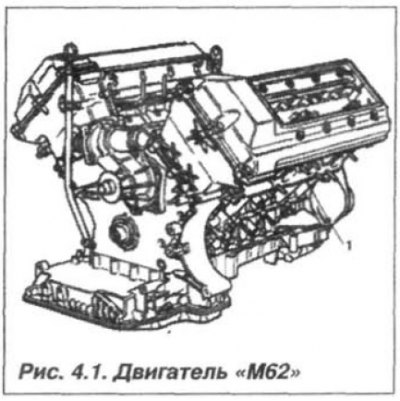
The general layout of the engine and the location of its serial number (1) are shown in Fig. 4.1.
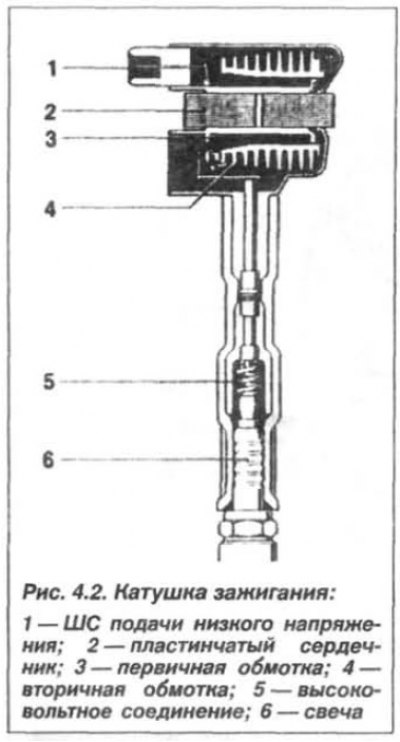
The electronic engine control system ensures the preparation of the fuel-air mixture and its ignition. The M62 engine models use a modification of the Bosch (Germany) fuel injection and ignition system, indexed DME ("Digital Motor Electronics" (Motronic) – digital electronic engine management system). In the future it will be called simply "DME" or "Motronic". The ignition system is fully electronic with individual ignition coils (Fig. 4.2) and is controlled by a single ECU from the DME.
The engines use gasoline with an octane number (ROZ) of 95 as fuel, however, the ability to suppress detonation in individual cylinders allows the use of fuels with octane numbers from ROZ 91 to ROZ 98. In the first case, fuel consumption increases due to loss of power, while in the second case there is fuel savings and increased power.
The transmission with manual or automatic control is fixed to the rear wall (on the end) of the engine and has an all-wheel drive option (4x4). The design of the engines differs only in the dimensions of the block and its cylinder-piston group.
Engine specifications
Engines model "M62" | B44 | B46 |
| Start of release | September 1999 | March 2001 |
| Cylinder arrangement | V8/90° | |
| Cylinder diameter, mm | 92 | 93 |
| Piston stroke, mm | 82,7 | 85 |
| Working volume, cm³ | 4398 | 4619 |
| Compression ratio | 10,0 | 10,5 |
| Compression pressure, kg/cm² | 12 – 14 | |
| Nominal power, | ||
| – according to the EEC standard, kW | 210 | 255 |
| – according to DIN standard, hp. | 286 | 347 |
| Rotation speed, min⁻¹ | 5400 | 5700 |
| Maximum torque, | ||
| – according to the EEC standard, Nm | 440 | 480 |
| – according to DIN standard, kgf∙m | 44,9 | 49,0 |
| Rotation speed, min⁻¹ | 3600 | 3700 |
| Maximum frequency, min⁻¹ | 6100 | 6500 |
| Mixing system | M 7.2 | |
| Cylinder firing order | 1–5–4–8–6–3–7–2 | |
| Piston-cylinder clearance, mm | ||
| - nominal | 0,03 | |
| - maximum permissible | 0,10 | |
| Cylinder diameter, mm | ||
| - nominal | 92,00 | 93,00 |
| - intermediate | 92,08 | 93,08 |
| – 1st repair size | 92,25 | 93,25 |
| Permissible ovality of cylinder mirrors, mm | 0,007 | |
| Permissible conicity of cylinder mirrors, mm | 0,008 | |
| Execution tolerance, mm | From 0.00 to +0.014 | |
The article text was copied from an online resource «www.bmwman.ru»