
Table of contents: Removal ↓ Installation ↓
- Home
- BMW 3 Series
- E36
- Power unit
- Engine repair
- Removal and installation the cylinder head. Models 318is, 318ti
Removal and installation the cylinder head. Models 318is, 318ti (BMW 3 Series E36)
See above for signs of a bad head gasket.
Disconnect the ground wire from the battery.
Raise the car.
Unscrew the front muffler pipe from the exhaust manifold.
Unscrew the exhaust manifold. The intake manifold cannot be removed.
Drain the coolant from the engine.
Drain the coolant from the engine by unscrewing the drain plug on the side of the engine block under the exhaust manifold. After draining, immediately screw the plug back on and tighten it.
Disconnect the water hoses from the thermostat, first releasing their clamps.
Disconnect the throttle cable from the throttle lever.
Disconnect the following hoses and connectors from the throttle support. It is recommended to pre-mark the hoses and connectors and their connection points so as not to mix them up when connecting them later. Loosen the hose clamps: fuel tank vent hose "3", fuel inlet hose "2", fuel return hose "1".
Loosen the intake manifold support mounting bolts.
Disconnect the connectors from the components on the intake manifold and cylinder head by pressing the wire clamps of the connectors: idle speed control valve, throttle potentiometer, coolant temperature sensor, oil pressure switch.
Remove the cylinder head cover and disconnect the spark plug tips.
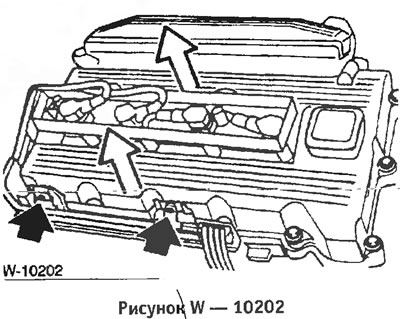
Unscrew the 2 "arrow" nuts and remove the ignition wires as a set.
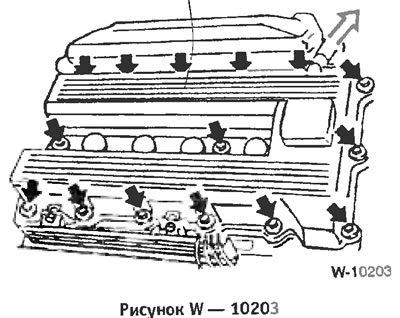
Disconnect the crankcase ventilation hose from the cylinder head.
Unscrew the cylinder head cover, see figure.
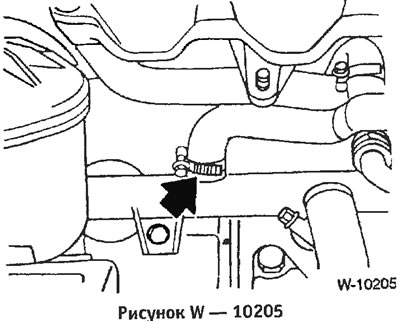
Loosen the clamp and disconnect the water hose from the water pipe.
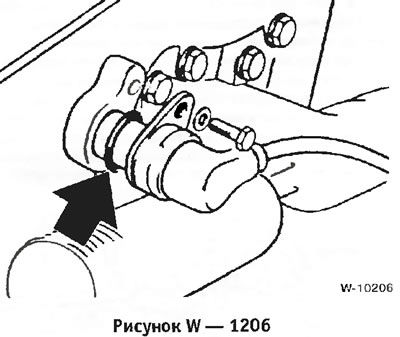
Unscrew the camshaft position sensor and pull it out with the gasket.
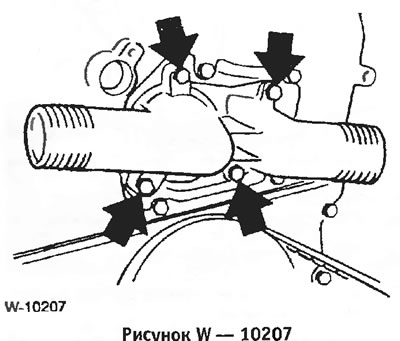
Unscrew the thermostat housing and pull it out together with the thermostat.
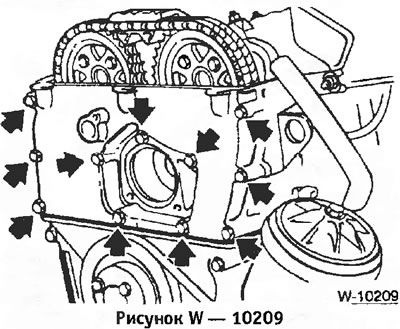
Unscrew and remove the top cover of the gearbox.
Set the engine to the top dead center position. To do this, engage 5th gear and move the car on a level surface, or turn the engine by the crankshaft pulley in the direction of engine rotation until the tips of the cams of the inlet and outlet valves of cylinder 1 are aligned. The arrows on both camshaft sprockets should point upward.
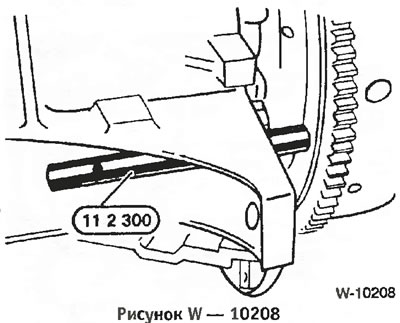
Fix the crankshaft in the top dead center position using the BMW 11 2 300 device or another suitable rod. To do this, insert the rod through the hole in the engine block into the hole in the flywheel.
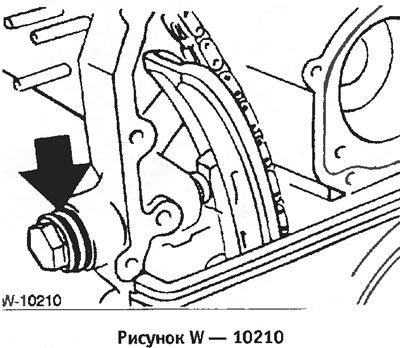
Unscrew the chain tensioner from the cylinder head.
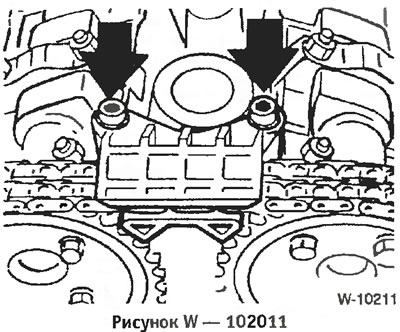
Unscrew the upper chain guide.
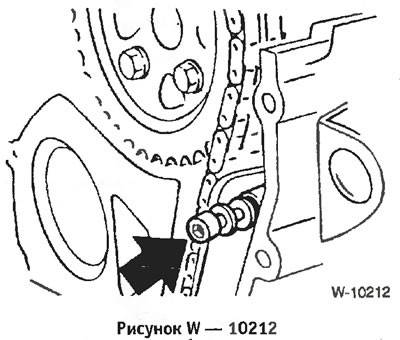
Loosen the upper bolt of the right chain guide.
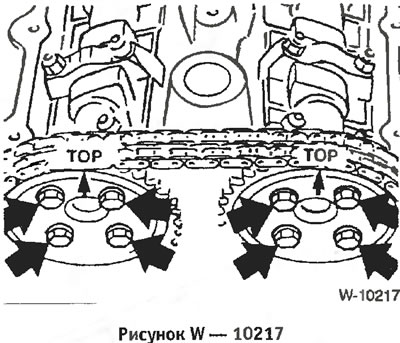
Unscrew and remove the sprockets. The arrows on the sprockets should point upwards.
Loosen the cylinder head bolts in several passes from the inside out. A Torx head bolt wrench is required to loosen the cylinder head bolts.
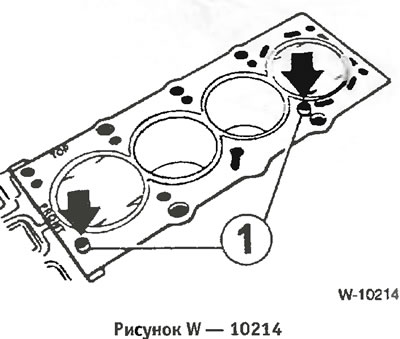
Before installation, clean the cylinder head and engine block from seal residues. Seal residues should not get into the holes, cover the holes with rags.
Check the position and integrity of the centering bushings "arrows". There should be no oil in the threaded holes.
Check the cylinder head for cracks and scratches on its surface.
Measure the flatness of the cylinder head and engine block with a steel ruler in the longitudinal and transverse directions and, if necessary, mill it (work at a service station). The maximum permissible non-flatness is 0.03 mm.
Thoroughly clean the cylinder head holes from oil and other objects. Caution: No oil should remain in the blind holes, otherwise the bolts will not fully tighten the cylinder head, although they will be tightened to the required torque. In addition, the engine block may crack.
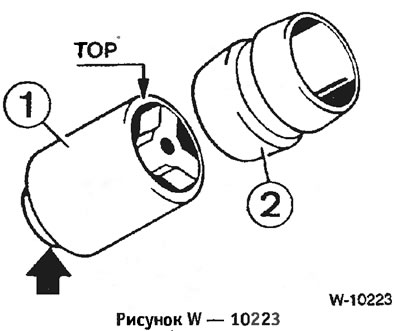
If the oil check valve "1" was removed, insert it with the lug towards the crankcase into the lubrication channel of the cylinder head. Insert the rubberized spacer sleeve "2".
Be sure to replace the cylinder head gasket. Apply a new gasket without sealing compound so that it does not cover the holes. The inscription "FRONT" should be directed upwards, and the inscription "TOP" to the chain drive of the engine.
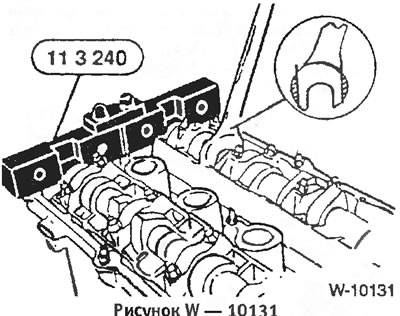
Secure the camshafts with the BMW tool shown in the figure. If necessary, turn the camshafts using the 27 mm Allen key.
If the camshaft has to be turned so much that the valves of the 1st and 4th cylinders begin to move, then the crankshaft should first be turned approximately 90° and only then the camshaft should be turned. This eliminates contact between the valves and the pistons.
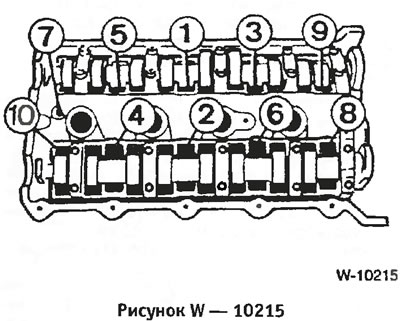
Tighten the cylinder head bolts in three passes each time in sequence 1 through 10:
Place the gasket on the gearbox.
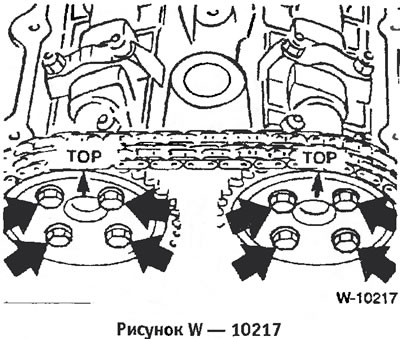
Screw the sprockets with the chain on to the camshaft flanges. The arrows on the sprockets should point upwards. Tighten the bolts to 15 Nm, i.e. not too tight.
Tighten the bolt of the right guide and also install the upper chain guide.
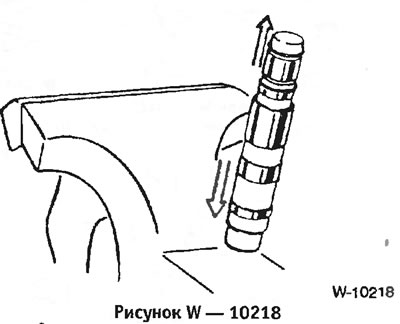
Tap the chain tensioner outer sleeve on a hard surface (for example, in a vice). This causes the piston to become unfastened.
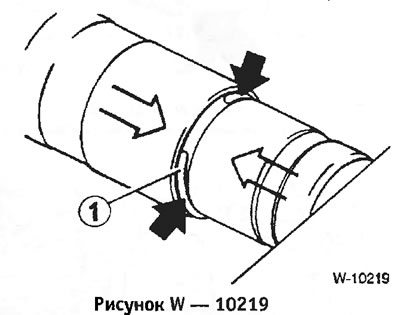
Clamp the chain tensioner in a vice and compress it. To avoid damaging the pistons, place gaskets in the vice jaws. When compressed, the spring ring "1" is pressed into the tensioner bushing.
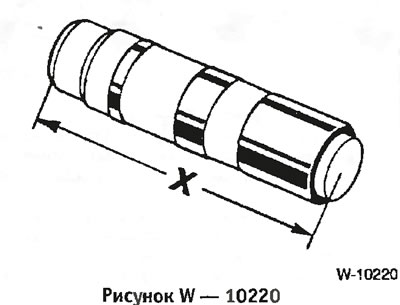
Compress the chain tensioner to the dimension X = 68.5 mm, in this position you should hear the outer spring ring jumping. Release the vice, the tensioner should maintain its dimension. If this does not happen, the fixation point has not been reached or passed, repeat the adjustment.
Screw in the lower chain tensioner with the sealing ring and tighten to 25 Nm. Fill the joints of the gearbox cover gaskets with elastic mass "3 Bond 1209".
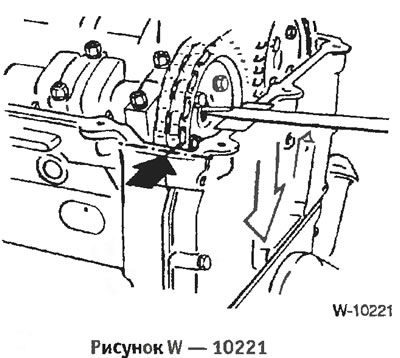
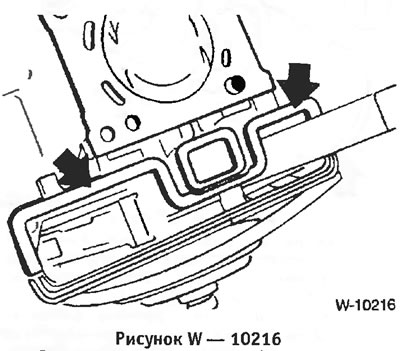
Install the gearbox cover with a new gasket. Tighten the M6 bolts to 10 Nm and the M8 bolts to 22 Nm. When tightening the bolts, press the cover down with a screwdriver, as shown in the figure, so that it is flush with the top edge of the cylinder head.
Remove the camshaft locking device.
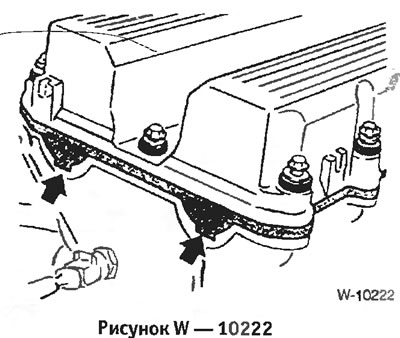
Apply the cylinder head cover gasket, paying particular attention to its position in the cylinder head cutouts on the front side. Replace a damaged gasket.
Tighten the cylinder head cover bolts evenly to 10 Nm.
Install the cooling system thermostat.
Connect the throttle cable to the throttle lever.
Connect and secure all water, fuel and vacuum hoses with clamps.
Connect the electrical wires.
Route the spark plug wires and connect the spark plug caps.
Screw the exhaust manifold with a new gasket to the cylinder head with a tightening torque of 25 Nm. The groove of the gasket should face the cylinder head. Coat the studs with high-temperature paste.
Screw the front muffler pipe to the exhaust manifold.
Fill the engine with coolant.
Check the engine oil level, top up if necessary. If the cylinder head was removed to replace a blown cylinder head gasket, it is recommended to change the oil and replace the oil filter, as coolant may have gotten into the oil.
Removal
Note: Some works are described in more detail in the section "Removal and installation the engine", so it is recommended to also read this section. Remove the cylinder head only on a cold engine.
Disconnect the ground wire from the battery.
Warning: When the battery is disconnected, the information in the electronic memory devices is erased, for example, the engine fault memory or the radio security code memory. When disconnecting the battery, follow the instructions in the sections "Radio" and "Removing and installing the battery".
Raise the car.
Unscrew the front muffler pipe from the exhaust manifold.
Unscrew the exhaust manifold. The intake manifold cannot be removed.
Drain the coolant from the engine.
Drain the coolant from the engine by unscrewing the drain plug on the side of the engine block under the exhaust manifold. After draining, immediately screw the plug back on and tighten it.
Disconnect the water hoses from the thermostat, first releasing their clamps.
Disconnect the throttle cable from the throttle lever.
Disconnect the following hoses and connectors from the throttle support. It is recommended to pre-mark the hoses and connectors and their connection points so as not to mix them up when connecting them later. Loosen the hose clamps: fuel tank vent hose "3", fuel inlet hose "2", fuel return hose "1".
Warning: Flammable, no smoking. Wipe up any leaking fuel with a cloth.
Loosen the intake manifold support mounting bolts.
Disconnect the connectors from the components on the intake manifold and cylinder head by pressing the wire clamps of the connectors: idle speed control valve, throttle potentiometer, coolant temperature sensor, oil pressure switch.
Remove the cylinder head cover and disconnect the spark plug tips.
Unscrew the 2 "arrow" nuts and remove the ignition wires as a set.
Disconnect the crankcase ventilation hose from the cylinder head.
Unscrew the cylinder head cover, see figure.
Note: Pay attention to the location of the rubber gaskets under the bolts for subsequent installation.
Loosen the clamp and disconnect the water hose from the water pipe.
Unscrew the camshaft position sensor and pull it out with the gasket.
Unscrew the thermostat housing and pull it out together with the thermostat.
Unscrew and remove the top cover of the gearbox.
Set the engine to the top dead center position. To do this, engage 5th gear and move the car on a level surface, or turn the engine by the crankshaft pulley in the direction of engine rotation until the tips of the cams of the inlet and outlet valves of cylinder 1 are aligned. The arrows on both camshaft sprockets should point upward.
Fix the crankshaft in the top dead center position using the BMW 11 2 300 device or another suitable rod. To do this, insert the rod through the hole in the engine block into the hole in the flywheel.
Unscrew the chain tensioner from the cylinder head.
Unscrew the upper chain guide.
Loosen the upper bolt of the right chain guide.
Unscrew and remove the sprockets. The arrows on the sprockets should point upwards.
Caution: Hook the chain onto the wire hook to prevent it from slipping down.
Loosen the cylinder head bolts in several passes from the inside out. A Torx head bolt wrench is required to loosen the cylinder head bolts.
Caution: Do not place the cylinder head on the contact surface after removal, otherwise the fully open valves may be damaged. Therefore, the cylinder head should be placed on 2 wooden pads.
Installation
Before installation, clean the cylinder head and engine block from seal residues. Seal residues should not get into the holes, cover the holes with rags.
Check the position and integrity of the centering bushings "arrows". There should be no oil in the threaded holes.
Caution: Always install new cylinder head bolts. The seal washers are not supplied in serial cylinder heads, as they are pressed in. When installing a new cylinder head, install seal washers without pressing them in.
Check the cylinder head for cracks and scratches on its surface.
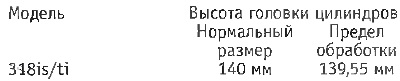
Measure the flatness of the cylinder head and engine block with a steel ruler in the longitudinal and transverse directions and, if necessary, mill it (work at a service station). The maximum permissible non-flatness is 0.03 mm.
Note: When the cylinder head is milled, depending on the height of the cylinder head after machining, you can install a cylinder head gasket of either the original thickness or one 0.3 mm thicker. Installing a thicker gasket prevents a reduction in the volume of the combustion chamber.
Thoroughly clean the cylinder head holes from oil and other objects. Caution: No oil should remain in the blind holes, otherwise the bolts will not fully tighten the cylinder head, although they will be tightened to the required torque. In addition, the engine block may crack.
If the oil check valve "1" was removed, insert it with the lug towards the crankcase into the lubrication channel of the cylinder head. Insert the rubberized spacer sleeve "2".
Be sure to replace the cylinder head gasket. Apply a new gasket without sealing compound so that it does not cover the holes. The inscription "FRONT" should be directed upwards, and the inscription "TOP" to the chain drive of the engine.
Secure the camshafts with the BMW tool shown in the figure. If necessary, turn the camshafts using the 27 mm Allen key.
Caution: Do not damage the camshaft housing. If necessary, file the wrench to make it narrower.
If the camshaft has to be turned so much that the valves of the 1st and 4th cylinders begin to move, then the crankshaft should first be turned approximately 90° and only then the camshaft should be turned. This eliminates contact between the valves and the pistons.
Tighten the cylinder head bolts in three passes each time in sequence 1 through 10:
- 1st pass: tighten the bolts in sequence 1 to 10 with a torque wrench to a tightening torque of 30 Nm.
- 2nd pass: tighten the bolts with a hard wrench to 90°.
- 3rd pass: tighten the bolts with a rigid wrench to 90°.
Caution: Tighten the cylinder head bolts very carefully. Before tightening the bolts, check the accuracy of the torque wrench. In addition, a protractor, such as the HAZET 6690, is required to tighten the cylinder head bolts. If you do not have a protractor, place the wrench on the bolt head, attach a square to the wrench handle and mark the desired angle with chalk. Then turn the wrench handle in one pass to the line marked with chalk.
Place the gasket on the gearbox.
Screw the sprockets with the chain on to the camshaft flanges. The arrows on the sprockets should point upwards. Tighten the bolts to 15 Nm, i.e. not too tight.
Tighten the bolt of the right guide and also install the upper chain guide.
Caution: Set the hydraulic chain tensioner to the basic installation position. Caution: Before each installation, the hydraulic chain tensioner must be set to the basic installation position, since the fully extended hydraulic tappet jams and therefore no longer has spring properties. If this is not observed, serious engine damage may occur due to an incorrectly tensioned or broken chain.
Tap the chain tensioner outer sleeve on a hard surface (for example, in a vice). This causes the piston to become unfastened.
Clamp the chain tensioner in a vice and compress it. To avoid damaging the pistons, place gaskets in the vice jaws. When compressed, the spring ring "1" is pressed into the tensioner bushing.
Compress the chain tensioner to the dimension X = 68.5 mm, in this position you should hear the outer spring ring jumping. Release the vice, the tensioner should maintain its dimension. If this does not happen, the fixation point has not been reached or passed, repeat the adjustment.
Screw in the lower chain tensioner with the sealing ring and tighten to 25 Nm. Fill the joints of the gearbox cover gaskets with elastic mass "3 Bond 1209".
Install the gearbox cover with a new gasket. Tighten the M6 bolts to 10 Nm and the M8 bolts to 22 Nm. When tightening the bolts, press the cover down with a screwdriver, as shown in the figure, so that it is flush with the top edge of the cylinder head.
Remove the camshaft locking device.
Apply the cylinder head cover gasket, paying particular attention to its position in the cylinder head cutouts on the front side. Replace a damaged gasket.
Tighten the cylinder head cover bolts evenly to 10 Nm.
Install the cooling system thermostat.
Connect the throttle cable to the throttle lever.
Connect and secure all water, fuel and vacuum hoses with clamps.
Connect the electrical wires.
Route the spark plug wires and connect the spark plug caps.
Screw the exhaust manifold with a new gasket to the cylinder head with a tightening torque of 25 Nm. The groove of the gasket should face the cylinder head. Coat the studs with high-temperature paste.
Screw the front muffler pipe to the exhaust manifold.
Caution: Before starting the engine, pull out the locking rod to set the top dead center.
Fill the engine with coolant.
Check the engine oil level, top up if necessary. If the cylinder head was removed to replace a blown cylinder head gasket, it is recommended to change the oil and replace the oil filter, as coolant may have gotten into the oil.
This article is available at russian, bulgarian, belarusian, ukrainian, serbian, croatian, romanian, polish, slovak, hungarian
Article verified: Chebotarev Vladislav
Share information:
Previous articles
БМВ E36: Engine repair
Next articles
Features of the 316i, 318i models produced since September 1993 (M43…
Removal and installation the cylinder head. Models 316i, 318i
Removal and installation the timing belt
Removal and installation the engine
Engine: General information
Removal and installation the cylinder head. Models 316i, 318i
Removal and installation the timing belt
Removal and installation the engine
Engine: General information
Removal and installation the cylinder head. Models 320i, 325i, 328i…
Removal and installation the cylinder head. Models 318tds/325td…
Removal and installation the camshaft. Models 316i, 318i
Removal and installation the camshaft. Models 318is/ti, 320i, 325i,…
Removal and installation the camshaft. Models 318tds, 325td/tds
Removal and installation the cylinder head. Models 318tds/325td…
Removal and installation the camshaft. Models 316i, 318i
Removal and installation the camshaft. Models 318is/ti, 320i, 325i,…
Removal and installation the camshaft. Models 318tds, 325td/tds
Similar articles on other types of BMW cars:
Removal and installation the cylinder head — M50 engine (models 520i,… BMW 5 Series E34 (1988-1996)
Removal and installation the cylinder head — 520d models only (M47… BMW 5 Series E39 (1995-2003)
Cylinder head of gasoline engines of the M52 series — removal and… BMW 7 Series E32 (1986-1994)
Removal and installation cylinder head covers BMW 7 Series E38 (1994-2001)
Removal and installation the cylinder head BMW X3 E83 (2003-2010)
Removal and installation the lock cylinder BMW X5 E53 (1999-2006)
Removal and installation the cylinder head — M50 engine (models 520i,… BMW 5 Series E34 (1988-1996)
Removal and installation the cylinder head — 520d models only (M47… BMW 5 Series E39 (1995-2003)
Cylinder head of gasoline engines of the M52 series — removal and… BMW 7 Series E32 (1986-1994)
Removal and installation cylinder head covers BMW 7 Series E38 (1994-2001)
Removal and installation the cylinder head BMW X3 E83 (2003-2010)
Removal and installation the lock cylinder BMW X5 E53 (1999-2006)
Link in different formats to this page
Visitor comments
No comments yet
- General information
- Manual
- Maintenance
- Power unit
- Engine repair
- Cooling system
- Power system (gasoline)
- Injection system (gasoline)
- Fuel system (diesel)
- Exhaust system
- Ignition system
- Charge and launch systems
- Transmission
- Car gearbox
- Clutch and drive shafts
- Chassis
- Brake system
- Suspension front and rear
- Steering
- Body
- Body care and repair
- Exterior
- Interior
- Electrical equipment
- Troubleshooting
- Lighting and signaling
- Equipment and devices
- Heater and air conditioner
- Electrical circuits
- General information
- Manual
- Repair on the road
- Weekly checks
- Maintenance
- Troubleshooting
- Power unit
- 4 cylinder engines
- 6 cylinder engines
- Engine overhaul
- Cooling and heating
- Fuel and exhaust system
- Starting and charging system
- Ignition system
- Transmission
- Clutch
- Mechanical gearbox
- Automatic gearbox
- Cardan and drive shafts
- Chassis
- Brake system
- Wheel suspension
- Steering
- Body
- Exterior
- Interior
- Electrical equipment
- Equipment and devices
- Electrical circuits
- General information
- Maintenance
- Power unit
- Engine repair
- Cooling system
- Ignition system
- Supply system
- Fuel injection system
- Exhaust system
- Transmission
- Clutch
- Car gearbox
- Front and rear axle
- Chassis
- Steering
- Brake system
- Body
- Exterior
- Interior
- Electrical equipment
- Heating system
- Equipment and devices
- Power devices
- Electrical circuits
- Power unit
- M10/M20 engine
- M40 engine
- Ignition system
- Lubrication system
- Cooling system
- Supply system
- Fuel injection
- Exhaust system
- Transmission
- Clutch
- Manual gearbox
- Front axle
- Rear axle
- Chassis
- Steering
- Brake system
- Body
- Exterior
- Interior
- Electrical equipment
- Heating system
- Equipment and devices
- Electrical circuits
- General information
- Specifications
- Operation and maintenance
- 4-cylinder engine
- Engine repair
- Cooling and lubrication system
- Supply system
- Ignition system
- 6-cylinder engine
- Engine repair
- Cooling and lubrication system
- Supply system
- Fuel injection system
- Ignition system
- Transmission
- Clutch
- 4-speed manual gearbox
- 5-speed manual gearbox
- Automatic gearbox
- Cardan and rear axle
- Chassis
- Steering
- Front suspension
- Rear suspension
- Brake system
- Electrical equipment
- Equipment and devices
- Electrical circuits