



- Home
- BMW 3 Series
- E46
- Power unit
- Cooling and heating
- Radiator — removal, condition check and installation
Radiator — removal, condition check and installation (BMW 3 Series E46)
If the radiator is to be removed due to leaks, keep in mind that small leaks can be repaired with a radiator sealant without removing the radiator from the vehicle.
Removal
1. Disconnect the negative battery cable (see chapter 5A).
2. Drain the coolant (see chapter 1).
6-cylinder engine
3. Remove the air cleaner (see chapter 4A).
4. Remove the cooling system fan with a viscous coupling or with an electric drive (depending on the model). You only need to remove the radiator, which is located in the engine compartment. There is no need to remove the external fan.
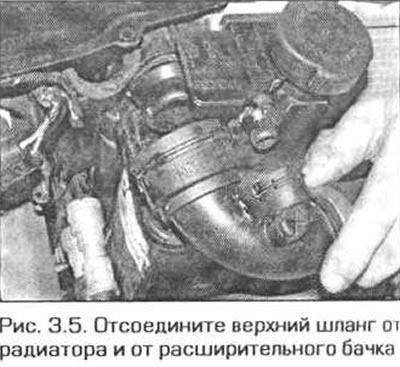
5. Remove the wire clamps and disconnect the upper hose from the radiator and from the expansion tank (Fig. 3.5).
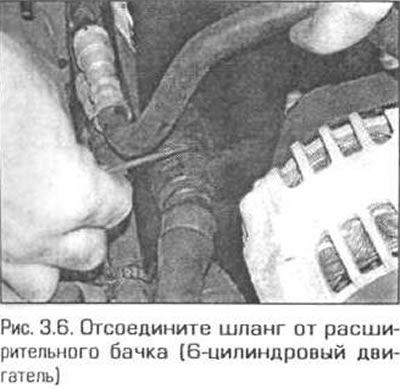
6. Remove the wire clamp and disconnect the hose from the expansion tank (Fig. 3.6).
4-cylinder engine
7. Remove the fan and its casing (see paragraph 6).
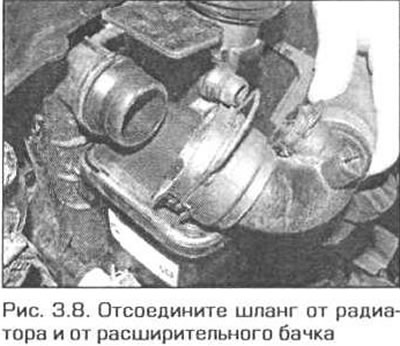
8. Remove the wire clamps and disconnect the upper hose from the radiator and from the expansion tank (Fig. 3.8).
All models
9. Remove the wire clamp and disconnect the lower hose from the radiator.
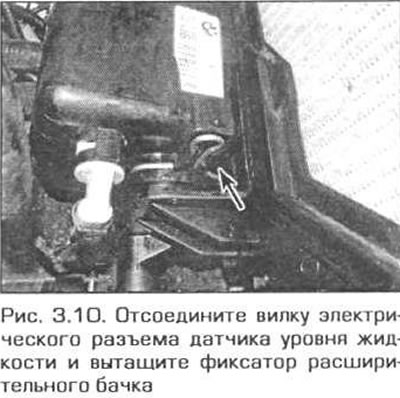
10. Disconnect the wiring from the fluid level sensor at the bottom of the expansion tank. Remove the retainer from the base of the expansion tank (Fig. 3.10).
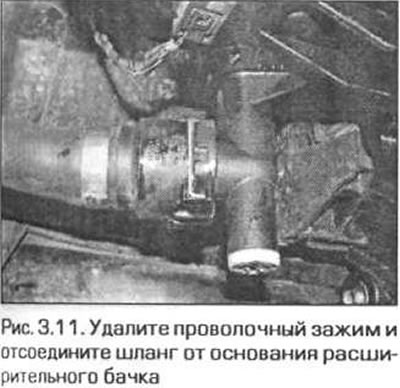
11. Disconnect the hose from the base of the expansion tank (Fig. 3.11) or from the radiator on its left side (depending on the model). Remove the expansion tank from the radiator.
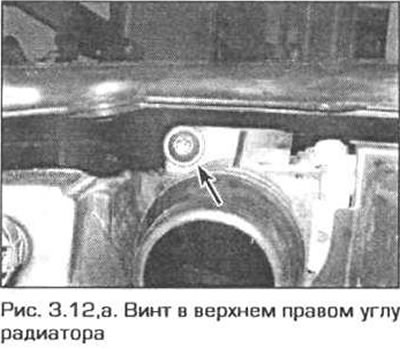
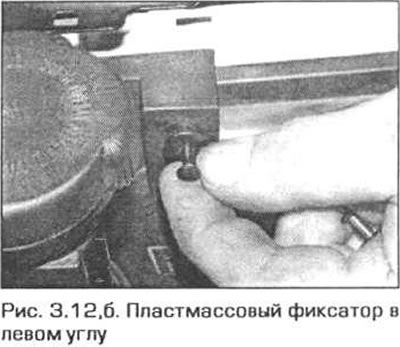
12. Depending on the model, the radiator may be secured with one or two screws and one plastic clip in the upper corners of the radiator (fig. 3.12,a,b). Remove the screws. Pull the central pin out of the retainer, then hook and pull out the retainer itself. Pull the radiator up and off the car.
Checking the status
13. If the radiator was removed due to clogging, back flush it as described in chapter 1.
14. Clean the radiator core from dirt and insects with compressed air (in this case, wear protective glasses) or a soft brush. Be careful - the core plates are sharp and break easily.
15. If necessary, a radiator specialist can perform a test to determine if there is a blockage.
16. Take a leaking radiator to a specialist for repair. Do not try to solder or weld a leaking radiator yourself: most likely, you will just ruin it even more.
17. Inspect the lower rubber radiator mounts for damage or signs of decomposition. Replace the mounts if necessary.
Installation
18. Installation is carried out in the reverse order of removal, taking into account the following notes.
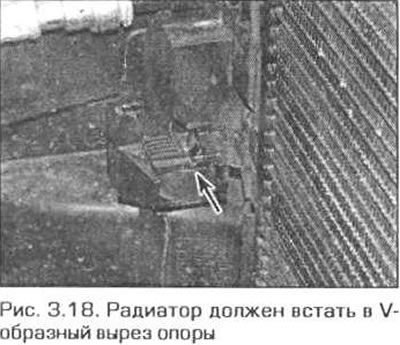
- a) Make sure that the radiator rubber supports are in place. Lower the radiator onto the supports and secure it from above with screws and a clamp (Fig. 3.18).
- b) Secure the fan shroud to the radiator.
- c) Connect the hoses to their original places and secure them with clamps.
- d) Check the condition of the sealing tracks on the radiator pipes and replace them if necessary.
- d) Finally, connect the battery and fill the cooling system.
This article is available at russian, bulgarian, belarusian, ukrainian, serbian, croatian, romanian, polish, slovak, hungarian
Article verified: Ilyinsky Matvey
Share information:
Previous articles
БМВ E46: Cooling and heating
Next articles
Similar articles on other types of BMW cars:
Removal and installation the radiator BMW 5 Series E34 (1988-1996)
Removal and installation the radiator BMW 5 Series E39 (1995-2003)
Removal and installation the EGR system radiator BMW 7 Series E38 (1994-2001)
Radiator — removal and installation BMW 7 Series E32 (1986-1994)
Pistons — removal and installation BMW X3 E83 (2003-2010)
Removal and installation the radiator BMW X5 E53 (1999-2006)
Removal and installation the radiator BMW 5 Series E34 (1988-1996)
Removal and installation the radiator BMW 5 Series E39 (1995-2003)
Removal and installation the EGR system radiator BMW 7 Series E38 (1994-2001)
Radiator — removal and installation BMW 7 Series E32 (1986-1994)
Pistons — removal and installation BMW X3 E83 (2003-2010)
Removal and installation the radiator BMW X5 E53 (1999-2006)
Link in different formats to this page
Visitor comments
No comments yet
- General information
- Manual
- Maintenance
- Power unit
- Engine repair
- Cooling system
- Power system (gasoline)
- Injection system (gasoline)
- Fuel system (diesel)
- Exhaust system
- Ignition system
- Charge and launch systems
- Transmission
- Car gearbox
- Clutch and drive shafts
- Chassis
- Brake system
- Suspension front and rear
- Steering
- Body
- Body care and repair
- Exterior
- Interior
- Electrical equipment
- Troubleshooting
- Lighting and signaling
- Equipment and devices
- Heater and air conditioner
- Electrical circuits
- General information
- Manual
- Repair on the road
- Weekly checks
- Maintenance
- Troubleshooting
- Power unit
- 4 cylinder engines
- 6 cylinder engines
- Engine overhaul
- Cooling and heating
- Fuel and exhaust system
- Starting and charging system
- Ignition system
- Transmission
- Clutch
- Mechanical gearbox
- Automatic gearbox
- Cardan and drive shafts
- Chassis
- Brake system
- Wheel suspension
- Steering
- Body
- Exterior
- Interior
- Electrical equipment
- Equipment and devices
- Electrical circuits
- General information
- Maintenance
- Power unit
- Engine repair
- Cooling system
- Ignition system
- Supply system
- Fuel injection system
- Exhaust system
- Transmission
- Clutch
- Car gearbox
- Front and rear axle
- Chassis
- Steering
- Brake system
- Body
- Exterior
- Interior
- Electrical equipment
- Heating system
- Equipment and devices
- Power devices
- Electrical circuits
- Power unit
- M10/M20 engine
- M40 engine
- Ignition system
- Lubrication system
- Cooling system
- Supply system
- Fuel injection
- Exhaust system
- Transmission
- Clutch
- Manual gearbox
- Front axle
- Rear axle
- Chassis
- Steering
- Brake system
- Body
- Exterior
- Interior
- Electrical equipment
- Heating system
- Equipment and devices
- Electrical circuits
- General information
- Specifications
- Operation and maintenance
- 4-cylinder engine
- Engine repair
- Cooling and lubrication system
- Supply system
- Ignition system
- 6-cylinder engine
- Engine repair
- Cooling and lubrication system
- Supply system
- Fuel injection system
- Ignition system
- Transmission
- Clutch
- 4-speed manual gearbox
- 5-speed manual gearbox
- Automatic gearbox
- Cardan and rear axle
- Chassis
- Steering
- Front suspension
- Rear suspension
- Brake system
- Electrical equipment
- Equipment and devices
- Electrical circuits