
Note: Before starting work, read the warnings given in paragraph 1 of this chapter.
1. If during the check described in chapter 1, a defective hose is found, it must be replaced as described below.
2. First, drain the cooling system (see chapter 1); if the antifreeze does not require replacement, the used liquid can be used repeatedly, but it should be stored in a clean container.
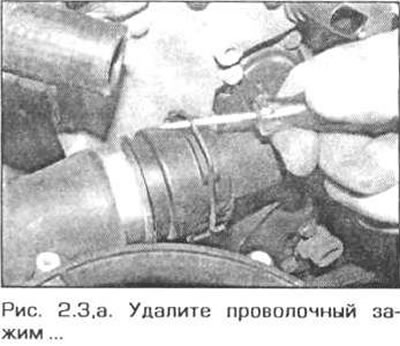
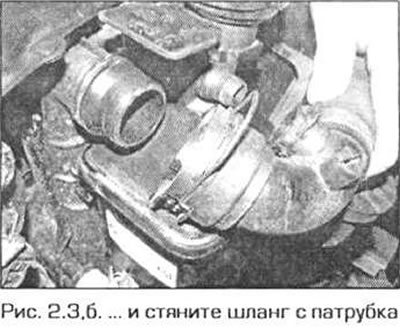
3. To disconnect the hose, remove the wire clamp and pull the hose off the fitting (fig. 2.3,a,b). Some hoses are attached with regular clamps. To disconnect the hose, loosen the clamp and pull it off the branch pipe along the hose. Carefully pull the hose off the branch pipe. While the hose is relatively new, it is not difficult to pull it off. A hot hose is also easier to remove than a cold one, but it is not recommended to work with hot hoses - you can get burned.
4. Keep in mind that the radiator hoses are very fragile - do not use brute force when removing the hoses from them. If the hose does not pull off, try to twist it on the hose.
If no method can remove the hose from the branch pipe, cut it with a sharp knife and peel it off like an orange peel. The hose will naturally have to be replaced after this, but it is cheaper than replacing the radiator.
5. To connect the hose, simply slide the end of the hose onto the fitting and secure it with a clamp or spring clip. To check that the hose is securely fastened, pull it back off the fitting. When using conventional clamps, first place the clamp on the hose and slide it along the hose, then slide the hose onto the fitting. If the hose was originally secured with spring clips, replace the clamps with non-traditional screw-type clamps. If the hose is difficult to slide onto the fitting, wet it with water. When sliding the hose onto the fitting, make sure that the hose is routed correctly and is not twisted after installation. After installing the ends of the hose onto the fittings, slide the clamps to the ends of the hose by the protrusions on the fittings and tighten the clamps.
6. Check the coolant level and top up as necessary.
7. After replacing hoses, check the connections for leaks as soon as possible.
[Read the original source on the website: «bmwman»]