
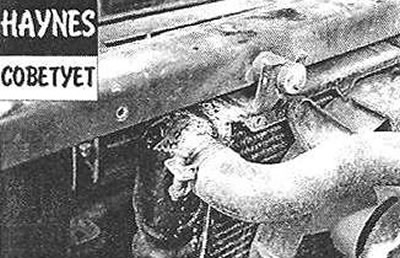
Leaks in the cooling system usually leave behind a trace of white or rusty deposits
2. Check the condition and reliability of fastening of all pipes and hoses related to the engine. Make sure that all clamps are in place and securely tightened. Broken or lost clamps can cause very serious consequences in the future.
3. Carefully check the entire length of the radiator and heater hoses. If you notice signs of cracking, rubber decomposition or abrasion, replace the hose. Cracks become more noticeable if you squeeze the hose. Pay attention to the clamps that attach the hoses to the radiator and to the engine. A clamp that is too tight can cut through the hose and cause a leak.
4. Inspect all components and connections of the cooling system for leaks. If a leak is detected, replace the gasket or seal (see chapter 3).
5. If the vehicle is equipped with an automatic transmission, check the transmission coolant hoses in the same manner.
6. Raise the vehicle and inspect the fuel tank and filler neck for cracks, holes, and other damage. Pay particular attention to the connection between the filler neck and the tank. Sometimes leaks occur due to cracks in the connecting hose or a poorly tightened clamp.
7. Inspect all rubber hoses and metal tubes coming from the tank. Check if the connections are tight, if there are any kinks in the tubes, and if the hoses are in good condition. Pay attention to the ventilation hoses, which tend to wrap around the filler neck and can therefore become pinched or kinked. Follow the hoses along their entire length to the front of the car. Replace any faulty sections.
8. Carefully inspect the metal brake system tubes that run underneath the car. If the tubes are damaged or rusty, replace them.
9. In the engine compartment, check the reliability of the connection of all fuel lines. Inspect the vacuum hoses for kinks, abrasions and signs of decomposition.
10. Check the condition of the hydraulic steering system hoses and pipes.