
- Home
- BMW 3 Series
- E46
- General information
- Maintenance
- Accessory Drive Belt — Checking and Replacing
Accessory Drive Belt — Checking and Replacing (BMW 3 Series E46)
Examination
1. The functions performed, the material and the design of the belt are such that over time it ages and can break. To prevent problems when the belt breaks while driving, it should be periodically inspected and, if necessary, replaced.
2. Depending on the number of auxiliary units the car is equipped with, there may be several belts for their drive. The belts drive the water pump, generator, air conditioner compressor, and steering pump.
3. To inspect the belts, first remove the cooling fan with the casing (see chapter 3).
4. Stop the engine, open the hood, inspect and feel the belts for cracks and delamination. Also inspect the belts for signs of burning and shiny spots. Inspect both surfaces of the belt, turning it as necessary. To inspect the belts along their entire length, turn the engine as necessary using a socket wrench placed on the head of the central crankshaft bolt.
Replacement - M43TU engine
Compressor drive belt
5. The best way to access the belt is from underneath the vehicle. Raise the front of the vehicle and support it securely (see appendix: Lifting the vehicle and placing it on supports). Remove the crankcase guard from under the engine.
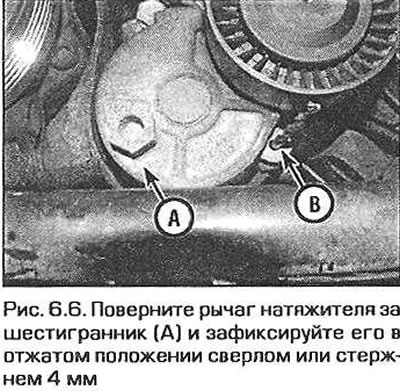
6. Place the key on the Allen key of the tensioner lever and turn the lever fully clockwise. Having thus loosened the belt tension, remove it from the pulleys. Fix the tensioner position by inserting a 4 mm drill or a suitable rod into the hole of the lever (Fig. 6.6).
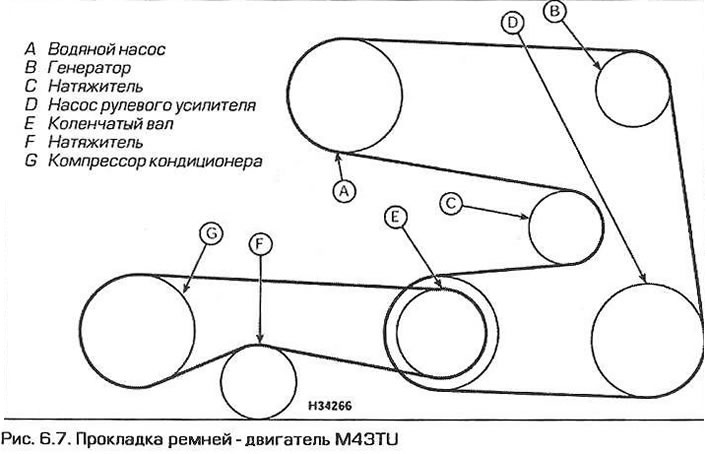
7. Put the new belt on the pulleys. Press the tensioner lever with a hex key and pull out the locking rod (or a drill). Release the lever, let it turn and tighten the belt (Fig. 6.7).
8. Replace the crankcase guard and lower the vehicle.
Water pump, alternator and steering pump drive belt (with hydraulic tensioner)
9. Remove the compressor drive belt as described above (if there is a compressor).
10. If the belt is to be reinstalled and used further, mark the direction of rotation of the belt before removing it.
11. For better access, remove the cooling system fan together with its shroud (see chapter 3).
12. Before removing the belt, remember its routing.
13. Loosen the tensioner with an open-end wrench (sink the plunger) and remove the belt from the pulleys.
14. Release the tensioner.
15. If you are installing a previously used belt, note the mark indicating its direction of rotation.
16. Move the tensioner back and place the belt on the pulleys, routing it as before. Make sure that the belt is correctly positioned relative to the pulley grooves.
17. Reinstall the cooling fan and fan shroud (if necessary, refer to the chapter 3).
18. Install the compressor drive belt (if there is a compressor), as stated above.
Water pump, alternator and steering pump drive belt (with mechanical tensioner)
19. Remove the compressor drive belt as described above (if there is a compressor).
20. If the belt is to be reinstalled and used further, mark the direction of rotation of the belt before removing it.
21. For better access, remove the cooling system fan together with its shroud (see chapter 3).
22. Before removing the belt, remember its routing.
23. Remove the cover from the center of the tensioner pulley.
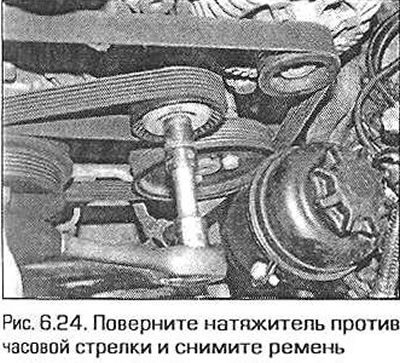
24. Using a wrench, turn the tensioner counterclockwise on the pulley bolt head. Remove the belt from the pulleys (Fig. 6.24).
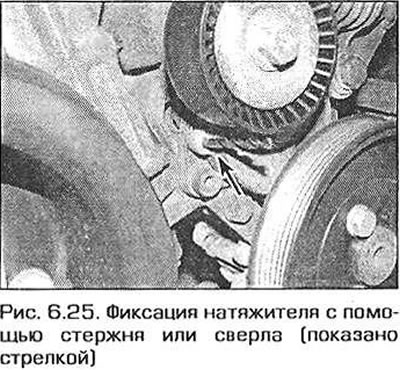
25. To facilitate installation, the tensioner belt can be fixed in the pressed position by inserting a suitable rod into the holes in the tensioner and its support plate (Fig. 6.25). Note that the tensioner has a fairly strong spring, so the locking rod must be strong enough.
26. If you are installing a previously used belt, take note of the mark indicating its direction of rotation.
27. If the tensioner was not fixed in the depressed position, press it with a key and put the belt on the pulleys (see fig. 6.7). Make sure that the belt projections fit into the pulley grooves.
28. If the tensioner was locked, press it down and pull out the locking rod (drill). Release the tensioner.
29. Reinstall the cooling fan and its housing.
30. Install the compressor drive belt as described above in this paragraph.
Replacement - N42 engine
31. Open the hood. At the front of the engine compartment, remove the intake air duct cover. To do this, pull the central pins out of the cover clips, and then remove the clips themselves. Pull the cover out of the engine compartment.
32. If the belt is to be reinstalled and used further, mark the direction of rotation of the belt before removing it.
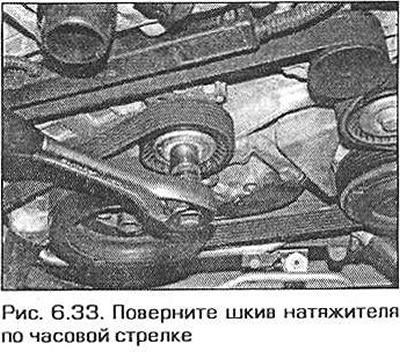
33. Using a wrench, turn the tensioner clockwise to loosen the belt tension. Remove the belt from the pulleys (Fig. 6.33).
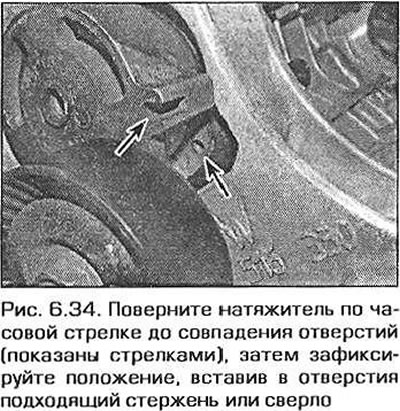
34. If desired, to facilitate installation of the belt, the tensioner can be turned all the way and fixed in the pressed position with a rod of a suitable diameter (Fig. 6.34). Note that the tensioner has a fairly strong spring, so the locking rod must be strong enough.
35. If a previously used belt is being installed, note the mark indicating its direction of rotation.
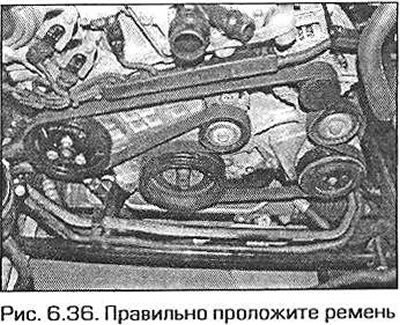
36. If the tensioner was not fixed in the released position, release it with a key and put the belt on the pulleys, observing the order of its installation (Fig. 6.36). Make sure that the belt projections fit into the pulley grooves.
37. If the tensioner was locked, press it down and pull out the locking rod (drill). Release the tensioner.
38. Reinstall the intake duct cover.
Replacement - 6-cylinder engine
Air conditioning compressor drive belt
39. The best way to access the belt is from underneath the vehicle. Raise the front of the vehicle and support it securely (see Appendix: Lifting the car and placing it on supports). Remove the crankcase guard from under the engine.
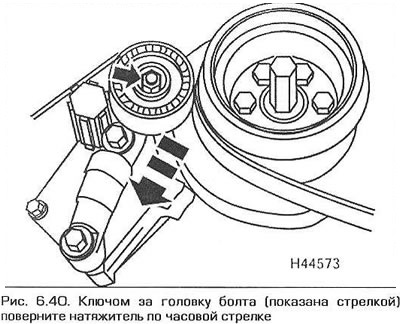
40. On models with a hydraulic tensioner, remove the cover from the center of the tensioner pulley. Using a wrench on the head of the pulley bolt, turn the tensioner clockwise (Fig. 6.40). Remove the belt from the pulleys.
41. On models with a mechanical tensioner, turn the tensioner lever clockwise with a hex key and remove the belt from the pulleys (Fig. 6.41).
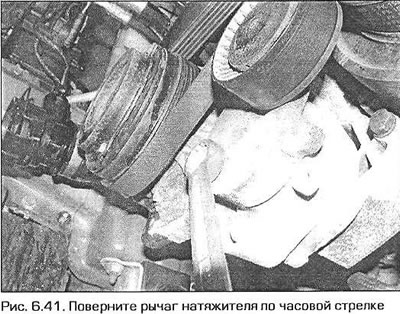
42. On all models, push the tensioner back until the new belt can be placed on the pulleys, then release the tensioner. Make sure the belt tabs fit into the pulley grooves.
43. Replace the tensioner pulley cover and lower the vehicle.
Water pump, alternator and steering pump drive belt
44. Remove the compressor drive belt as described above.
45. If the belt is to be reinstalled and used further, mark the direction of rotation of the belt before removing it.
46. For better access, remove the cooling system fan together with its shroud (see chapter 3).
47. Before removing the belt, remember its routing.
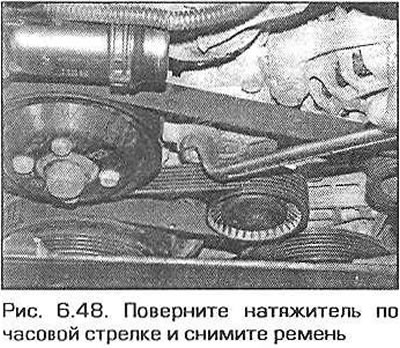
48. Using the Allen key on the tensioner lever, turn the lever clockwise and remove the belt from the pulleys (Fig. 6.48).
49. If a previously used belt is being installed, note the mark indicating its direction of rotation.
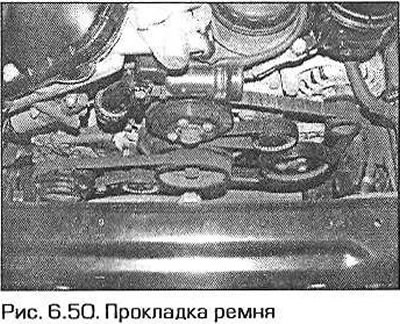
50. Press the tensioner and put the belt on the pulleys, observing the previous belt routing (Fig. 6.50). Make sure that the belt protrusions fit into the pulley grooves.
51. Reinstall the cooling fan and its shroud (see chapter 3).
52. Install the compressor drive belt as described above in this paragraph.
This article is available at russian, bulgarian, belarusian, ukrainian, serbian, croatian, romanian, polish, slovak, hungarian
Article verified: Ilyinsky Matvey
Share information:
Previous articles
БМВ E46: Maintenance
Next articles
Similar articles on other types of BMW cars:
Replacing the camshaft drive belt of the 6-cylinder BMW «520» and… BMW 5 Series E12 (1972-1981)
Checking the condition, adjusting the tension and replacing the drive… BMW 5 Series E28 (1981-1988)
Checking the condition of the auxiliary drive belt BMW 7 Series E38 (1994-2001)
Valve guides — checking and replacing BMW 7 Series E32 (1986-1994)
Generator drive belt BMW X3 E83 (2003-2010)
Replacing the air conditioning compressor drive belt BMW X5 E53 (1999-2006)
Replacing the camshaft drive belt of the 6-cylinder BMW «520» and… BMW 5 Series E12 (1972-1981)
Checking the condition, adjusting the tension and replacing the drive… BMW 5 Series E28 (1981-1988)
Checking the condition of the auxiliary drive belt BMW 7 Series E38 (1994-2001)
Valve guides — checking and replacing BMW 7 Series E32 (1986-1994)
Generator drive belt BMW X3 E83 (2003-2010)
Replacing the air conditioning compressor drive belt BMW X5 E53 (1999-2006)
Link in different formats to this page
Visitor comments
No comments yet
- General information
- Manual
- Maintenance
- Power unit
- Engine repair
- Cooling system
- Power system (gasoline)
- Injection system (gasoline)
- Fuel system (diesel)
- Exhaust system
- Ignition system
- Charge and launch systems
- Transmission
- Car gearbox
- Clutch and drive shafts
- Chassis
- Brake system
- Suspension front and rear
- Steering
- Body
- Body care and repair
- Exterior
- Interior
- Electrical equipment
- Troubleshooting
- Lighting and signaling
- Equipment and devices
- Heater and air conditioner
- Electrical circuits
- General information
- Manual
- Repair on the road
- Weekly checks
- Maintenance
- Troubleshooting
- Power unit
- 4 cylinder engines
- 6 cylinder engines
- Engine overhaul
- Cooling and heating
- Fuel and exhaust system
- Starting and charging system
- Ignition system
- Transmission
- Clutch
- Mechanical gearbox
- Automatic gearbox
- Cardan and drive shafts
- Chassis
- Brake system
- Wheel suspension
- Steering
- Body
- Exterior
- Interior
- Electrical equipment
- Equipment and devices
- Electrical circuits
- General information
- Maintenance
- Power unit
- Engine repair
- Cooling system
- Ignition system
- Supply system
- Fuel injection system
- Exhaust system
- Transmission
- Clutch
- Car gearbox
- Front and rear axle
- Chassis
- Steering
- Brake system
- Body
- Exterior
- Interior
- Electrical equipment
- Heating system
- Equipment and devices
- Power devices
- Electrical circuits
- Power unit
- M10/M20 engine
- M40 engine
- Ignition system
- Lubrication system
- Cooling system
- Supply system
- Fuel injection
- Exhaust system
- Transmission
- Clutch
- Manual gearbox
- Front axle
- Rear axle
- Chassis
- Steering
- Brake system
- Body
- Exterior
- Interior
- Electrical equipment
- Heating system
- Equipment and devices
- Electrical circuits
- General information
- Specifications
- Operation and maintenance
- 4-cylinder engine
- Engine repair
- Cooling and lubrication system
- Supply system
- Ignition system
- 6-cylinder engine
- Engine repair
- Cooling and lubrication system
- Supply system
- Fuel injection system
- Ignition system
- Transmission
- Clutch
- 4-speed manual gearbox
- 5-speed manual gearbox
- Automatic gearbox
- Cardan and rear axle
- Chassis
- Steering
- Front suspension
- Rear suspension
- Brake system
- Electrical equipment
- Equipment and devices
- Electrical circuits