
If the radiator grille is clogged with foreign debris and dead insects, it is necessary to blow air through the grille using the counter-flow method. The automatic transmission oil cooler is installed in front of the engine cooling system radiator, but can be mounted with the cooling system radiator into one unit.
The power steering and air conditioning radiators are installed in front of the engine cooling system radiator.
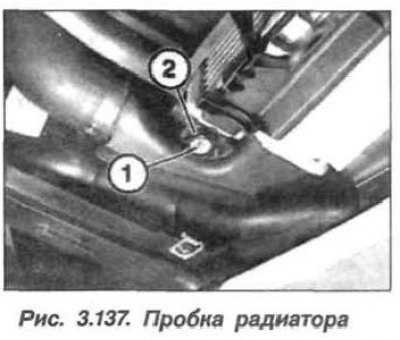
Removing the radiator of the cooling system must be carried out in the following order. Unscrew the drain plug at the bottom of the radiator (see fig. 3.137), drain the coolant only from the radiator and remove the fan shroud.
Remove the expansion tank of the cooling system.
On vehicles equipped with automatic transmission, pull the locking lever (1, Fig. 3.141) upwards and remove its heat exchanger from the radiator mounting plate.
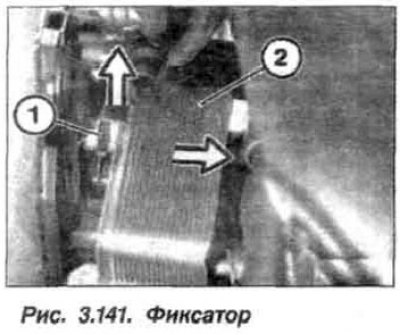
Leave the heat exchanger pipes connected.
Disconnect the engine cooling system hoses. Unscrew the bolts and remove the clamp (1, Fig. 3. 142).
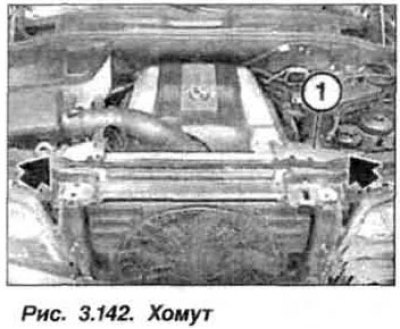
When installing the clamps, tighten the bolts to a torque of 10 N·m (1.0 kgf·m).
Remove the sealing strip between the radiator and its cassette. Unscrew the bolt on the radiator on the right and left sides and remove the radiator (fig. 3.143) cooling systems, moving upwards.
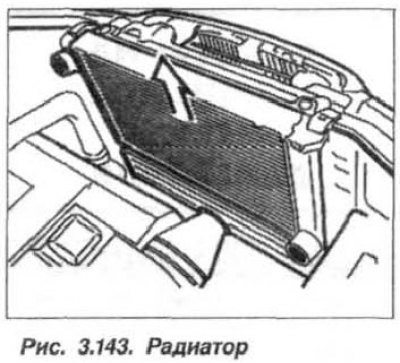
Warning! The radiator fins have very sharp edges to reduce air flow resistance. There is a risk of injury.
The radiator should be installed in the reverse order, while checking the technical condition of the hoses and rubber radiator supports. Insert the radiator together with the rubber cushions on the left and right sides into the brackets.
Replace damaged plastic guides. The tabs of both plastic guides must be securely fixed in the holes.
Install the automatic transmission heat exchanger with new seals; when installing, the retainer should click into place with a characteristic sound.
Fill the system with coolant, bleed it and check the system for leaks. Check the coolant level and restore it if necessary.