
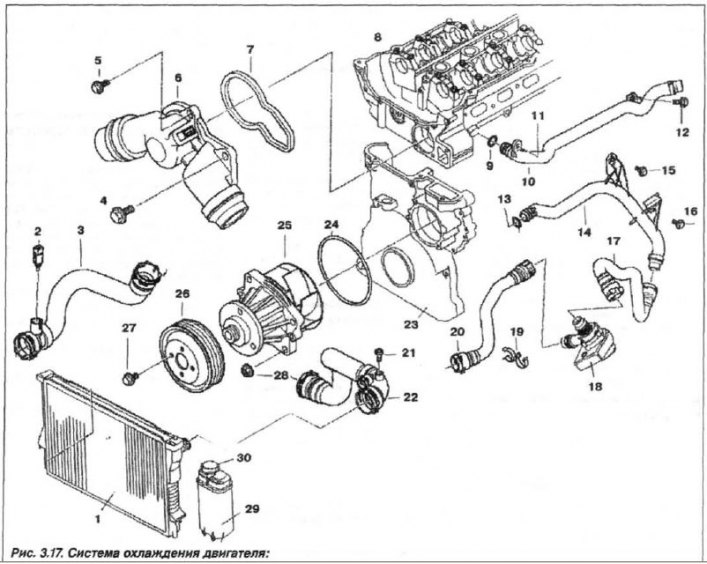
1 - radiator; 2 - temperature sensor; 3, 17, 20, 22 - hose; 5 - bolt (M6x25); 6 - thermostat in the housing; 7 - gasket; 3 - cylinder head; 9, 13 - ring (20x3); 10 - heating hose; 11 - nut (M6); 12, 15, 16 - bolt; 14 - pipeline; 18 - heating pump; 19 - holder; 21 - Air bleed screw; 23 - timing belt cover; 24 - ring (68x5); 25 - engine pump; 26 - pulley; 27 - bolt (M6x16); 28 - nut (M6); 29 - expansion tank; 30 - tank cap
The thermostat must be replaced in the following order: Drain the coolant, remove the fan casing and the fan drive coupling with the impeller.
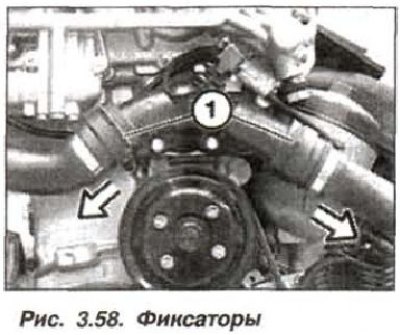
Loosen the mounting clamps and disconnect the hoses (arrows, see Fig. 3.58) cooling systems from the thermostat housing (from the front side of the cylinder block).
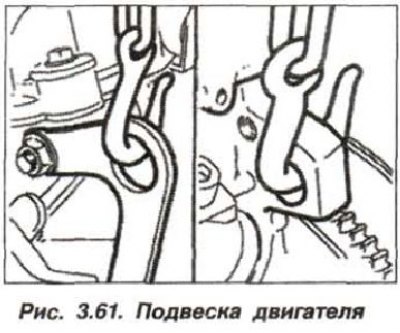
Remove the lug from the engine (left, see Fig. 3.61) his rise.
Mark the bolts (4, see Fig. 3.17) fastenings of the thermostat housing cover, since they have different diameters and lengths.
Check the operation of the thermostat.
Before installation, clean the mounting surfaces on the thermostat housing and cylinder head from dirt and oil traces. Replace the sealing gasket (7). When installing, tighten the thermostat housing mounting bolts to a torque of 1.0 kgf·m (10 N·m). Tighten the engine lug mounting bolts (M8) to a torque of 2.0 kgf·m (20 N·m). Replace the sealing gasket and tighten the drain hole bolt (M 14x1.5) on the cylinder block to a torque of 25 N·m (2.5 kgf·m). Fill the engine cooling system and perform a test drive.
Check the operation of the viscous coupling (when the fan is turned on), whether the temperature in the lower part of the radiator has increased and whether the thermostat housing is sealed. If there is a leak, tighten the mounting bolts.
[The original source of the article is on the website «BMWMAN.ru»]