
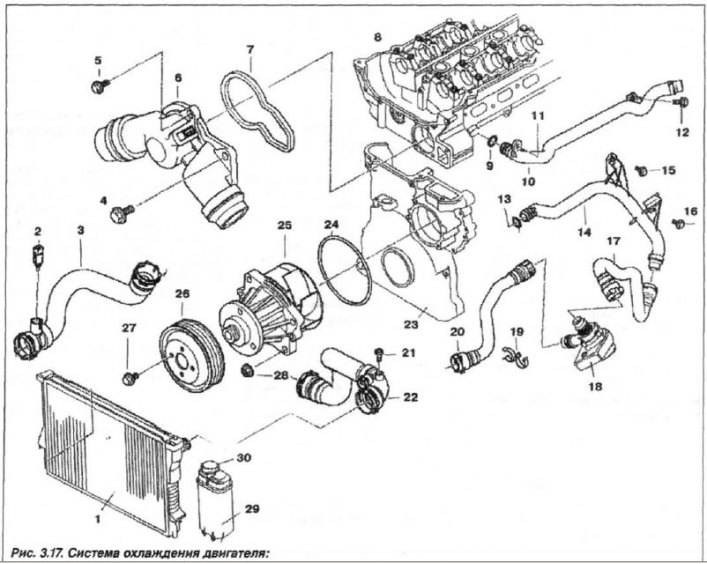
1 - radiator; 2 - temperature sensor; 3, 17, 20, 22 - hose; 5 - bolt (M6x25); 6 - thermostat in the housing; 7 - gasket; 3 - cylinder head; 9, 13 - ring (20x3); 10 - heating hose; 11 - nut (M6); 12, 15, 16 - bolt; 14 - pipeline; 18 - heating pump; 19 - holder; 21 - Air bleed screw; 23 - timing belt cover; 24 - ring (68x5); 25 - engine pump; 26 - pulley; 27 - bolt (M6x16); 28 - nut (M6); 29 - expansion tank; 30 - tank cap
The coolant pump must be replaced in the following order. Remove the alternator drive belt and drain the coolant and send it for disposal. Remove the radiator and thermostat housing. Remove the fan impeller with a viscous coupling.
Loosen the pulley mounting bolts (27, 4 pcs., see Fig. 3.17), while holding it from turning by squeezing the belt. Remove the pulley (26) from the hub of the coolant pump (25).
Remove four bolts (arrows, Fig. 3.140) coolant pump mounts.
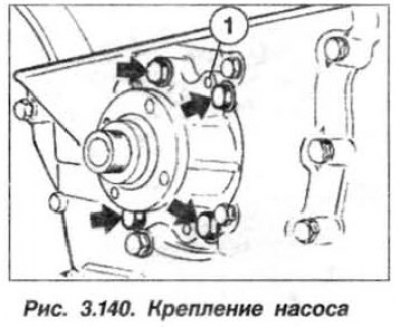
Screw two M6 bolts into the holes (1) in the pump body, located diametrically opposite each other, and evenly press the pump away from the engine timing cover. Make sure that the pump is not skewed.
When installing the pump, replace the sealing ring (24, see Fig. 3.17) steep section (68x5) and the pump gasket, applying coolant to the ring as a lubricant for easier sliding.
Make sure the centering bushings are positioned correctly. Tighten the bolts (M6) securing the thermostat housing to a torque of 1.0 kgf·m (10 N·m). Tighten the bolts (M8) securing the pump to the timing belt cover to a torque of 2.0 kgf·m (20 N·m). Tighten the four bolts (M6) securing the pulley to a torque of 1.0 kgf·m (10 N·m). Install the drain plug (M14x1.5), replacing the sealing ring, and tighten it to a torque of 25 N·m (2.5 kgf·m).
Fill the system with coolant, bleed the air, start the engine, warm it up and check the system for leaks. Check the coolant level and restore it if necessary.