
- Home
- BMW 3 Series
- E21
- General information
- Operation and maintenance
- Starting the engine
Starting the engine (BMW 3 Series E21)
Place the gear shift lever in neutral position.
On vehicles with automatic transmission, the engine can be started in the "P" (Park) or "O" or "N" (Neutral) positions of the selector lever.
The engine is equipped with a carburetor with an automatic starting device.
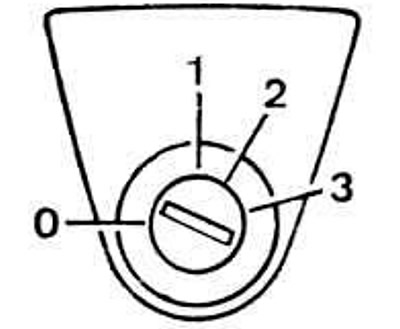
Ignition key position:
0 - everything is off, the anti-theft device is on when the key is removed; 1 - the anti-theft device is on, the receiver and sunroof electric drive circuits may be on; 2 — ignition is on, oil pressure and battery charge indicator lights are on red, fuel level and coolant temperature indicator circuits are on; 3 - the starter is on, after the engine starts, release the key, which automatically returns to position "2"
Turn on the starting device by sharply pressing and releasing the accelerator pedal. Insert the key into the ignition switch and turn on the starter by turning the key to position "3" (see picture), without pressing the accelerator pedal. Do not turn on the starter for more than 10-15 s.
If the engine does not start on the first try, turn on the ignition and after about 20-30 seconds, turn on the starter again.
If the engine does not start after several attempts, despite the fact that the fuel-air mixture has ignited several times, sharply press and release the accelerator pedal again and try to start the engine again.
In all cases, do not press the accelerator pedal several times to avoid flooding the carburetor.
At low ambient temperatures, to facilitate engine starting, it is recommended to switch off all electrical consumers and press the clutch pedal before engaging the starter.
Immediately after starting the engine, the crankshaft rotates at a high speed: 2500-3000 rpm. After a few seconds, press the accelerator pedal again and the engine speed decreases to fast idle mode.
After warming up the engine (the coolant temperature gauge arrow is between the two colored zones of the scale) the normal idle mode is automatically set.
Do not press the accelerator pedal before starting the engine.
Press the accelerator pedal all the way down and turn on the starter.
The engine has the same carburetor with automatic starting device as the models "315", "316", "318".
The engine is equipped with a carburetor with an automatic starting device and a thermostatic auxiliary starting device.
Starting a cold or hot engine. Do not press the accelerator pedal until the starter engages.
Starting a very hot engine: Press the accelerator pedal all the way down and engage the starter.
The engine is equipped with a carburetor with an automatic engine starting and warming up system.
When starting the engine, do not press the accelerator pedal. After starting and warming up the engine, press the accelerator pedal no more than 1/2 of its stroke. After starting the engine, you can start driving at medium engine speed. After the engine switches to fast idle mode, the oil pressure and battery charge indicator lights should go out.
The original source of the article is on the website: «BMWMan.ru»
On vehicles with automatic transmission, the engine can be started in the "P" (Park) or "O" or "N" (Neutral) positions of the selector lever.
Models "315", "316", "318"
The engine is equipped with a carburetor with an automatic starting device.
Ignition key position:
0 - everything is off, the anti-theft device is on when the key is removed; 1 - the anti-theft device is on, the receiver and sunroof electric drive circuits may be on; 2 — ignition is on, oil pressure and battery charge indicator lights are on red, fuel level and coolant temperature indicator circuits are on; 3 - the starter is on, after the engine starts, release the key, which automatically returns to position "2"
Cold engine start
Turn on the starting device by sharply pressing and releasing the accelerator pedal. Insert the key into the ignition switch and turn on the starter by turning the key to position "3" (see picture), without pressing the accelerator pedal. Do not turn on the starter for more than 10-15 s.
If the engine does not start on the first try, turn on the ignition and after about 20-30 seconds, turn on the starter again.
If the engine does not start after several attempts, despite the fact that the fuel-air mixture has ignited several times, sharply press and release the accelerator pedal again and try to start the engine again.
In all cases, do not press the accelerator pedal several times to avoid flooding the carburetor.
At low ambient temperatures, to facilitate engine starting, it is recommended to switch off all electrical consumers and press the clutch pedal before engaging the starter.
Immediately after starting the engine, the crankshaft rotates at a high speed: 2500-3000 rpm. After a few seconds, press the accelerator pedal again and the engine speed decreases to fast idle mode.
After warming up the engine (the coolant temperature gauge arrow is between the two colored zones of the scale) the normal idle mode is automatically set.
Starting a hot engine
Do not press the accelerator pedal before starting the engine.
Starting a very hot engine
Press the accelerator pedal all the way down and turn on the starter.
Models "320"
1st modification
The engine has the same carburetor with automatic starting device as the models "315", "316", "318".
2nd modification
The engine is equipped with a carburetor with an automatic starting device and a thermostatic auxiliary starting device.
Starting a cold or hot engine. Do not press the accelerator pedal until the starter engages.
Starting a very hot engine: Press the accelerator pedal all the way down and engage the starter.
Models "320i", "323i"
The engine is equipped with a carburetor with an automatic engine starting and warming up system.
When starting the engine, do not press the accelerator pedal. After starting and warming up the engine, press the accelerator pedal no more than 1/2 of its stroke. After starting the engine, you can start driving at medium engine speed. After the engine switches to fast idle mode, the oil pressure and battery charge indicator lights should go out.
The original source of the article is on the website: «BMWMan.ru»
This article is available at russian, bulgarian, belarusian, ukrainian, serbian, croatian, romanian, polish, slovak, hungarian
Article verified: Polikarpov Saveliy
Share information:
Previous articles
БМВ E21: Operation and maintenance
Next articles
Similar articles on other types of BMW cars:
Starting the engine BMW 5 Series E12 (1972-1981)
Starting the engine from an external source BMW 5 Series E34 (1988-1996)
Starting the engine from an auxiliary battery BMW 7 Series E32 (1986-1994)
Starting the engine from an auxiliary power source BMW 7 Series E38 (1994-2001)
Starting the engine from an external power source BMW X3 E83 (2003-2010)
Features of winter operation of a diesel engine BMW X5 E53 (1999-2006)
Starting the engine BMW 5 Series E12 (1972-1981)
Starting the engine from an external source BMW 5 Series E34 (1988-1996)
Starting the engine from an auxiliary battery BMW 7 Series E32 (1986-1994)
Starting the engine from an auxiliary power source BMW 7 Series E38 (1994-2001)
Starting the engine from an external power source BMW X3 E83 (2003-2010)
Features of winter operation of a diesel engine BMW X5 E53 (1999-2006)
Link in different formats to this page
Visitor comments
No comments yet
- General information
- Manual
- Maintenance
- Power unit
- Engine repair
- Cooling system
- Power system (gasoline)
- Injection system (gasoline)
- Fuel system (diesel)
- Exhaust system
- Ignition system
- Charge and launch systems
- Transmission
- Car gearbox
- Clutch and drive shafts
- Chassis
- Brake system
- Suspension front and rear
- Steering
- Body
- Body care and repair
- Exterior
- Interior
- Electrical equipment
- Troubleshooting
- Lighting and signaling
- Equipment and devices
- Heater and air conditioner
- Electrical circuits
- General information
- Manual
- Repair on the road
- Weekly checks
- Maintenance
- Troubleshooting
- Power unit
- 4 cylinder engines
- 6 cylinder engines
- Engine overhaul
- Cooling and heating
- Fuel and exhaust system
- Starting and charging system
- Ignition system
- Transmission
- Clutch
- Mechanical gearbox
- Automatic gearbox
- Cardan and drive shafts
- Chassis
- Brake system
- Wheel suspension
- Steering
- Body
- Exterior
- Interior
- Electrical equipment
- Equipment and devices
- Electrical circuits
- General information
- Maintenance
- Power unit
- Engine repair
- Cooling system
- Ignition system
- Supply system
- Fuel injection system
- Exhaust system
- Transmission
- Clutch
- Car gearbox
- Front and rear axle
- Chassis
- Steering
- Brake system
- Body
- Exterior
- Interior
- Electrical equipment
- Heating system
- Equipment and devices
- Power devices
- Electrical circuits
- Power unit
- M10/M20 engine
- M40 engine
- Ignition system
- Lubrication system
- Cooling system
- Supply system
- Fuel injection
- Exhaust system
- Transmission
- Clutch
- Manual gearbox
- Front axle
- Rear axle
- Chassis
- Steering
- Brake system
- Body
- Exterior
- Interior
- Electrical equipment
- Heating system
- Equipment and devices
- Electrical circuits
- General information
- Specifications
- Operation and maintenance
- 4-cylinder engine
- Engine repair
- Cooling and lubrication system
- Supply system
- Ignition system
- 6-cylinder engine
- Engine repair
- Cooling and lubrication system
- Supply system
- Fuel injection system
- Ignition system
- Transmission
- Clutch
- 4-speed manual gearbox
- 5-speed manual gearbox
- Automatic gearbox
- Cardan and rear axle
- Chassis
- Steering
- Front suspension
- Rear suspension
- Brake system
- Electrical equipment
- Equipment and devices
- Electrical circuits