



Table of contents: Digital Engine Management (DME)…↓ Sensors for petrol engine injection…↓
- Home
- BMW 3 Series
- E46
- Power unit
- Injection system (gasoline)
- How the DME system works
How the DME system works (BMW 3 Series E46)
Digital Engine Management (DME) system diagram
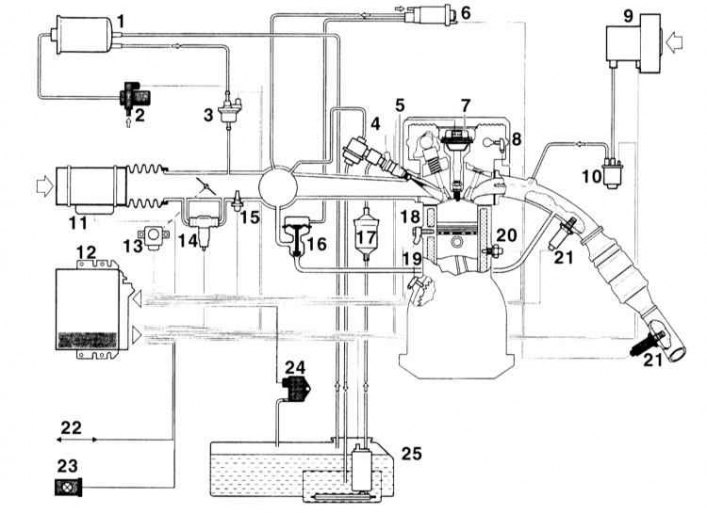
1 — adsorber
2 - shut-off valve
3 — fuel tank ventilation valve
4 — fuel pressure regulator
5 — injector
6 — pressure regulator
7 — ignition coil
8 — position sensor
9 — secondary air pump
10 - shut-off valve
11 - air mass meter
12 — control device
13 - throttle position sensor
14 — idle speed control
15 - air temperature sensor
16 — exhaust gas recirculation valve
17 — fuel filter
18 - knock sensor
19 — speed sensor
20 - engine temperature sensor
21 - oxygen sensor
22 — diagnostic connector
23 - diagnostic lamp
24 - differential pressure sensor
25 - fuel pump
Sensors for petrol engine injection systems
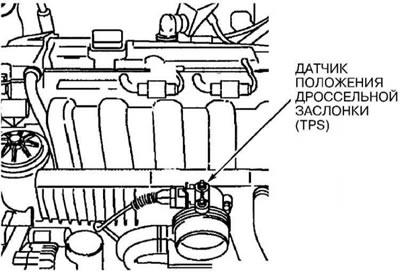
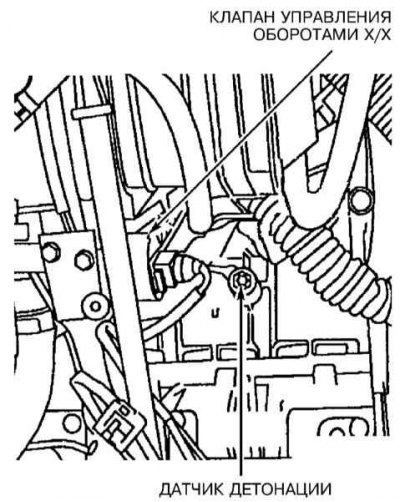
Fuel is sucked from the fuel tank by an electric fuel pump located in the fuel tank and supplied through a fuel filter to the injectors. The pressure regulator maintains constant fuel pressure in the system.
The injectors are electrically controlled and inject fuel in pulses into the intake manifold in front of the engine's intake valves.
Air is drawn into the engine through the air filter and supplied through the throttle body assembly and intake manifold to the intake valves.
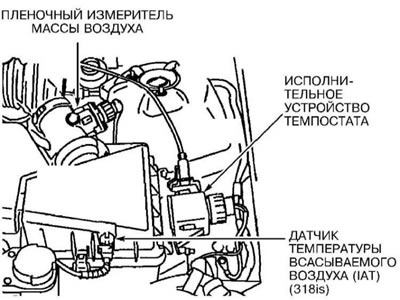
The injected amount of fuel is determined primarily by the mass of the air being sucked in. The mass of the sucked in air is determined by a meter located in the intake manifold. The casing of the mass meter contains a thin, electrically heated plate, which is cooled by the passing air flow. The control system changes the value of the heating current so that the temperature of the plate remains constant. If, for example, the amount of sucked in air increases, the plate tends to cool down. As a result, the value of the heating current of the plate increases. Based on the deviations in the heating current, the engine control system determines the mass of the air and regulates the amount of fuel being injected accordingly.
Information from various sensors and commands to the actuators ensure optimal engine operation in any mode. If the sensors fail, the control unit switches to emergency mode to prevent engine damage and ensure the possibility of further vehicle movement. Sensor failure does not necessarily have to be felt by deterioration in engine performance. However, no later than the next exhaust gas inspection, data on this will be recorded in the engine management system fault memory.
Idle speed control controls the amount of air at idle speed bypassing the throttle valve. This ensures that the idle speed is maintained at a constant level regardless of the connection of additional consumers such as power steering or a cooling compressor.
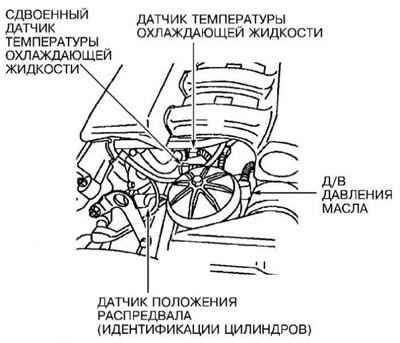
Coolant temperature sensors and intake air temperature sensor report the current temperature value as a result of the change in the resistance of the resistor. As the temperature increases, the resistance decreases.
Fuel tank ventilation system consists of an adsorber and a shut-off valve. The adsorber accumulates fuel vapors formed as a result of heating the fuel. When the engine is running, the vapors are sucked out of the adsorber and fed into the combustion chambers of the engine.
Oxygen sensors measure the oxygen content in the exhaust gases before and after the catalytic converter and transmit the corresponding signals to the engine control unit.
Fuel pump relay is located in the relay block above the glove compartment. The relay supplies current to the fuel pump.
Ignition system has no moving parts, there is no traditional ignition distributor. Each spark plug has its own coil.
Ignition Voltage Control System if the voltage is too low, the DME unit switches off (for example, due to damage to the cable). In this case, the engine cannot be started. This eliminates damage to the catalytic converter.
Anti-knock control system serves to determine and regulate the optimal ignition timing for each cylinder. If a malfunction occurs in the ignition system, the fuel supply to the corresponding cylinder is stopped.
320i, 323i, 328i: Variable Valve Timing System (moments of opening and closing of intake and exhaust valves), called Doppel VANOS for short, rotates both camshafts in relation to the sprockets at an angle that ensures optimum valve timing in all engine operating modes, and therefore optimum idle speed, high torque characteristics and reduced fuel consumption. The rotation is carried out under oil pressure. To do this, the DME system regulates the oil pressure in the VANOS control element via an electrically controlled valve.
Adjustable intake manifold depending on the engine speed, it regulates the length of the intake manifold. For this purpose, a pneumatically controlled rotary valve is installed in the intake manifold. The long length of the manifold at low speeds ensures good filling of the cylinders due to resonance and thus higher torque. At high speeds, the length of the intake tract is reduced, which increases the engine's power potential.
This article is available at russian, bulgarian, belarusian, ukrainian, serbian, croatian, romanian, polish, slovak, hungarian
Article verified: Sevastyanov Nikolay
Share information:
Previous articles
БМВ E46: Injection system (gasoline)
Next articles
Similar articles on other types of BMW cars:
Cooling system BMW 5 Series E12 (1972-1981)
Checking the cooling system for tightness BMW 7 Series E32 (1986-1994)
Cruise control system (optional) BMW X3 E83 (2003-2010)
Automatic diagnostic system BMW X5 E53 (1999-2006)
Cooling system BMW 5 Series E12 (1972-1981)
Checking the cooling system for tightness BMW 7 Series E32 (1986-1994)
Cruise control system (optional) BMW X3 E83 (2003-2010)
Automatic diagnostic system BMW X5 E53 (1999-2006)
Link in different formats to this page
Visitor comments
No comments yet
- General information
- Manual
- Maintenance
- Power unit
- Engine repair
- Cooling system
- Power system (gasoline)
- Injection system (gasoline)
- Fuel system (diesel)
- Exhaust system
- Ignition system
- Charge and launch systems
- Transmission
- Car gearbox
- Clutch and drive shafts
- Chassis
- Brake system
- Suspension front and rear
- Steering
- Body
- Body care and repair
- Exterior
- Interior
- Electrical equipment
- Troubleshooting
- Lighting and signaling
- Equipment and devices
- Heater and air conditioner
- Electrical circuits
- General information
- Manual
- Repair on the road
- Weekly checks
- Maintenance
- Troubleshooting
- Power unit
- 4 cylinder engines
- 6 cylinder engines
- Engine overhaul
- Cooling and heating
- Fuel and exhaust system
- Starting and charging system
- Ignition system
- Transmission
- Clutch
- Mechanical gearbox
- Automatic gearbox
- Cardan and drive shafts
- Chassis
- Brake system
- Wheel suspension
- Steering
- Body
- Exterior
- Interior
- Electrical equipment
- Equipment and devices
- Electrical circuits
- General information
- Maintenance
- Power unit
- Engine repair
- Cooling system
- Ignition system
- Supply system
- Fuel injection system
- Exhaust system
- Transmission
- Clutch
- Car gearbox
- Front and rear axle
- Chassis
- Steering
- Brake system
- Body
- Exterior
- Interior
- Electrical equipment
- Heating system
- Equipment and devices
- Power devices
- Electrical circuits
- Power unit
- M10/M20 engine
- M40 engine
- Ignition system
- Lubrication system
- Cooling system
- Supply system
- Fuel injection
- Exhaust system
- Transmission
- Clutch
- Manual gearbox
- Front axle
- Rear axle
- Chassis
- Steering
- Brake system
- Body
- Exterior
- Interior
- Electrical equipment
- Heating system
- Equipment and devices
- Electrical circuits
- General information
- Specifications
- Operation and maintenance
- 4-cylinder engine
- Engine repair
- Cooling and lubrication system
- Supply system
- Ignition system
- 6-cylinder engine
- Engine repair
- Cooling and lubrication system
- Supply system
- Fuel injection system
- Ignition system
- Transmission
- Clutch
- 4-speed manual gearbox
- 5-speed manual gearbox
- Automatic gearbox
- Cardan and rear axle
- Chassis
- Steering
- Front suspension
- Rear suspension
- Brake system
- Electrical equipment
- Equipment and devices
- Electrical circuits