
The fan impeller contains a viscous coupling. As soon as the temperature of the air passing through the radiator reaches +82°C, the bimetal switch engages the viscous coupling.
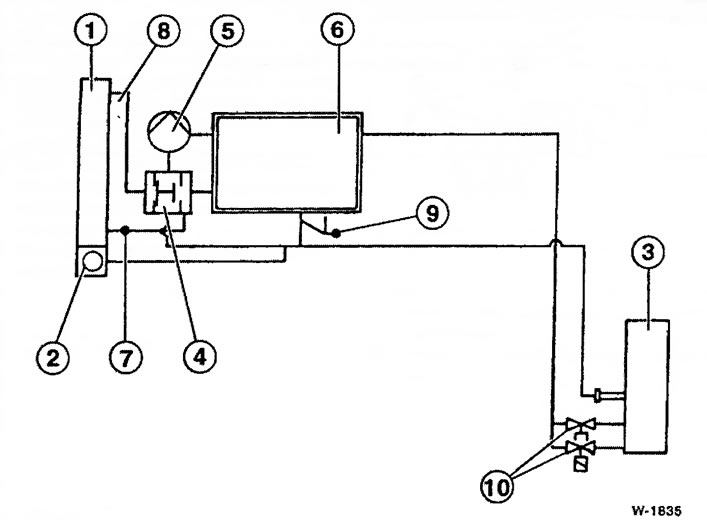
Coolant circulation diagram
1 - radiator
2 - expansion tank
3 - cabin heater
4 - thermostat
5 - coolant pump
6 - engine cylinder block
7 - draining liquid from the radiator
8 - supply of liquid to the radiator
9 - throttle valve preheating
10 - heater valves
After this, the fan speed increases and it operates at increased capacity until the air temperature drops below +60°C. At this point, the viscous clutch switches off and the fan speed decreases.
Thanks to the fan, which does not always operate at maximum frequency, the useful power of the engine increases and fuel consumption decreases.
Caution: When the engine is hot, place a thick cloth around the expansion tank cap before opening it to avoid scalding from hot liquid or steam. Risk of accident! Open the cap only when the coolant temperature is below +90°C.
The work on replacing the coolant and the data on the capacity of the cooling system are described in the section "Maintenance work".
A thermal energy accumulator is installed as an additional option.
It accumulates thermal energy from the coolant, and when the cold engine is started, it releases it back into the cooling system. This allows the interior heater to start working faster and reduces the engine warm-up time. A heat-insulated container located in the passenger footwell next to the driver serves as a thermal energy accumulator. It is filled with a chemically stable and reusable material. The accumulator is connected in parallel to the coolant circulation circuit and exchanges heat with the liquid. The coolant flow through the accumulator during the accumulation and release of heat is controlled automatically using various electromagnetic valves.
[The website served as the basis for the text BMWMan]