
Table of contents: Four-cylinder engine ↓ Six-cylinder engine ↓
- Home
- BMW 3 Series
- E30
- Power unit
- Cooling system
- Removal and installation, checking of the thermostat
Removal and installation, checking of the thermostat (BMW 3 Series E30)
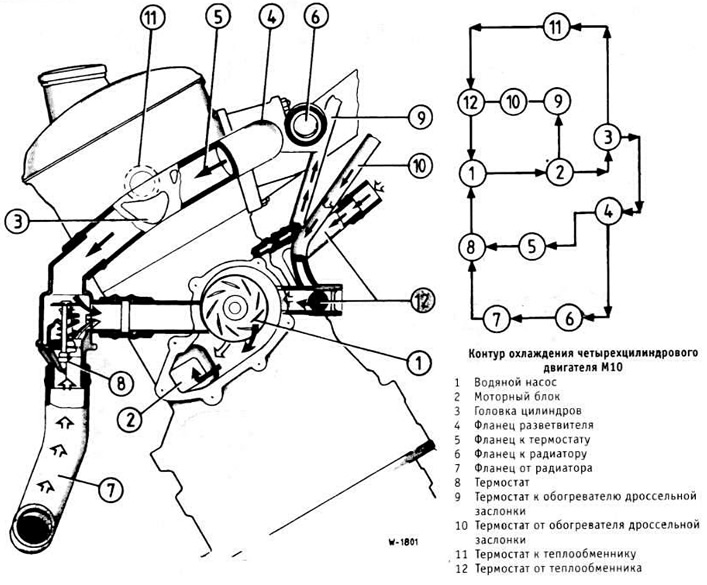
As the engine warms up, the thermostat opens a large cooling circuit. If the thermostat fails, the engine overheats. This is determined by the temperature readings on the temperature gauge: it is elevated, while the radiator remains cold. But a thermostat defect can also manifest itself in the fact that it remains open after the liquid has cooled. This is determined by the fact that the engine does not warm up to its operating temperature, or the temperature gauge needle moves more slowly than before, or in winter the heating power is insufficient.
Removal
Disconnect the ground wire from the battery.
Drain the coolant from the engine into a container.
Completely release clamps "1", "2" and "4" and move them back.
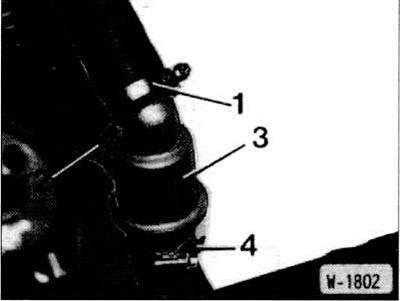
Disconnect the water hoses and remove thermostat "3".
Examination
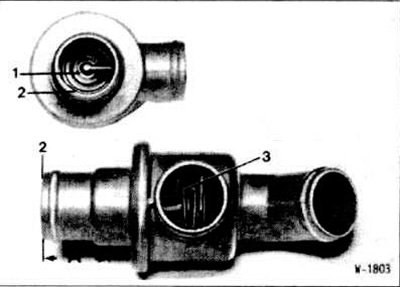
Using a steel ruler or calipers, measure the position of thermostat "1" in the housing relative to the edge of the lower fitting "2" and record the result as dimension "a".
Heat the thermostat in a water bath. Monitor the temperature with a suitable thermometer.
At a temperature of approximately 80°—88°C, the bimetallic spring "3" of the thermostat begins to expand. Measure the position of the thermostat after exceeding the opening temperature, i.e. dimension "b". Dimension "b" must be greater than dimension "a", otherwise replace the thermostat. The opening temperature is engraved on the thermostat.
The thermostat reaches its maximum opening at approximately 95°C. When the temperature of full opening is reached, measure the position of the thermostat. The size should be 8±1 mm larger than the size "b", i.e. "b" - "a" = 8±1 mm.
Installation
Insert the thermostat.
Fill with coolant (see section "Replacing the coolant").
Connect the ground wire to the battery.
Warm up the engine until the viscous coupling fan turns on. Check if the lower part of the radiator is warm and if the thermostat housing is sealed.
Removal
Disconnect the ground wire from the battery.
Drain some coolant from the engine into a container.
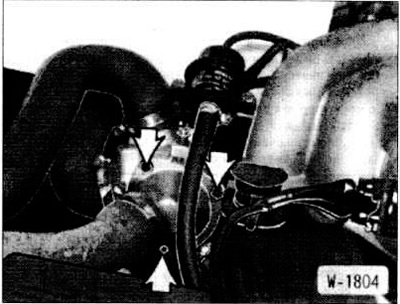
Unscrew the thermostat housing cover (arrows).
Remove the thermostat.
Examination
Heat the thermostat in a water bath. The thermostat should not touch the walls of the vessel. Monitor the temperature with an appropriate thermometer.
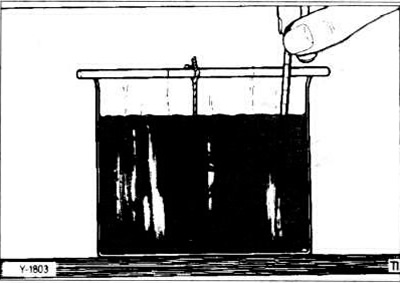
At a temperature of approximately 80°C, the bimetallic spring of the thermostat begins to expand. The thermostat reaches its maximum opening at approximately 95°C.
Check the opening and closing of the thermostat and the compliance of the opening temperature with the value engraved on the thermostat housing. If there are any deviations, replace the thermostat.
Installation
Clean the contact surfaces on the body and cover.
Insert the thermostat with the new gasket, bracket facing out.
Replace the cap and tighten evenly to 9 Nm.
Fill the engine with coolant and bleed air from the cooling system.
Connect the ground wire to the battery.
Warm up the engine until the viscous coupling fan turns on. Check if the lower part of the radiator is warm and if the thermostat housing is sealed.
[This article is based on data from the website: «bmwman.ru»]
Caution: If the engine overheats after a short distance, the cause may be limescale deposits in the radiator.
Four-cylinder engine
Removal
Disconnect the ground wire from the battery.
Drain the coolant from the engine into a container.
Completely release clamps "1", "2" and "4" and move them back.
Disconnect the water hoses and remove thermostat "3".
Examination
Using a steel ruler or calipers, measure the position of thermostat "1" in the housing relative to the edge of the lower fitting "2" and record the result as dimension "a".
Heat the thermostat in a water bath. Monitor the temperature with a suitable thermometer.
At a temperature of approximately 80°—88°C, the bimetallic spring "3" of the thermostat begins to expand. Measure the position of the thermostat after exceeding the opening temperature, i.e. dimension "b". Dimension "b" must be greater than dimension "a", otherwise replace the thermostat. The opening temperature is engraved on the thermostat.
The thermostat reaches its maximum opening at approximately 95°C. When the temperature of full opening is reached, measure the position of the thermostat. The size should be 8±1 mm larger than the size "b", i.e. "b" - "a" = 8±1 mm.
Installation
Insert the thermostat.
Fill with coolant (see section "Replacing the coolant").
Connect the ground wire to the battery.
Warm up the engine until the viscous coupling fan turns on. Check if the lower part of the radiator is warm and if the thermostat housing is sealed.
Six-cylinder engine
Removal
Disconnect the ground wire from the battery.
Drain some coolant from the engine into a container.
Unscrew the thermostat housing cover (arrows).
Remove the thermostat.
Examination
Heat the thermostat in a water bath. The thermostat should not touch the walls of the vessel. Monitor the temperature with an appropriate thermometer.
At a temperature of approximately 80°C, the bimetallic spring of the thermostat begins to expand. The thermostat reaches its maximum opening at approximately 95°C.
Check the opening and closing of the thermostat and the compliance of the opening temperature with the value engraved on the thermostat housing. If there are any deviations, replace the thermostat.
Installation
Clean the contact surfaces on the body and cover.
Insert the thermostat with the new gasket, bracket facing out.
Replace the cap and tighten evenly to 9 Nm.
Caution: Do not overtighten the screws.
Fill the engine with coolant and bleed air from the cooling system.
Connect the ground wire to the battery.
Warm up the engine until the viscous coupling fan turns on. Check if the lower part of the radiator is warm and if the thermostat housing is sealed.
[This article is based on data from the website: «bmwman.ru»]
This article is available at russian, bulgarian, belarusian, ukrainian, serbian, croatian, romanian, polish, slovak, hungarian
Article verified: Polikarpov Saveliy
Share information:
Previous articles
БМВ E30: Cooling system
Next articles
Similar articles on other types of BMW cars:
Removal and installation, checking of the thermostat BMW 5 Series E34 (1988-1996)
Removal and installation / checking the thermostat BMW 5 Series E39 (1995-2003)
Thermostat — Removal, Installation and Checking BMW 7 Series E32 (1986-1994)
Removal and installation the thermostat BMW 7 Series E38 (1994-2001)
Pistons — removal and installation BMW X3 E83 (2003-2010)
Checking the Thermostat BMW X5 E53 (1999-2006)
Removal and installation, checking of the thermostat BMW 5 Series E34 (1988-1996)
Removal and installation / checking the thermostat BMW 5 Series E39 (1995-2003)
Thermostat — Removal, Installation and Checking BMW 7 Series E32 (1986-1994)
Removal and installation the thermostat BMW 7 Series E38 (1994-2001)
Pistons — removal and installation BMW X3 E83 (2003-2010)
Checking the Thermostat BMW X5 E53 (1999-2006)
Link in different formats to this page
Visitor comments
No comments yet
- General information
- Manual
- Maintenance
- Power unit
- Engine repair
- Cooling system
- Power system (gasoline)
- Injection system (gasoline)
- Fuel system (diesel)
- Exhaust system
- Ignition system
- Charge and launch systems
- Transmission
- Car gearbox
- Clutch and drive shafts
- Chassis
- Brake system
- Suspension front and rear
- Steering
- Body
- Body care and repair
- Exterior
- Interior
- Electrical equipment
- Troubleshooting
- Lighting and signaling
- Equipment and devices
- Heater and air conditioner
- Electrical circuits
- General information
- Manual
- Repair on the road
- Weekly checks
- Maintenance
- Troubleshooting
- Power unit
- 4 cylinder engines
- 6 cylinder engines
- Engine overhaul
- Cooling and heating
- Fuel and exhaust system
- Starting and charging system
- Ignition system
- Transmission
- Clutch
- Mechanical gearbox
- Automatic gearbox
- Cardan and drive shafts
- Chassis
- Brake system
- Wheel suspension
- Steering
- Body
- Exterior
- Interior
- Electrical equipment
- Equipment and devices
- Electrical circuits
- General information
- Maintenance
- Power unit
- Engine repair
- Cooling system
- Ignition system
- Supply system
- Fuel injection system
- Exhaust system
- Transmission
- Clutch
- Car gearbox
- Front and rear axle
- Chassis
- Steering
- Brake system
- Body
- Exterior
- Interior
- Electrical equipment
- Heating system
- Equipment and devices
- Power devices
- Electrical circuits
- Power unit
- M10/M20 engine
- M40 engine
- Ignition system
- Lubrication system
- Cooling system
- Supply system
- Fuel injection
- Exhaust system
- Transmission
- Clutch
- Manual gearbox
- Front axle
- Rear axle
- Chassis
- Steering
- Brake system
- Body
- Exterior
- Interior
- Electrical equipment
- Heating system
- Equipment and devices
- Electrical circuits
- General information
- Specifications
- Operation and maintenance
- 4-cylinder engine
- Engine repair
- Cooling and lubrication system
- Supply system
- Ignition system
- 6-cylinder engine
- Engine repair
- Cooling and lubrication system
- Supply system
- Fuel injection system
- Ignition system
- Transmission
- Clutch
- 4-speed manual gearbox
- 5-speed manual gearbox
- Automatic gearbox
- Cardan and rear axle
- Chassis
- Steering
- Front suspension
- Rear suspension
- Brake system
- Electrical equipment
- Equipment and devices
- Electrical circuits