
Table of contents: Bosch spark plugs ↓ Beru spark plugs ↓
- Home
- BMW 3 Series
- E30
- Power unit
- Ignition system
- Spark plugs
Spark plugs (BMW 3 Series E30)
The spark plug consists of a central electrode, an insulator with a housing, and a ground electrode. The ground electrode is hermetically secured in an insulator rigidly connected to the housing. A spark jumps between the central electrode and the ground electrode, which ignites the air-fuel mixture. The ease of starting the engine, its behavior in idle mode, acceleration and maximum speed of the car depend on the spark plugs. Therefore, you should not deviate from the type of spark plugs without good reason, which is characterized by the heat rating recommended by the manufacturer. The heat rating indicates the degree of resistance of the spark plug to thermal loads in the engine under various operating conditions. Spark plugs are selected for the engine in such a way that their self-cleaning temperature is achieved under all conditions. The lower the heat rating of the spark plug, the higher the resistance to glow ignition and the less its resistance to contamination. The higher the heat rating of the spark plug, the lower the resistance to glow ignition and the greater its resistance to contamination.
The heat rating is contained in the spark plug designation. The designation is deciphered as follows:
Example: WR 7 D C R
Thanks to the copper (Cu), and especially the silver central electrode, the thermal conductivity and therefore the heat resistance are increased. The advantages of spark plugs with platinum central electrodes are easier spark formation, as well as less wear and a wide temperature range.
Example: 14 K 7 DUR
The glow plug value recommended by the manufacturer may be deviated from only if the operating conditions differ significantly from normal and malfunctions occur. If the spark plugs are constantly covered with soot, i.e. do not reach the self-cleaning temperature (when traveling short distances), then it is recommended to replace them with spark plugs with the next higher heat rating. If the engine is operated exclusively at full load, then it is recommended to replace the spark plugs with spark plugs with the next lower heat rating.
Spark plug tightening torque: 25 Nm.
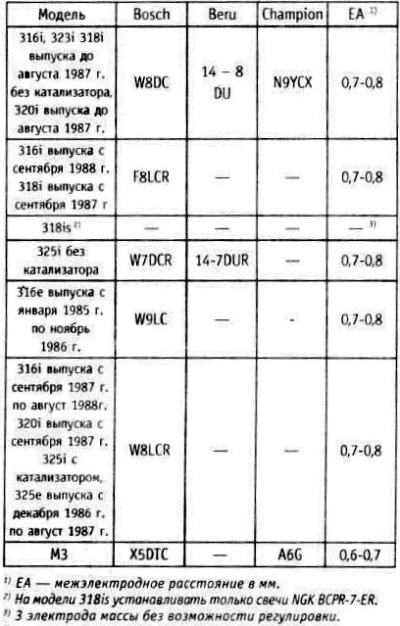
Recommended spark plugs for BMW vehicles
The heat rating is contained in the spark plug designation. The designation is deciphered as follows:
Bosch spark plugs
Example: WR 7 D C R
- 1) W = M14S1.25 thread with flat sealing surface, key size 21 mm: F - M14S1.25 thread with flat sealing surface, key size 16 mm; M - thread M18S1.5 with flat sealing surface, key size 25 mm; H - thread M14S1.25 with conical sealing surface, key size 16 mm; D — thread M18Sl.5 with conical sealing surface, key size 21 mm.
- 2) R — with radio interference resistance, does not affect the functioning of the ignition system.
- 3) 7 - heat rating. The heat rating scale has a range of 06 ("cold") — 13 ("hot"). In this case, the number 7 corresponds to the previous designation 175.6 - 200.5-225, etc.
- 4) A - thread length 12.7 mm, normal spark position; B - thread length 12.7 mm, extended spark position; C - thread length 19 mm, normal spark position; D - thread length 19 mm, extended spark position; DT - thread length 19 mm, extended spark position, 3 ground electrodes; L - thread length 19 mm, significantly advanced spark position;
- 5) Central electrode material: Cr-Ni alloy (Cr-Ni = chromium-nickel). C — Ni-Cu alloy (Ni-Cu — nickel-copper), S — silver central electrode, P — platinum central electrode. 0 — standard spark plug with reinforced central electrode.
- 6) R — 1 kOhm quenching resistance
Thanks to the copper (Cu), and especially the silver central electrode, the thermal conductivity and therefore the heat resistance are increased. The advantages of spark plugs with platinum central electrodes are easier spark formation, as well as less wear and a wide temperature range.
Beru spark plugs
Example: 14 K 7 DUR
- 1) Thread diameter, here M14S1.25.
- 2) Design feature, for example, k - conical sealing surface, R - presence of radio interference resistance of 5/10 kOhm.
- 3) Heat rating — the decoding is the same as for Bosch spark plugs, except for Silverstone spark plugs: here the designation S6 corresponds to a heat rating of 145-200, S7 - 200-215.
- 4) Thread length — the decoding is the same as for Bosch spark plugs. Except for Silverstone spark plugs: here the designation S6 is short thread, S7 is long thread.
- 5) Central electrode material: U — Ni-Cu alloy. A spark plug with a silver central electrode is designated "Silverstone". Spark plugs "Silverstone" have a service life determined by the Vega company of 50,000 km.
- 6) R — quenching resistance 1 kOhm
The glow plug value recommended by the manufacturer may be deviated from only if the operating conditions differ significantly from normal and malfunctions occur. If the spark plugs are constantly covered with soot, i.e. do not reach the self-cleaning temperature (when traveling short distances), then it is recommended to replace them with spark plugs with the next higher heat rating. If the engine is operated exclusively at full load, then it is recommended to replace the spark plugs with spark plugs with the next lower heat rating.
Spark plug tightening torque: 25 Nm.
Recommended spark plugs for BMW vehicles
Note: Consider the constant technical progress - it is likely that other types of spark plugs can be installed on older vehicles. It is therefore recommended to obtain information about the admissibility of installing a particular type of spark plug at a service station.
This article is available at russian, bulgarian, belarusian, ukrainian, serbian, croatian, romanian, polish, slovak, hungarian
Article verified: Polikarpov Saveliy
Share information:
Previous articles
БМВ E30: Ignition system
Next articles
Similar articles on other types of BMW cars:
Spark plugs. General information BMW 5 Series E34 (1988-1996)
Standard spark plugs for BMW 5-series engines BMW 5 Series E39 (1995-2003)
Spark plugs BMW 7 Series E32 (1986-1994)
Replacing spark plugs BMW 7 Series E38 (1994-2001)
Identifying engine faults by the condition of spark plugs BMW X3 E83 (2003-2010)
Checking and replacing spark plugs BMW X5 E53 (1999-2006)
Spark plugs. General information BMW 5 Series E34 (1988-1996)
Standard spark plugs for BMW 5-series engines BMW 5 Series E39 (1995-2003)
Spark plugs BMW 7 Series E32 (1986-1994)
Replacing spark plugs BMW 7 Series E38 (1994-2001)
Identifying engine faults by the condition of spark plugs BMW X3 E83 (2003-2010)
Checking and replacing spark plugs BMW X5 E53 (1999-2006)
Link in different formats to this page
Visitor comments
No comments yet
- General information
- Manual
- Maintenance
- Power unit
- Engine repair
- Cooling system
- Power system (gasoline)
- Injection system (gasoline)
- Fuel system (diesel)
- Exhaust system
- Ignition system
- Charge and launch systems
- Transmission
- Car gearbox
- Clutch and drive shafts
- Chassis
- Brake system
- Suspension front and rear
- Steering
- Body
- Body care and repair
- Exterior
- Interior
- Electrical equipment
- Troubleshooting
- Lighting and signaling
- Equipment and devices
- Heater and air conditioner
- Electrical circuits
- General information
- Manual
- Repair on the road
- Weekly checks
- Maintenance
- Troubleshooting
- Power unit
- 4 cylinder engines
- 6 cylinder engines
- Engine overhaul
- Cooling and heating
- Fuel and exhaust system
- Starting and charging system
- Ignition system
- Transmission
- Clutch
- Mechanical gearbox
- Automatic gearbox
- Cardan and drive shafts
- Chassis
- Brake system
- Wheel suspension
- Steering
- Body
- Exterior
- Interior
- Electrical equipment
- Equipment and devices
- Electrical circuits
- General information
- Maintenance
- Power unit
- Engine repair
- Cooling system
- Ignition system
- Supply system
- Fuel injection system
- Exhaust system
- Transmission
- Clutch
- Car gearbox
- Front and rear axle
- Chassis
- Steering
- Brake system
- Body
- Exterior
- Interior
- Electrical equipment
- Heating system
- Equipment and devices
- Power devices
- Electrical circuits
- Power unit
- M10/M20 engine
- M40 engine
- Ignition system
- Lubrication system
- Cooling system
- Supply system
- Fuel injection
- Exhaust system
- Transmission
- Clutch
- Manual gearbox
- Front axle
- Rear axle
- Chassis
- Steering
- Brake system
- Body
- Exterior
- Interior
- Electrical equipment
- Heating system
- Equipment and devices
- Electrical circuits
- General information
- Specifications
- Operation and maintenance
- 4-cylinder engine
- Engine repair
- Cooling and lubrication system
- Supply system
- Ignition system
- 6-cylinder engine
- Engine repair
- Cooling and lubrication system
- Supply system
- Fuel injection system
- Ignition system
- Transmission
- Clutch
- 4-speed manual gearbox
- 5-speed manual gearbox
- Automatic gearbox
- Cardan and rear axle
- Chassis
- Steering
- Front suspension
- Rear suspension
- Brake system
- Electrical equipment
- Equipment and devices
- Electrical circuits