



Note: On engines with Motronic, the ignition timing can only be checked, but not set. If there are deviations from the specified values, it is necessary to identify the failed elements of the ignition system and replace them.
Warm up the engine. Operating temperature is reached when the lower radiator water hose is warm.
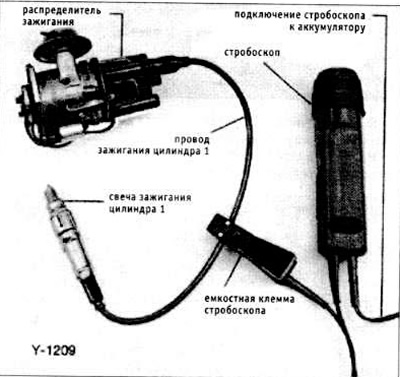
Four-cylinder engine
Start the engine, let it idle and measure the closing angle.
Note: The closing angle is determined by the design and can only be checked, but not adjusted. If the measurement result does not correspond to the specified value, check the pulse sensor in the ignition distributor (work must be performed at a service station).
Depending on the model, disconnect 1 or 2 vacuum hoses from the vacuum diaphragm "1" of the ignition distributor.
Caution: On vehicles with automatic transmission there is only one vacuum hose with a double membrane. In this case, the 2nd nipple remains open.
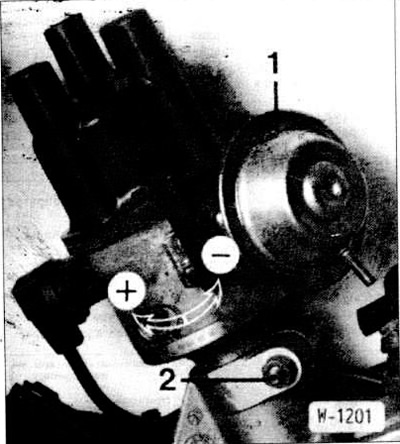
Increase engine speed to the control value (see ignition timing table).
Point the stroboscope at the arrow on the timing case cover.
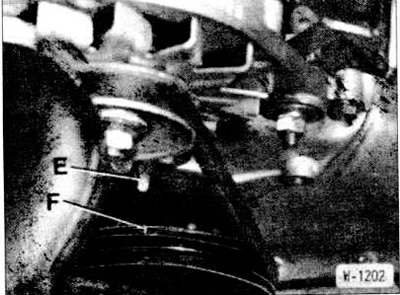
Caution: Be careful when the pulley and belt are rotating.
When the ignition timing is set correctly, the "F" and "E" marks should be stationary relative to each other (see ignition timing table).
If both marks do not match, loosen the clamping bolt "2" on the ignition distributor and turn the distributor until the marks match. To remove the ignition distributor, lightly tap the vacuum membrane with a screwdriver handle in the direction of rotation. On the 320i and 325i models, turn the ignition distributor by the teeth.
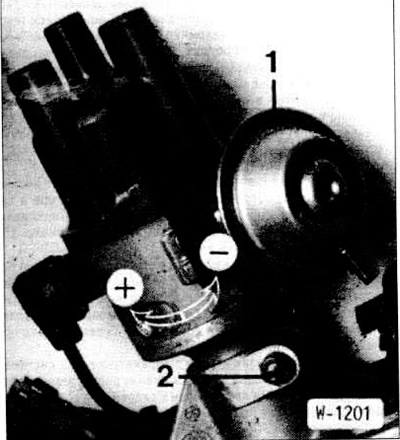
Tighten the mounting bolt.
Check the idle speed adjustment.
Finally, check the ignition timing again.
Disconnect the measuring instruments, connect the vacuum hoses. If there is a double membrane, the black hose is connected to the thinner nipple (to set earlier ignition), and a white or white-black hose goes to a thicker fitting (to set a later ignition timing).