
The inductive sensor controls the switch of the transistor ignition system, determining the moments of switching on and off the voltage supplied to the ignition coil. In this way, the ignition moment is determined.
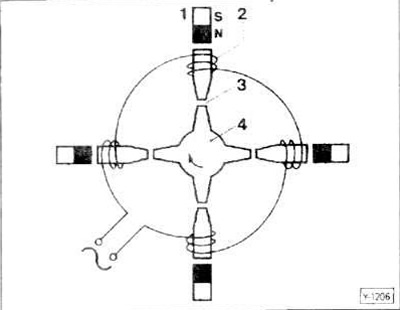
Since the anchor "4" of the distributor rotates on the shaft of the ignition distributor, there is a constant change in the distance "3" between the anchor of the distributor and the poles of the stator. This causes the induction of alternating voltage in the winding "2". In accordance with the change in the amplitude of the voltage, the commutator together with the ignition coil generates an ignition spark. Ignition occurs exactly when the anchor poles begin to move away from the poles of the stator winding. The figure also shows: 1 - a permanent magnet; S — south pole of a permanent magnet; N is the north pole of the permanent magnet.
To prevent overheating of the switch and ignition coil, the switch disconnects power to the ignition coil when the ignition is turned off and the engine is not running.
For safety purposes, the ignition coil has a 5.5 mm diameter hole with a plug. It serves to intentionally drain the ignition coil filling compound in the event of a switch failure.