
Cars Mazda Cars Mitsubishi Cars Toyota Cars Chevrolet Cars AvtoVAZ Cars Kia Cars Nissan
English Русский
Български
Беларускі
Український
Српски
Hrvatski
Română
Polski
Slovenský
Magyar
| Articles | Contacts | Sitemap |   
BMWman.ru


3 series   5 series   7 series   BMW X3   BMW X5   BMW X6

E38 (1994-2001) E32 (1986-1994)
  • Home
  • BMW 7 Series
  • E32
  • Power unit
  • Ignition system
  • Ignition system. General description

Ignition system. General description (BMW 7 Series E32)

            0

The ignition system generates a spark that ignites the fuel-air mixture that has entered the cylinders. In order to achieve a powerful spark, in the ignition coil, the voltage of 12 V from the battery (AB) is converted to a voltage of about 30,000 V.

A diesel engine does not have an ignition system, because due to the strong compression the air is heated so much that after the fuel is injected into the cylinder it ignites spontaneously.
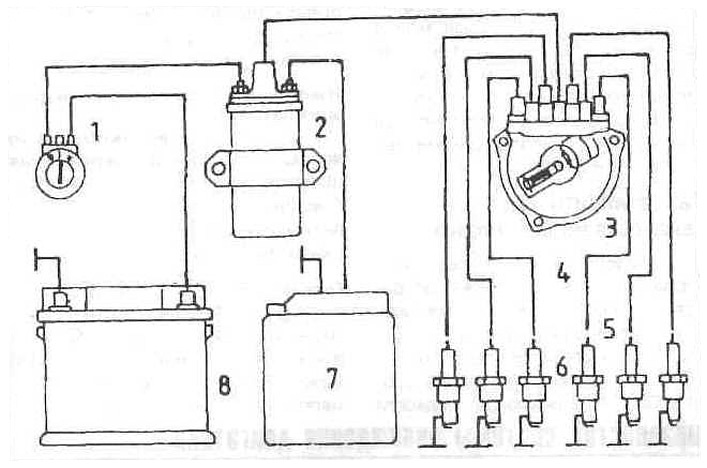
Schematic diagram of the Motronic ignition system (models since 1986)
1 - ignition switch;
2 - ignition coil;
3 - high voltage distributor;
4 - ignition cables;
5 - spark plug tips;
6 - spark plugs;
7 — control device;
8 — battery.


Modern BMW petrol engines are equipped with an electronically controlled ignition system, the control unit of which is integrated into the engine control unit. It does not have a conventional ignition distributor. Instead, the distribution of high voltage to the individual cylinders is carried out by fixed electronic elements. In modern engines, high voltage is generated in six separate ignition coils, which are located above the spark plugs. The operation of the ignition system is synchronized by signals that the pulse generator sends to the control unit. The pulse generator is located at the front of the cylinder block and displays the number of revolutions of the crankshaft.


To determine the right moment (lead angle) the ignition control unit uses an electronic database. Thanks to this, the ignition system easily adapts to various engine operating conditions.
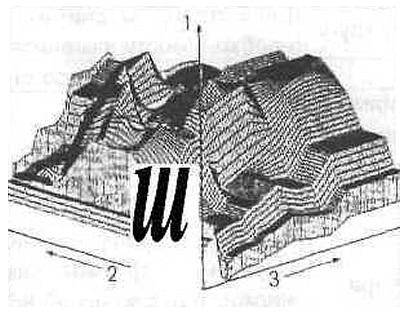
Ignition System Database Features
1 — ignition timing angle;
2 — load;
3 — number of revolutions.


The ignition timing is also adjusted by knock sensors. Since fuel consumption is minimal at high compression ratios, modern engines compress the air-fuel mixture as much as possible. However, due to high compression, uncontrolled combustion, called detonation, can occur. Over time, detonation can cause engine damage. To prevent this phenomenon, a knock sensor is needed, which detects uncontrolled combustion and informs the control unit, which ensures that the ignition timing is shifted in the retarded direction. BMW engines have two knock sensors screwed into the cylinder block, one sensor for cylinders No.1, 2, 3, and the other for cylinders 4, 5 and 6. Thanks to knock control, the engine can run on fuel that is less resistant to detonation (91 octane gasoline), although this will produce less power. When using gasoline with an octane rating of 98, the engine power increases.


All ignition system components are matched to each other and always provide the optimum ignition timing. Adjusting the ignition timing is no longer possible.

When working on the electronic ignition system, it is necessary to pay attention to safety precautions to avoid injury and damage to system parts.

(The original article is posted on the resource «bmwman»)

This article is available at russian, bulgarian, belarusian, ukrainian, serbian, croatian, romanian, polish, slovak, hungarian
Article verified: Sevastyanov Nikolay

Share information:
Previous articles
БМВ E32: Ignition system
Next articles

Precautions when working with the ignition system
Distributor — removal and installation
Distributor Cap and Rotor — Check
Ignition coil
Ignition coils — removal, inspection and installation


Similar articles on other types of BMW cars:
Ignition system — general information BMW 3 Series E30 (1982-1994)
Ignition system. General information BMW 3 Series E36 (1990-2000)
Ignition system. General information BMW 5 Series E34 (1988-1996)
Ignition system — general information BMW 5 Series E39 (1995-2003)
Fuses — general description BMW X3 E83 (2003-2010)
VANOS system — design description BMW X5 E53 (1999-2006)
Link in different formats to this page


Visitor comments

No comments yet


How much 45 + 15 =


BMW E38 (1994-2001) 
  • General information
  • Introduction to guide
  • Manual
  • Maintenance
  • Power unit
  • Engine M60/1, M60/2 (petrol)
  • M62 engine (petrol)
  • M57 engine (diesel)
  • M67 engine (diesel)
  • Cooling system
  • Fuel system (petrol)
  • Fuel system (diesel)
  • Exhaust system
  • Ignition and control systems
  • Charge and launch systems
  • Transmission
  • Clutch
  • Mechanical gearbox
  • Automatic gearbox
  • Cardan and drive shafts
  • Chassis
  • Brake system
  • Front suspension
  • Rear suspension
  • Steering
  • Body
  • Exterior
  • Interior
  • Electrical equipment
  • Equipment and devices
  • Lighting
  • Heating and air conditioning
  • Electrical circuits
BMW E32 (1986-1994) 
  • General information
  • Care and maintenance
  • Power unit
  • Minor engine repair
  • Engine overhaul
  • Lubrication system
  • Cooling system
  • Ignition system
  • Supply system
  • Injection system (petrol)
  • Injection system (diesel)
  • Exhaust system
  • Transmission
  • Clutch
  • Manual gearbox
  • Automatic gearbox
  • Cardan gear
  • Rear axle and shafts
  • Chassis
  • Front suspension
  • Rear suspension
  • Steering
  • Wheels and tires
  • Brake system
  • Body
  • Body elements
  • Electrical equipment
  • Equipment and devices
  • Electrical circuits
BMWman.ru © 2017-2026 · Mobile version · News and articles · Sitemap: EN BG BY UA RS HR RO PL SK HU · Feedback · Site search
3er E21 · 3er E30 · 3er E36 · 3er E46 [petrol] · 3er E46 · 5er E12 · 5er E28 · 5er E34 · 5er E39 · 7er E32 · 7er E38 · X3 E83 · X5 E53 ·
This site uses cookies 🍪, without them some features simply would not work.