
The diesel engine does not have an ignition system, because due to high compression the air heats up so much that after fuel is injected it ignites spontaneously.
The petrol engines of BMW cars are equipped with an ignition system with a control map. The ignition system control is integrated into the engine control unit. The ignition is direct. The system does not have a conventional ignition distributor. Instead, the distribution of the ignition voltage to the individual cylinders is carried out through fixed parts that have electronic control. High ignition voltage is induced in six individual coils located above the spark plugs. Synchronization of the system is carried out using signals from the pulse sensor transmitted to the control unit. The pulse sensor is located in front of the cylinder block and records the crankshaft speed.
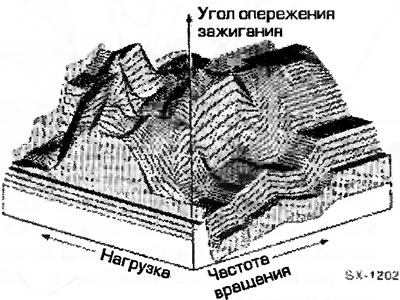
The required ignition advance angle is determined by the control unit based on the characteristics stored in its memory (control cards). Thanks to this, the ignition system can be easily adapted to various operating conditions.
The ignition timing is influenced by the signal from the knock sensor. Since the best fuel consumption occurs at a high compression ratio, it is assigned to modern engines as high as possible. However, a high compression ratio can lead to uncontrolled combustion, and in this case we speak of knock combustion in the engine. Long-term knock combustion can lead to engine damage. To avoid this, a knock sensor is required, which registers combustion disturbances and transmits a signal to the control unit, which ensures that the ignition is retarded. BMW cars have 2 knock sensors, which are located on the engine cylinder block. One sensor monitors the combustion process in cylinders 1-2-3, and the other in cylinders 4-5-6. Due to the regulating effect of the knock sensors, it is possible to run the engine on gasoline with a lower octane number (Normal 91), but this inevitably reduces engine power.
All components of the ignition system are coordinated, which ensures that the optimum ignition advance angle is always guaranteed. Adjustment of the ignition advance angle is no longer necessary.
To avoid injury and damage to the ignition system, safety precautions must be followed when working with the electronic ignition system.