
- Home
- BMW 3 Series
- E30
- Power unit
- Lubrication system
- Engine lubrication system
Engine lubrication system (BMW 3 Series E30)
Purpose of motor oil
During operation, engine oil is subject to the most uniform effects. Therefore, it is very difficult to accurately determine the effect of various operational effects on engine lubrication. Engines that operate for a long time at high speeds or under full load heat up to high temperatures. Under the influence of high temperature and oxygen contained in the air, the process of oil oxidation begins. Oxidation products thicken the oil and can form varnish-like deposits on the upper parts of the pistons, in the grooves under the piston rings and on the valve stems. This can lead to coking of the valve heads.
When an over-enriched fuel mixture enters the cylinders, or when the engine is rarely or never required to develop full power, or when the engine is often operated in a cold state (short trips around the city), the consequence is incomplete combustion of fuel. Carbon deposits, oil carbons, unburned fuel itself and other combustion products, as well as moisture condensates, cause the formation of sludge, acid and asphalt. Unburned fuel gets on the cold cylinder walls and flows down them into the crankcase, washing off the oil film from the cylinder walls and pistons. The consequence of this is deterioration of lubrication of the cylinder walls and dilution of the oil, which affects its lubricating properties depending on the amount of fuel that gets into it.
If the oil is very thin, it should be replaced early. Since with a sharp driving style (hot engine) gasoline particles evaporate in the oil, the oil level should be checked more often in winter (numerous cold starts - high proportion of gasoline in the oil).
Viscosity of motor oil
The viscosity of motor oil changes with temperature. When heated, the oil liquefies. This affects the adhesion and pressure resistance of the oil film. When cooled, the viscosity of the oil increases, and the internal friction resistance increases. This property requires the use of oil with a viscosity that would change as little as possible with temperature changes.
When the engine is cold, the oil should be thin enough to not impede the starter's operation and to reach all lubrication points as quickly as possible.
Viscosity is identical to the internal friction of the oil and is classified according to the SAE system (Society of Automotive Engineers), for example SAE 30, SAE 10, etc. High indexes are assigned to thick oils, low ones to liquid ones.
Universal (all season) oil
BMW engines must use all-season oil. All-season oils have the advantage of working in a wide temperature range (summer/winter). The basis of all-season oil is a grade of liquid oil (for example, 15W). Thanks to the so-called thickener, the oil is stabilized in a hot state, thus maintaining its lubricating properties under any operating conditions. When using all-season oils, modern grades with a wide temperature range of viscosity should be selected (eg 15 W-40, 15 W-50).
The letter "W" in the SAE designation indicates the suitability of the oil grade for winter use.
Light-duty oils
With low-friction oils we are talking about all-season oil with an additive that reduces internal friction, which can provide savings of up to 2%. Low-friction oils have low viscosity (for example, 10 W-30). Unusual oils are used as base oils here (synthetic). When purchasing light-duty oil, you should pay attention to BMW approval (it is written on the label of the can).
Application ranges/Viscosity grades
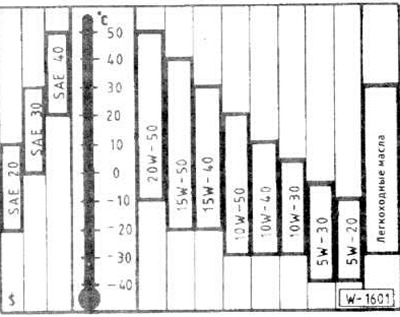
Since the application ranges of seasonal oils of adjacent SAE classes overlap, short-term temperature changes can be ignored. It is permissible to mix oils of different viscosity classes if oil topping up is required and the ambient temperature no longer corresponds to the viscosity class of the oil poured into the engine.
Additives of any kind should not be mixed into either oil or fuel.
Specification of motor oils
Only HO oils are permitted for modern engines. HD oils are alloyed oils, the lubricating properties of which are significantly improved by adding various chemicals. These additives provide good anti-corrosion protection, reduced oxidation activity, especially low tendency to form sludge in the crankcase, better viscosity characteristics, cleaning and dissolving properties. Cleaning and dissolving additives not only reduce the formation of deposits in the engine, but also have the ability to dissolve deposits and constantly keep them, as well as other contaminants in the engine oil in a suspended state, so that when changing the oil, they flow down together with the old oil.
The parameters of HO oils are classified according to the API system (American Petroleum Institut). European manufacturers also adhere to this system.
Two-letter designations. The first letter characterizes the range of application: S — Service, intended for gasoline engines; C — Commercial, designed for diesel engines. The second letter in alphabetical order characterizes the grade of oil.
The highest grades of oils are SG oils for gasoline engines and CE oils for diesel engines (according to API specification).
Note: Motor oils clearly labelled by the manufacturer as diesel engine oils are not suitable for petrol engines. There are oils that are suitable for both petrol and diesel engines. In this case, both specifications are indicated on the packaging (eg SF/CD).
The following oil grades are suitable for BMW vehicles with petrol or diesel engines: API specification SF/SG, SG/CD or SG/CE oils.
In any case, you need to pay attention to the fact that the oil you buy is approved for use in BMW vehicles (it's written on the package).
Oil consumption
In internal combustion engines, oil consumption is the amount of oil consumed as a result of the combustion process. Oil consumption cannot be equated with oil leaks occurring in the oil pan, cylinder head cover, etc.
Normal oil consumption results from the combustion of a small amount of oil in the cylinders and its oil along with objects of combustion and friction. In addition, oil consumption occurs due to high temperatures and pressures constantly affecting the engine.
In addition, oil consumption is affected by external operating conditions, driving style, and manufacturing tolerances. Oil consumption should not exceed 1.5 liters per 1000 km.
When the oil level drops to the "Add" level, you must add oil (the volume of oil added is a maximum of 1 l).
(The original source of the article is on the website: www.bmwman.ru)
This article is available at russian, bulgarian, belarusian, ukrainian, serbian, croatian, romanian, polish, slovak, hungarian
Article verified: Polikarpov Saveliy
Share information:
Previous articles
БМВ E30: Lubrication system
Next articles
Similar articles on other types of BMW cars:
Engine lubrication system. General information BMW 5 Series E34 (1988-1996)
Engine cooling system parts BMW 5 Series E12 (1972-1981)
Diagnostics of lubrication system faults BMW 7 Series E32 (1986-1994)
Replacing the sensors of the engine management system BMW 7 Series E38 (1994-2001)
Exhaust system assembly (Engine M54 and N52 K) BMW X3 E83 (2003-2010)
Electrical diagram of the engine lubrication system BMW X5 E53 (1999-2006)
Engine lubrication system. General information BMW 5 Series E34 (1988-1996)
Engine cooling system parts BMW 5 Series E12 (1972-1981)
Diagnostics of lubrication system faults BMW 7 Series E32 (1986-1994)
Replacing the sensors of the engine management system BMW 7 Series E38 (1994-2001)
Exhaust system assembly (Engine M54 and N52 K) BMW X3 E83 (2003-2010)
Electrical diagram of the engine lubrication system BMW X5 E53 (1999-2006)
Link in different formats to this page
Visitor comments
No comments yet
- General information
- Manual
- Maintenance
- Power unit
- Engine repair
- Cooling system
- Power system (gasoline)
- Injection system (gasoline)
- Fuel system (diesel)
- Exhaust system
- Ignition system
- Charge and launch systems
- Transmission
- Car gearbox
- Clutch and drive shafts
- Chassis
- Brake system
- Suspension front and rear
- Steering
- Body
- Body care and repair
- Exterior
- Interior
- Electrical equipment
- Troubleshooting
- Lighting and signaling
- Equipment and devices
- Heater and air conditioner
- Electrical circuits
- General information
- Manual
- Repair on the road
- Weekly checks
- Maintenance
- Troubleshooting
- Power unit
- 4 cylinder engines
- 6 cylinder engines
- Engine overhaul
- Cooling and heating
- Fuel and exhaust system
- Starting and charging system
- Ignition system
- Transmission
- Clutch
- Mechanical gearbox
- Automatic gearbox
- Cardan and drive shafts
- Chassis
- Brake system
- Wheel suspension
- Steering
- Body
- Exterior
- Interior
- Electrical equipment
- Equipment and devices
- Electrical circuits
- General information
- Maintenance
- Power unit
- Engine repair
- Cooling system
- Ignition system
- Supply system
- Fuel injection system
- Exhaust system
- Transmission
- Clutch
- Car gearbox
- Front and rear axle
- Chassis
- Steering
- Brake system
- Body
- Exterior
- Interior
- Electrical equipment
- Heating system
- Equipment and devices
- Power devices
- Electrical circuits
- Power unit
- M10/M20 engine
- M40 engine
- Ignition system
- Lubrication system
- Cooling system
- Supply system
- Fuel injection
- Exhaust system
- Transmission
- Clutch
- Manual gearbox
- Front axle
- Rear axle
- Chassis
- Steering
- Brake system
- Body
- Exterior
- Interior
- Electrical equipment
- Heating system
- Equipment and devices
- Electrical circuits
- General information
- Specifications
- Operation and maintenance
- 4-cylinder engine
- Engine repair
- Cooling and lubrication system
- Supply system
- Ignition system
- 6-cylinder engine
- Engine repair
- Cooling and lubrication system
- Supply system
- Fuel injection system
- Ignition system
- Transmission
- Clutch
- 4-speed manual gearbox
- 5-speed manual gearbox
- Automatic gearbox
- Cardan and rear axle
- Chassis
- Steering
- Front suspension
- Rear suspension
- Brake system
- Electrical equipment
- Equipment and devices
- Electrical circuits