
Six-cylinder engine
Removal
Disconnect the ground wire from the battery.
Raise the car.
On vehicles produced since September 1984, unscrew the reinforcing frame.
Drain the oil from the engine (see section "Engine oil change").
Unscrew the steering gear from the front axle beam.
Unscrew the ground jumper from the oil pan.
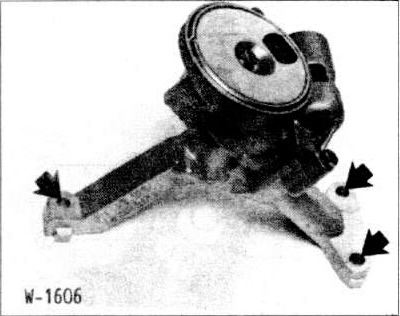
Remove the oil level sensor wire from the holder above the oil pan and disconnect the wire.
Unscrew the oil pan and tilt it slightly without removing it.
Unscrew the oil pump (arrows).
Unscrew the oil bypass valve and remove it with the casing.
Remove the oil pan together with the pump and valve.
Installation
Check the oil pump.
Clean the contact surfaces of the upper and lower parts of the oil pan. Carefully straighten any bent contact surfaces on the lower part of the oil pan.
Coat the contact surfaces of both halves with a universal sealing paste, such as Curil.
Glue the gasket with a small amount of grease, check the fit of the gasket.
Insert the oil pan together with the oil pump.
Tighten the oil pump fastening to a tightening torque of 22 Nm.
Insert and tighten the oil bypass valve.
Install the oil pan and tighten the bolts by hand. Then tighten all bolts to 10 Nm.
Connect the oil level sensor wire and secure it in the holder.
Connect the ground wire to the battery.
Bolt the steering gear to the front axle beam and tighten the bolts to a torque of 45 Nm.
If the reinforcement frame was removed, install and secure it.
Fill the engine with oil. There are two marks on the oil dipstick. These marks determine the amount of oil poured into the engine. The volume of oil between the -min- and -max- marks is 1 l.
Lower the car.
After the test drive, check the tightness of the oil pan and, if necessary, carefully tighten all bolts.