
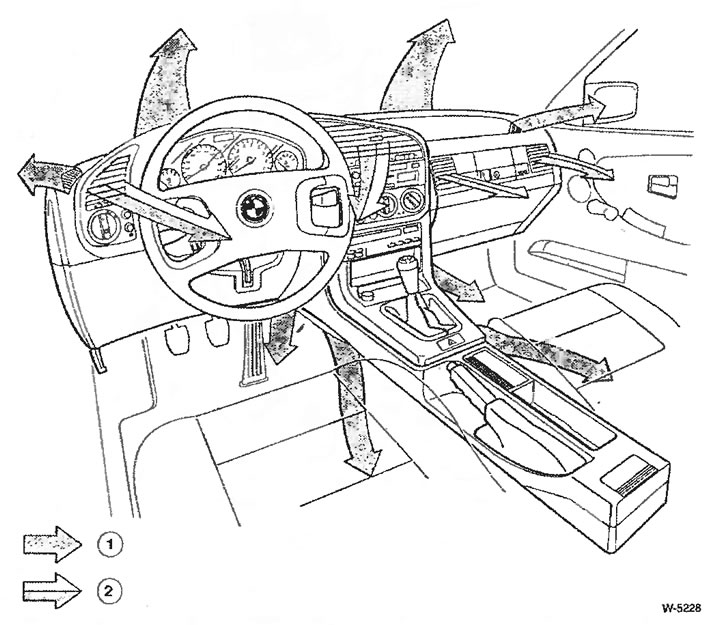
1. Warm air - warm air
2. Temperature control outside air - adjustable outside air
Outside air enters the car through the air intake grille under the windshield and is supplied to the car by the fan. In this case, the air passes through the air distributor housing and is directed by a system of flaps controlled by cables to individual air nozzles. If the heating is set to the "heat" mode, cold air is directed to the heater radiator, where it is heated. The radiator is located in the heater housing and is heated by hot coolant. The flowing fresh air is heated by the hot lamellas of the heat exchanger and then enters the car. The heating has a water control mode, i.e. the temperature is regulated by the flow section of the radiator by two electromagnetic valves at the inlet of the heat exchanger.
The temperature in the cabin can be set by a switch. In accordance with the position of the switch and the current temperature, the electronic unit in the heater control panel regulates the opening time of the valves. Thanks to the presence of electronic regulation, an approximately constant temperature in the cabin is maintained regardless of the speed of movement and the outside temperature.
To increase the heater's performance, a heater fan with four control stages is designed. To ensure different fan speeds, ballast resistors are switched on at different stages. If one of the resistors fails, the fan does not operate at the corresponding speed.
The air conditioner consists of a compressor, a condenser, a throttle, an evaporator, a collecting tank and a pressure pipeline. Freegen or freon (R12) is used as a cooling agent, the latter units are filled with less harmful to the environment "R134a". The compressor is driven by a V-belt or V-ribbed belt from the crankshaft. It increases the pressure in the cooling circuit to a maximum of 30 bar, which causes the working gas to heat up. In the condenser, heat is removed by the flowing air (cooling air remaining in the outer area), which causes cooling and condensation of the working gas. The working substance of the air conditioner becomes liquid. It flows under still high pressure through the throttle, where the pressure decreases. As a result, the working substance turns back into gas and simultaneously cools down significantly. In the evaporator, the working gas takes heat from the flowing air. The air cools down. The cooled air then enters the car interior. The collecting tank serves as an expansion vessel for the working substance.
Note: Description of work with the air conditioner is not given. Except for maintenance work (compressor drive belt tension) all work with the air conditioner must be carried out in special workshops. It should be especially noted that it is forbidden to open the air conditioner system, since contact with the working substance can cause frostbite. In addition, the working substance R12 from FCKW (fluorocarbons) when released into the atmosphere, it destroys the ozone layer.