
- Home
- BMW 7 Series
- E38
- Electrical equipment
- Heating and air conditioning
- General information about the heating, ventilation and air conditioning system
General information about the heating, ventilation and air conditioning system (BMW 7 Series E38)
Description of systems
Description of the ventilation system control with heater and air conditioning is given in Chapter Controls and operating techniques.
The coolant heated in the engine passes through the heat exchanger, giving off heat to the air passing through it. The air supply to the passenger compartment is regulated by the flaps. If you turn on the heater fan, the air will be supplied to the passenger compartment more intensively. The fan speed can be adjusted. When the flap is closed, the coolant flows through the small circuit back to the engine radiator circuit.
Before entering the cabin, the air passes through a filter, where most of the dust settles. It is necessary to observe the frequency of filter replacement, because a filter blocked by dust restricts the air supply, which will lead to stagnation of air inside the cabin.
Distribution of air flows of the ventilation system is also carried out using flaps. All models have an air circulation mode.
System air conditioning (K/V) is installed as additional equipment.
Work on the A/C system must be carried out in a specialized workshop. Do not open the refrigerant circuit, as the refrigerant may cause frostbite if it comes into contact with the skin.
With the help of the K/V system, the air temperature in the cabin can be lowered relative to the outside temperature. In addition, when the K/V system is operating, the humidity in the cabin decreases.
The refrigerant circulates in the system R134a, which, depending on temperature and pressure, can be in a liquid or gaseous state.
Functional diagram of the K/V system
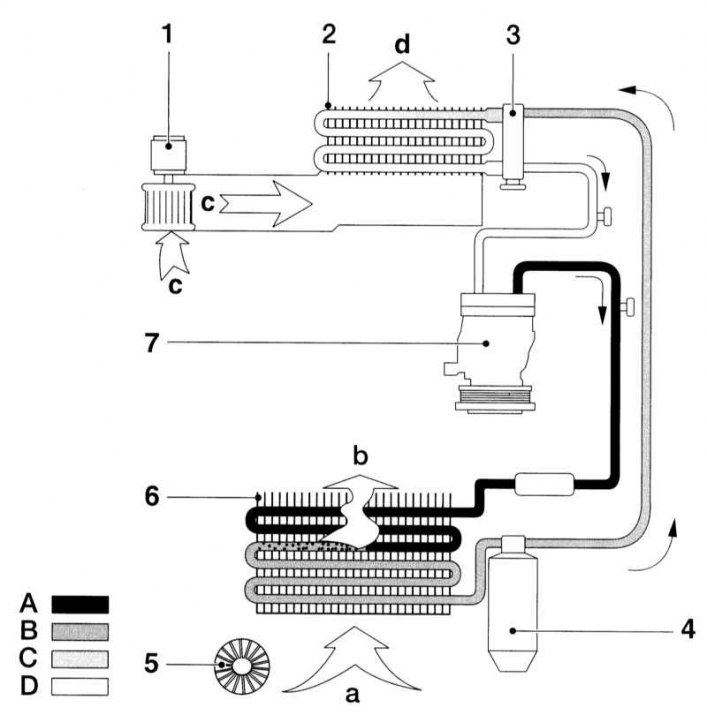
1 - Fan
2 - Evaporator
3 - Expansion valve
4 - Dehumidifier
5 — Condenser fan
6 - Capacitor
7 — Compressor
a — Outside air
b - Heated air
c - Warm outside air
d — Cooled outside air
A - High pressure circuit, gaseous refrigerant
B - High pressure circuit, liquid refrigerant
C - Low pressure circuit, liquid refrigerant
D — Low pressure circuit, gaseous refrigerant
The air conditioner compressor is driven by a belt from the engine crankshaft and creates pressure in the refrigerant circuit, which is a gas. In this case, the refrigerant heats up. In the condenser, the refrigerant is cooled by the outside air. As a result, the heated refrigerant passes into the liquid phase. Then, under high pressure, the refrigerant is passed through the expansion valve, as a result of which the pressure of the refrigerant drops. After this, the refrigerant evaporates in the circuit, simultaneously cooling down significantly. In the evaporator, the refrigerant takes heat from the air blown through it. As a result, the air cools down and enters the car's interior. As a result of heating in the evaporator, the refrigerant turns into gas and enters the compressor under low pressure, after which the circulation process is repeated.
Compressor oil is used to lubricate the components of the air conditioning system and circulates in the system together with the refrigerant.
Safety precautions when servicing the air conditioning system
The A/C system should only be serviced by trained technicians who are familiar with safe operation, proper equipment, proper depressurization procedures, and the proper handling and storage of vehicle refrigerant.
- Avoid contact of refrigerant with skin;
- Wear safety glasses when working near the A/C system;
- If refrigerant gets on your skin or in your eyes, do not rub the affected area. Immediately rinse the affected area with cold water for at least 15 minutes and seek qualified medical help. Self-medication is not allowed;
- The refrigerant is stored in cylinders under pressure. Store the cylinder at a temperature not exceeding 50 degrees. Take measures to prevent the cylinder from falling from a height or other situations that may lead to its damage;
- Work should be carried out in a well-ventilated area. The refrigerant evaporates quickly, reducing oxygen supply and making breathing difficult;
- The gaseous refrigerant is heavier than air and should collect relatively quickly at a low level, such as under a car;
- When refrigerant burns, toxic gas is formed. Keep refrigerant away from open flames. Do not smoke when working on the A/C system;
- When welding near the A/C system, do not expose it to high temperatures or open flames. Overheating may cause the system to become pressurized and ignite;
- Cleaning the condenser or evaporator with water vapor is not permitted. Only cold water or compressed air should be used.
The article was copied from an online resource «BMWman»
This article is available at russian, bulgarian, belarusian, ukrainian, serbian, croatian, romanian, polish, slovak, hungarian
Article verified: Polikarpov Saveliy
Share information:
Previous articles
БМВ E38: Heating and air conditioning
Next articles
Similar articles on other types of BMW cars:
Heating and ventilation system — general information BMW 3 Series E46 (1998-2006, petrol)
Heating system. General information BMW 3 Series E30 (1982-1994)
Heating system — general information BMW 5 Series E34 (1988-1996)
Heating system — general information BMW 5 Series E39 (1995-2003)
Automatic heating and air conditioning system BMW X3 E83 (2003-2010)
Air supply system — general information BMW X5 E53 (1999-2006)
Heating and ventilation system — general information BMW 3 Series E46 (1998-2006, petrol)
Heating system. General information BMW 3 Series E30 (1982-1994)
Heating system — general information BMW 5 Series E34 (1988-1996)
Heating system — general information BMW 5 Series E39 (1995-2003)
Automatic heating and air conditioning system BMW X3 E83 (2003-2010)
Air supply system — general information BMW X5 E53 (1999-2006)
Link in different formats to this page
Visitor comments
No comments yet
- General information
- Introduction to guide
- Manual
- Maintenance
- Power unit
- Engine M60/1, M60/2 (petrol)
- M62 engine (petrol)
- M57 engine (diesel)
- M67 engine (diesel)
- Cooling system
- Fuel system (petrol)
- Fuel system (diesel)
- Exhaust system
- Ignition and control systems
- Charge and launch systems
- Transmission
- Clutch
- Mechanical gearbox
- Automatic gearbox
- Cardan and drive shafts
- Chassis
- Brake system
- Front suspension
- Rear suspension
- Steering
- Body
- Exterior
- Interior
- Electrical equipment
- Equipment and devices
- Lighting
- Heating and air conditioning
- Electrical circuits
- General information
- Care and maintenance
- Power unit
- Minor engine repair
- Engine overhaul
- Lubrication system
- Cooling system
- Ignition system
- Supply system
- Injection system (petrol)
- Injection system (diesel)
- Exhaust system
- Transmission
- Clutch
- Manual gearbox
- Automatic gearbox
- Cardan gear
- Rear axle and shafts
- Chassis
- Front suspension
- Rear suspension
- Steering
- Wheels and tires
- Brake system
- Body
- Body elements
- Electrical equipment
- Equipment and devices
- Electrical circuits