



Note 1. Below are the standards for the content of harmful impurities in the exhaust gases of cars with gasoline engines. valid in Russia at the time of writing this Guide. The standards are regulated by GOST R 52033-2003, introduced on 01.01.2004 to replace the previously valid GOST 17.8.3.03-87.
Note 2. The following terminology is used in GOST: Two-component exhaust gas neutralization system is a system that ensures a reduction in the content of exhaust gases, mainly carbon monoxide and hydrocarbons, without feedback on the composition of the working mixture. Three-component exhaust gas neutralization system is a system with feedback (by excess air coefficient X), ensuring a reduction in the content of carbon monoxide, hydrocarbons and nitrogen oxides in exhaust gases.
The content of carbon monoxide (CO) and hydrocarbons (HC) in the exhaust gases of vehicles is determined with the engine idling for two crankshaft speeds set by the manufacturer for a given model: minimum (nmin) and increased (npov).
If there is no such data, then the check is performed under the following conditions: Value nmin should not exceed 1100 min⁻¹;
The value of n is set within the range:
- 2500-3500 min⁻¹ for vehicles not equipped with an exhaust gas aftertreatment system;
- 2000-3500 min⁻¹, for vehicles equipped with an exhaust gas aftertreatment system.
To perform this work you will need an exhaust gas analyzer with a relative error of no more than 6%:
- for models not equipped with neutralization systems or equipped with two-component (oxidizing) neutralization systems - a two-channel gas analyzer designed to measure the content of carbon monoxide (CO) and hydrocarbons (CH);
- for models equipped with three-component neutralization systems - four-channel gas analyzers designed to measure the content of CO, CH, carbon dioxide (CO₂) and oxygen (O₂).
Four-channel gas analyzers can also be used to perform measurements on cars that are not equipped with neutralization systems or are equipped with two-component neutralization systems. If you do not have such a device and do not have the opportunity to borrow it for a while, then almost any auto repair shop will do this work for you for a reasonable fee.
Before taking measurements, check the presence of systems and devices on the vehicle that reduce harmful emissions. If the actual configuration of the vehicle does not correspond to that installed by the manufacturer, there is no point in taking measurements - you will not pass the technical inspection.
Before taking measurements, the car engine must be warmed up to a temperature not lower than the operating temperature of the engine oil or coolant specified in the car operating instructions, but not lower than 60°C. After warming up the engine, the car must be prepared for measurements in the following order:
- install gear shift lever (or mode selector for cars with automatic transmission) to neutral position;
- apply the parking brake and turn off the engine;
- connect the tachometer and oil temperature gauge sensors (if it is included in the measuring equipment kit);
- insert the gas analyzer sampling probe into the vehicle exhaust pipe to a depth of at least 300 mm from the cut (when the exhaust pipe is cut at an angle, the depth is measured from the short edge of the cut).
On models not equipped with an exhaust gas aftertreatment system, perform measurements in the following order:
- before taking measurements, check and set the gas analyzer readings to zero on the CO and HC measurement scales;
- start the engine by pressing the throttle pedal, increase the engine speed to 2000...2100 min⁻¹ and operate in this mode for at least 15 seconds;
- release the accelerator pedal, set the minimum engine speed nmin no earlier than 30 seconds later measure the content of carbon monoxide CO and hydrocarbons HC;
- set the engine speed to high npov and no earlier than 30 seconds later measure the CO and HC content.
On vehicles equipped with an exhaust gas aftertreatment system, perform measurements in the following order:
- before starting measurements, check and set the gas analyzer readings to zero on the CO, HC and CO₂ measurement scales.
- perform measurements in the following order:
- start the engine, press the throttle pedal, increase the engine speed to nst, maintain this mode for 2...3 minutes (at ambient temperatures below 0°C - 4...5 minutes), and after the readings have stabilized, measure the CO and HC content, and also record the value of the excess air coefficient
- set the minimum engine shaft speed nmin and no earlier than 30 s measure the content of carbon monoxide and hydrocarbons. You should start measuring no later than 30 s after checking in mode npov.
On vehicles equipped with a three-component exhaust gas neutralization system and a built-in diagnostic system, before measuring the CO and HC content, the engine and neutralization system performance is checked according to the readings of the diagnostic indicator located on the instrument panel:
- when the ignition is turned on before starting the engine, the diagnostic indicator should turn on for a short period of time; if there is no corresponding signal from the diagnostic indicator after turning on the ignition, the further testing procedure is stopped
- after starting the engine, the diagnostic indicator should turn off; if the diagnostic indicator remains on while the engine is running, the further testing procedure is stopped.
CO and HC content in exhaust gases
The content of CO and HC must be within the data set by the vehicle manufacturer, but not more than:
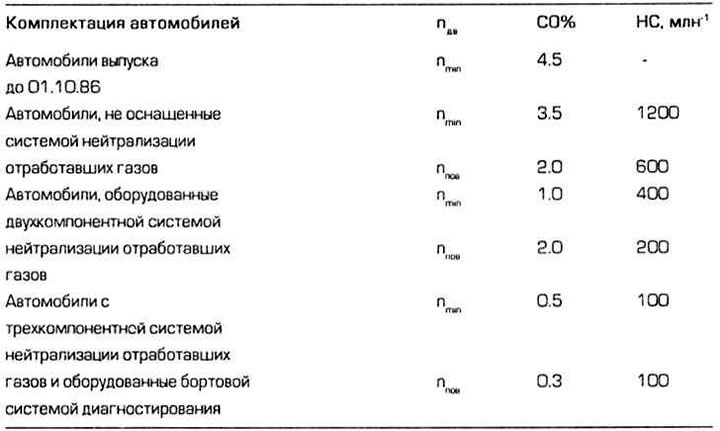
The value of the excess air coefficient λ in idle mode at nhall for vehicles equipped with a three-component neutralization system, must be within the data specified by the manufacturer. In the absence of such data, λ must be from 0.97 to 1.03.
[Information obtained from this online resource: BMWMAN.RU]