



- Home
- BMW 3 Series
- E46
- General information
- Manual
- Checks performed on a raised vehicle with wheels rotating freely
Checks performed on a raised vehicle with wheels rotating freely (BMW 3 Series E46)
Raise the front and rear of the vehicle with a jack and install reliable supports. Position the supports so that they do not touch the suspension units. Make sure that the wheels do not touch the ground and that the steering wheel can turn in both directions until it stops.
Have an assistant turn the steering wheel from lock to lock. Check the smoothness of the steering mechanism parts and make sure that no parts of the mechanism, including the wheel or tire, are touching the brake hoses or any parts of the body.
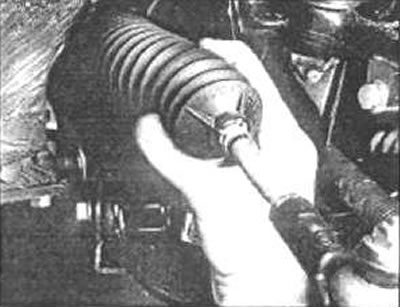
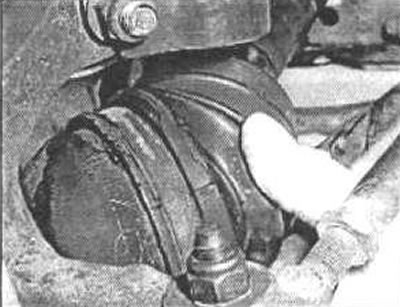
Check for damage to rubber boots and secure clamps. If power steering is installed, check for damage or leaks from hoses, pipes or connections. Check for excessively tight or binding steering, missing cotter pins or other fasteners, or severe body corrosion within 30 cm of any steering component mounting point.
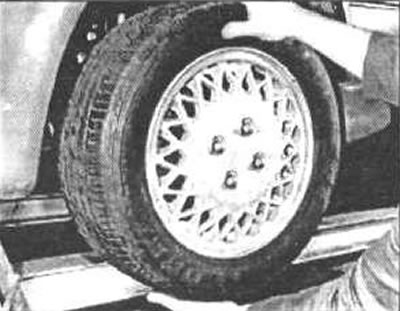
Starting at the front right side, grasp the wheel at the 3 o'clock and 9 o'clock positions and vigorously rock it horizontally. Check for play in the wheel bearings, ball joints, and suspension and steering mounts.
Now grab the wheel at the 12 o'clock and 8 o'clock positions and repeat the previous check. Spin the wheel and check the condition of its bearings.
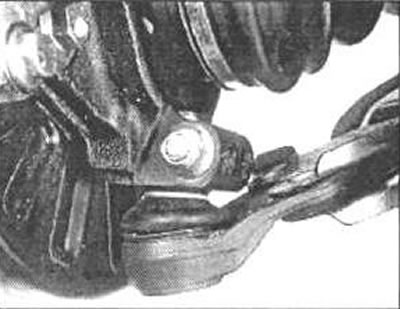
If a connection is suspected of having play, this suspicion can be confirmed by pressing a large screwdriver or similar tool between the suspected connection and the housing. This will make it clear where the wear has occurred: in the connection sleeve, the mounting bolts or in the support (bolt holes are often lengthened).
Perform the full set of tests on the other front wheel and then on both rear wheels.
Inspect the suspension struts for leaks, corrosion, or damage to the housing. Check the tightness of all mounting points.
If spring springs are installed, check the position of the outer coils of the suspension springs in their supports, as well as the absence of breakages and damage to the springs.
If leaf springs are installed, make sure that the leaves are not damaged, the springs are securely fastened to the axle supports, and that the spring fastening elements to the body are not damaged.
The same general inspection principles apply to vehicles with other types of suspension, such as torsion bar, hydraulic, etc. Make sure all fasteners are secure, there are no signs of excessive wear, corrosion or damage, and in hydraulic type suspensions there are no leaks or damage to the tubes and their connections.
Inspect the shock absorbers and make sure there are no serious leaks. Check the bushings and fasteners for wear, and make sure there is no damage to the housings.
Rotate each rear wheel in turn and inspect the constant velocity joint boots. Also make sure the drive shafts are not bent or damaged.
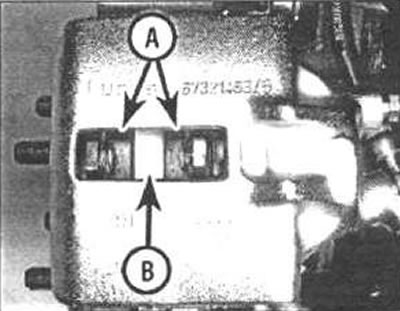
If possible without disassembling, check the brake pad wear and the condition of the disc. Make sure there is no excessive wear on the rubbing surfaces (A) and that the discs are free of cracks, chips, pitting, or other damage (B).
Check the condition of all metal brake pipes under the vehicle and the condition of flexible hoses. Look for corrosion, abrasions, or unreliable fastening of pipes, as well as swelling, abrasions, or signs of corrosion of flexible hoses.
Check for signs of brake fluid leakage on the caliper and rear wall of the brake. Restore or replace worn parts.
Slowly rotate each wheel while your assistant presses and releases the brake pedal. Make sure each brake is braking the wheel and does not rub when the pedal is released.
Check the handbrake drive, make sure there are no abrasions or breaks in the cables, excessive corrosion, wear and unreliability of the fasteners. Check the braking of each wheel and make sure that when releasing the brake, the wheel rotates freely, without jamming.
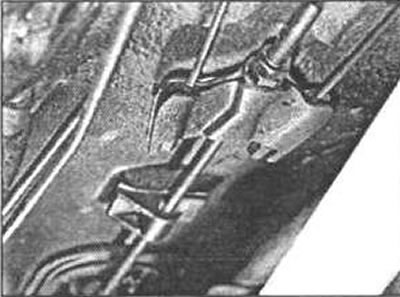
The effectiveness of the brakes cannot be checked without special equipment, but later you can test the brakes on the road, and you need to check whether the car skids when braking.
Inspect the fuel tank (including cover), fuel lines, hoses and connections (nipples). All components must be in good working order and show no signs of leakage.
Inspect the entire length of the exhaust system to ensure there is no damage, broken or deformed parts, rust or corrosion.
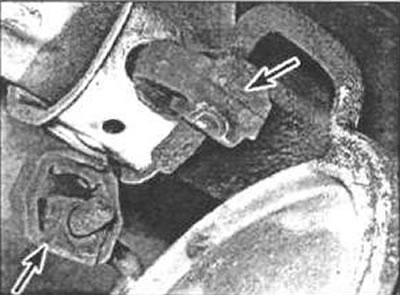
Inspect the sidewalls and tread area of each tire. Check for rips, bulges, tread tears, and cord damage. Check to see if the tire valve is correctly positioned on the inside sidewall of the wheel rim, make sure the valve is in good condition, and that the wheel rim is not damaged or deformed.
Make sure that the tires are the correct size for the vehicle, that each axle has the same type and size tires, and that the tire pressures are correct.
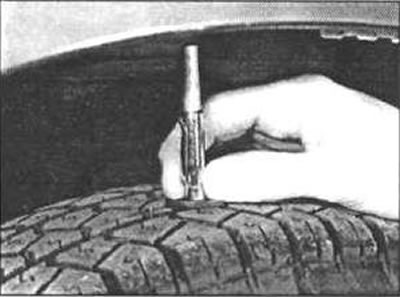
Check the depth of the tire tread pattern. The minimum depth-1.6 mm-must be at least 3/4 of the tread width. Incorrect tread wear may indicate that the front wheels are not properly installed.
Check the condition of the car body and make sure there are no signs of corrosion, especially in areas that bear loads (chassis side members and box-shaped parts, sills, cross members, pillars and the entire suspension, steering, braking system, safety belt fastenings, etc.). Any corrosion that seriously reduces the thickness of the metal in the loaded area can cause an accident. In such cases, it is necessary to repair the body by contacting a professional.
Damage or corrosion that results in sharp edges appearing on the body may be grounds for declaring the vehicle unfit for use.
Original publication posted on the website: «BMWMan»
Steering gear
Have an assistant turn the steering wheel from lock to lock. Check the smoothness of the steering mechanism parts and make sure that no parts of the mechanism, including the wheel or tire, are touching the brake hoses or any parts of the body.
Check for damage to rubber boots and secure clamps. If power steering is installed, check for damage or leaks from hoses, pipes or connections. Check for excessively tight or binding steering, missing cotter pins or other fasteners, or severe body corrosion within 30 cm of any steering component mounting point.
Front and rear suspension and wheel bearings
Starting at the front right side, grasp the wheel at the 3 o'clock and 9 o'clock positions and vigorously rock it horizontally. Check for play in the wheel bearings, ball joints, and suspension and steering mounts.
Now grab the wheel at the 12 o'clock and 8 o'clock positions and repeat the previous check. Spin the wheel and check the condition of its bearings.
If a connection is suspected of having play, this suspicion can be confirmed by pressing a large screwdriver or similar tool between the suspected connection and the housing. This will make it clear where the wear has occurred: in the connection sleeve, the mounting bolts or in the support (bolt holes are often lengthened).
Perform the full set of tests on the other front wheel and then on both rear wheels.
Springs and shock absorbers
Inspect the suspension struts for leaks, corrosion, or damage to the housing. Check the tightness of all mounting points.
If spring springs are installed, check the position of the outer coils of the suspension springs in their supports, as well as the absence of breakages and damage to the springs.
If leaf springs are installed, make sure that the leaves are not damaged, the springs are securely fastened to the axle supports, and that the spring fastening elements to the body are not damaged.
The same general inspection principles apply to vehicles with other types of suspension, such as torsion bar, hydraulic, etc. Make sure all fasteners are secure, there are no signs of excessive wear, corrosion or damage, and in hydraulic type suspensions there are no leaks or damage to the tubes and their connections.
Inspect the shock absorbers and make sure there are no serious leaks. Check the bushings and fasteners for wear, and make sure there is no damage to the housings.
Drive shafts
Rotate each rear wheel in turn and inspect the constant velocity joint boots. Also make sure the drive shafts are not bent or damaged.
Brake system
If possible without disassembling, check the brake pad wear and the condition of the disc. Make sure there is no excessive wear on the rubbing surfaces (A) and that the discs are free of cracks, chips, pitting, or other damage (B).
Check the condition of all metal brake pipes under the vehicle and the condition of flexible hoses. Look for corrosion, abrasions, or unreliable fastening of pipes, as well as swelling, abrasions, or signs of corrosion of flexible hoses.
Check for signs of brake fluid leakage on the caliper and rear wall of the brake. Restore or replace worn parts.
Slowly rotate each wheel while your assistant presses and releases the brake pedal. Make sure each brake is braking the wheel and does not rub when the pedal is released.
Check the handbrake drive, make sure there are no abrasions or breaks in the cables, excessive corrosion, wear and unreliability of the fasteners. Check the braking of each wheel and make sure that when releasing the brake, the wheel rotates freely, without jamming.
The effectiveness of the brakes cannot be checked without special equipment, but later you can test the brakes on the road, and you need to check whether the car skids when braking.
Fuel and exhaust system
Inspect the fuel tank (including cover), fuel lines, hoses and connections (nipples). All components must be in good working order and show no signs of leakage.
Inspect the entire length of the exhaust system to ensure there is no damage, broken or deformed parts, rust or corrosion.
Wheels and tires
Inspect the sidewalls and tread area of each tire. Check for rips, bulges, tread tears, and cord damage. Check to see if the tire valve is correctly positioned on the inside sidewall of the wheel rim, make sure the valve is in good condition, and that the wheel rim is not damaged or deformed.
Make sure that the tires are the correct size for the vehicle, that each axle has the same type and size tires, and that the tire pressures are correct.
Check the depth of the tire tread pattern. The minimum depth-1.6 mm-must be at least 3/4 of the tread width. Incorrect tread wear may indicate that the front wheels are not properly installed.
Body corrosion
Check the condition of the car body and make sure there are no signs of corrosion, especially in areas that bear loads (chassis side members and box-shaped parts, sills, cross members, pillars and the entire suspension, steering, braking system, safety belt fastenings, etc.). Any corrosion that seriously reduces the thickness of the metal in the loaded area can cause an accident. In such cases, it is necessary to repair the body by contacting a professional.
Damage or corrosion that results in sharp edges appearing on the body may be grounds for declaring the vehicle unfit for use.
Original publication posted on the website: «BMWMan»
This article is available at russian, bulgarian, belarusian, ukrainian, serbian, croatian, romanian, polish, slovak, hungarian
Article verified: Ilyinsky Matvey
Share information:
Previous articles
БМВ E46: Manual
Next articles
Similar articles on other types of BMW cars:
Vehicle Passport Data BMW 5 Series E12 (1972-1981)
Vehicle identification BMW 5 Series E34 (1988-1996)
Repair operations performed without removing the engine from the… BMW 7 Series E32 (1986-1994)
Troubleshooting — General Information and Preliminary Checks BMW 7 Series E38 (1994-2001)
Daily checks and troubleshooting BMW X3 E83 (2003-2010)
Wheels and tires BMW X5 E53 (1999-2006)
Vehicle Passport Data BMW 5 Series E12 (1972-1981)
Vehicle identification BMW 5 Series E34 (1988-1996)
Repair operations performed without removing the engine from the… BMW 7 Series E32 (1986-1994)
Troubleshooting — General Information and Preliminary Checks BMW 7 Series E38 (1994-2001)
Daily checks and troubleshooting BMW X3 E83 (2003-2010)
Wheels and tires BMW X5 E53 (1999-2006)
Link in different formats to this page
Visitor comments
No comments yet
- General information
- Manual
- Maintenance
- Power unit
- Engine repair
- Cooling system
- Power system (gasoline)
- Injection system (gasoline)
- Fuel system (diesel)
- Exhaust system
- Ignition system
- Charge and launch systems
- Transmission
- Car gearbox
- Clutch and drive shafts
- Chassis
- Brake system
- Suspension front and rear
- Steering
- Body
- Body care and repair
- Exterior
- Interior
- Electrical equipment
- Troubleshooting
- Lighting and signaling
- Equipment and devices
- Heater and air conditioner
- Electrical circuits
- General information
- Manual
- Repair on the road
- Weekly checks
- Maintenance
- Troubleshooting
- Power unit
- 4 cylinder engines
- 6 cylinder engines
- Engine overhaul
- Cooling and heating
- Fuel and exhaust system
- Starting and charging system
- Ignition system
- Transmission
- Clutch
- Mechanical gearbox
- Automatic gearbox
- Cardan and drive shafts
- Chassis
- Brake system
- Wheel suspension
- Steering
- Body
- Exterior
- Interior
- Electrical equipment
- Equipment and devices
- Electrical circuits
- General information
- Maintenance
- Power unit
- Engine repair
- Cooling system
- Ignition system
- Supply system
- Fuel injection system
- Exhaust system
- Transmission
- Clutch
- Car gearbox
- Front and rear axle
- Chassis
- Steering
- Brake system
- Body
- Exterior
- Interior
- Electrical equipment
- Heating system
- Equipment and devices
- Power devices
- Electrical circuits
- Power unit
- M10/M20 engine
- M40 engine
- Ignition system
- Lubrication system
- Cooling system
- Supply system
- Fuel injection
- Exhaust system
- Transmission
- Clutch
- Manual gearbox
- Front axle
- Rear axle
- Chassis
- Steering
- Brake system
- Body
- Exterior
- Interior
- Electrical equipment
- Heating system
- Equipment and devices
- Electrical circuits
- General information
- Specifications
- Operation and maintenance
- 4-cylinder engine
- Engine repair
- Cooling and lubrication system
- Supply system
- Ignition system
- 6-cylinder engine
- Engine repair
- Cooling and lubrication system
- Supply system
- Fuel injection system
- Ignition system
- Transmission
- Clutch
- 4-speed manual gearbox
- 5-speed manual gearbox
- Automatic gearbox
- Cardan and rear axle
- Chassis
- Steering
- Front suspension
- Rear suspension
- Brake system
- Electrical equipment
- Equipment and devices
- Electrical circuits