
Table of contents: Wheel alignment / kingpin camber and…↓ Prerequisites for verification ↓
- Home
- BMW 5 Series
- E39
- Chassis
- Steering
- Definition of chassis parameters
Definition of chassis parameters (BMW 5 Series E39)
Optimum driving dynamics and minimal wear can only be achieved with perfect wheel alignment. If the tires are worn abnormally, or if the driving stability is unsatisfactory - with poor stabilization when driving straight ahead and poor steering qualities when turning - you should contact a workshop for an optical determination of the chassis parameters.
The measurement of the chassis can only be performed using the appropriate measuring device. Therefore, I limit myself here to a description of the main parameters determined during the measurement.
Wheel alignment is the difference in distances measured in front and behind the steered wheels at the height of their rotation axis from the road. With positive wheel alignment, the distance between the wheels in front is less than the distance behind. With negative wheel alignment, on the contrary, the distance between the wheels will be less behind.
Overall positive wheel alignment 0°5'± 10'.
Wheel camber and kingpin inclination reduce the transmission of shock loads from the road to the steering and maintain a minimum friction moment between the wheels and the road when turning.
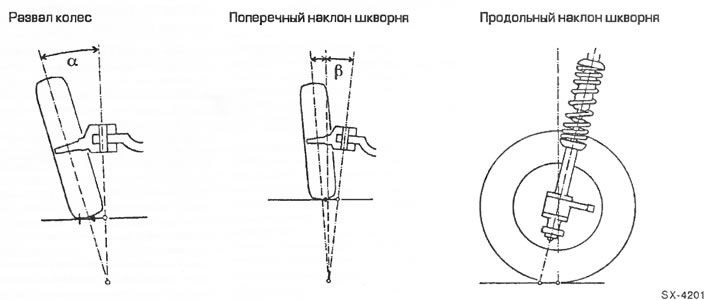
The camber of the wheels is characterized by the angle of inclination of the plane of the front wheel relative to the vertical plane (the figure shows a positive camber with a wheel plane tilt of angle α). BMW cars have a negative camber angle.
The transverse inclination of the kingpin is characterized by the angle p between the kingpin axis and the vertical passing through the point of contact of the tire with the road, when looking in the direction of vehicle travel.
The camber angle and the kingpin angle have a combined effect on the so-called rolling shoulder - the distance between the center of the supporting surface of the tire of the steered wheel and the point of intersection of the kingpin axis with the road. The greater the kingpin angle and the camber angle, the smaller the rolling shoulder. This ensures easy steering and significantly reduces the impact of impact loads from the road surface on the steering rods.
The longitudinal inclination of the kingpin is characterized by the angle between the axis of the kingpin and the vertical passing through the point of contact of the tire with the road, when looking in the direction perpendicular to the direction of the vehicle's movement. The longitudinal inclination of the kingpin has a proportionate effect on the straightness of the movement of the front wheels. A slight longitudinal inclination of the kingpin causes a deviation from straight-line movement on a bad road or in a crosswind and also forces the steering to not be completely returned to the neutral position after a turn.
The measurement of the chassis can only be performed using the appropriate measuring device. Therefore, I limit myself here to a description of the main parameters determined during the measurement.
Wheel alignment / kingpin camber and caster
Wheel alignment is the difference in distances measured in front and behind the steered wheels at the height of their rotation axis from the road. With positive wheel alignment, the distance between the wheels in front is less than the distance behind. With negative wheel alignment, on the contrary, the distance between the wheels will be less behind.
Overall positive wheel alignment 0°5'± 10'.
Wheel camber and kingpin inclination reduce the transmission of shock loads from the road to the steering and maintain a minimum friction moment between the wheels and the road when turning.
The camber of the wheels is characterized by the angle of inclination of the plane of the front wheel relative to the vertical plane (the figure shows a positive camber with a wheel plane tilt of angle α). BMW cars have a negative camber angle.
The transverse inclination of the kingpin is characterized by the angle p between the kingpin axis and the vertical passing through the point of contact of the tire with the road, when looking in the direction of vehicle travel.
The camber angle and the kingpin angle have a combined effect on the so-called rolling shoulder - the distance between the center of the supporting surface of the tire of the steered wheel and the point of intersection of the kingpin axis with the road. The greater the kingpin angle and the camber angle, the smaller the rolling shoulder. This ensures easy steering and significantly reduces the impact of impact loads from the road surface on the steering rods.
The longitudinal inclination of the kingpin is characterized by the angle between the axis of the kingpin and the vertical passing through the point of contact of the tire with the road, when looking in the direction perpendicular to the direction of the vehicle's movement. The longitudinal inclination of the kingpin has a proportionate effect on the straightness of the movement of the front wheels. A slight longitudinal inclination of the kingpin causes a deviation from straight-line movement on a bad road or in a crosswind and also forces the steering to not be completely returned to the neutral position after a turn.
Prerequisites for verification
- Steering in straight-ahead position.
- The tire pressure is within the specified value.
- Car in normal condition: 2 x 68 kg front, 1 x 68 kg rear middle, 1 x 21 kg in the center of the luggage compartment and a fully filled fuel tank.
- The vehicle's suspensions are pre-deformed in a highly elastic manner.
- The steering is adjusted correctly.
- No unacceptable gaps in the steering rods.
- No unacceptable gaps in the wheel suspensions.
- The car's stance is correct.
This article is available at russian, bulgarian, belarusian, ukrainian, serbian, croatian, romanian, polish, slovak, hungarian
Article verified: Ilyinsky Matvey
Share information:
Previous articles
БМВ E39: Steering
Next articles
Similar articles on other types of BMW cars:
Geometrical parameters of the chassis BMW 7 Series E32 (1986-1994)
Electrical diagram of the input parameters of the mixture/ignition… BMW X5 E53 (1999-2006)
Geometrical parameters of the chassis BMW 7 Series E32 (1986-1994)
Electrical diagram of the input parameters of the mixture/ignition… BMW X5 E53 (1999-2006)
Link in different formats to this page
Visitor comments
No comments yet
- General information
- Governing bodies
- Manual
- Maintenance
- Power unit
- Engine repair
- Lubrication system
- Cooling system
- Ignition system
- Supply system
- Injection system (gasoline)
- Injection system (diesel)
- Exhaust system
- Transmission
- Clutch
- Car gearbox
- Front axle
- Rear axle
- Chassis
- Steering
- Brake system
- Wheels and tires
- Body
- Interior
- Exterior
- Heating system
- Electrical equipment
- Equipment and devices
- Power devices
- Windscreen wipers
- Electrical circuits
- General information
- Manual
- Maintenance
- Power unit
- Engine repair
- Ignition system
- Engine lubrication system
- Cooling system
- Fuel system (gasoline)
- Fuel system (diesel)
- Exhaust system
- Transmission
- Clutch
- Car gearbox
- Chassis
- Front and rear suspension
- Steering
- Brake system
- Body
- Exterior
- Interior
- Electrical equipment
- Heating system
- Equipment and devices
- Power devices
- Electrical circuits
- General information
- Manual
- Maintenance
- Power unit
- Engine in a car
- Engine overhaul
- Cooling system
- Supply system
- Ignition system
- Control system
- Transmission
- Clutch
- Manual gearbox
- Automatic gearbox
- Transmission line
- Chassis
- Steering
- Front suspension
- Rear suspension
- Brake system
- Body
- Body elements
- Car care and painting
- Electrical equipment
- Heater and air conditioner
- Equipment and devices
- Starter and generator
- Electrical circuits
- General information
- Operation and maintenance
- Specifications
- Power unit
- Engine repair
- Cooling and lubrication system
- Supply system
- Ecotronic power supply system
- Fuel injection system
- Ignition system
- Transmission
- Clutch
- Gearbox BMW 242/4
- Gearbox Getrag 262/8
- Gearbox Getrag 265/6
- Automatic gearbox
- Cardan gear
- Rear axle
- Chassis
- Steering
- Front suspension
- Rear suspension
- Brake system
- Electrical equipment
- Equipment and devices
- Electrical circuits