
- quality of road surface
- tire inflation pressure
- driving style
- weather conditions
First of all, sporty driving style, quick starting and sharp braking contribute to rapid wear of tires.
Note: In fairness, it should be said that the tread pattern height can decrease to 1.6 mm when worn, namely the depth of the tread pattern grooves across the entire working surface should still be at least 1.6 mm. However, for safety reasons, it is recommended to replace tires when the tread pattern height is 2 mm.
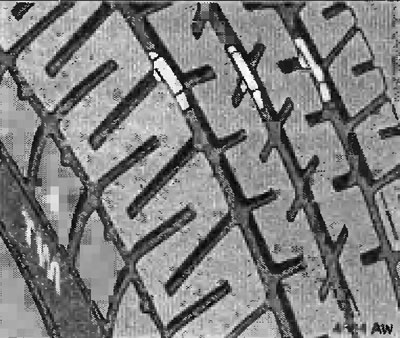
If the tread depth approaches the minimum permissible value, and the prescribed wear value of 1.6 mm is exceeded in many places around the tire perimeter and the pattern is no longer there, this means that such tires must be replaced immediately. Tire wear level indicators are applied along the entire perimeter of the sidewall. The corresponding positions are marked with the inscription TWI (TWI is a wear level indicator) and the symbol A.
Please note: Tyres with a winter tread pattern marked M+S have sufficient impact on mud and snow only if the tread depth is at least 4 mm.
Attention: Check the tires for cuts. If cuts are found, determine their depth using a small screwdriver. If the depth of the cut reaches the carcass, the steel cord of the tire is corroded due to water penetration. Under such circumstances, the working surface lags behind the carcass, the tire begins to crack. Therefore, if the tread is deeply cut, the tire must be replaced for safety reasons.
Tighten all wheel bolts crosswise to 100 Nm. Do not lubricate wheel bolts.