



- Home
- BMW 3 Series
- E21
- 6-cylinder engine
- Engine repair
- Characteristics of the crank mechanism
Characteristics of the crank mechanism (BMW 3 Series E21)
Pistons
The pistons are cast from aluminum alloy. Depending on the car model, the piston bottoms can be flat (on the "323i") or convex with a height of 2.1 mm (on the "320i").
Piston brand: Mahle or Karl Schmidt (KS).
The engine type is marked on the piston bottom (2.0 or 2.3), compression ratio (9.2 or 9.5), piston diameter class, piston group by weight ("+" or "-"). The arrow on the piston bottom shows how to correctly orient the piston when installing it in the cylinder.
Piston diameter, mm:
- normal: 79.98±0.009;
- intermediate size: 80.06±0.009;
- 1st repair size (increased by 0.25): 80,23±0,009;
- 2nd repair size (increased by 0.50): 80,48±0,009.
Clearance between piston and cylinder, mm: 0.035—0.040.
Difference in mass of assembled pistons, g, no more than: 10.
Piston pin hole diameter, mm: 22+0,0040
Offset of the axis of the hole for the piston pin in the piston bosses (for "320"), mm: 0.7.
Piston pins
The piston pin is made of steel and is ground. The pin rotates freely in the upper head of the connecting rod and in the piston bosses. It is held from axial displacement by retaining rings.
Piston pin outer diameter, mm: 22-0,0040
Clearance between piston pin and piston, mm:
- for Mahle brand pistons: 0.001-0.005;
- for KS brand pistons: 0.002-0.006.
Piston rings
Three grooves for installing rings are machined on the outer surface of the piston. The rings are installed with the TOR mark ("Top") toward the bottom of the cylinder. The upper compression ring is made of cast iron with spherical graphite inclusions, with a chrome-plated outer surface. Oil scraper ring with a spacer spring.
Characteristics of piston rings
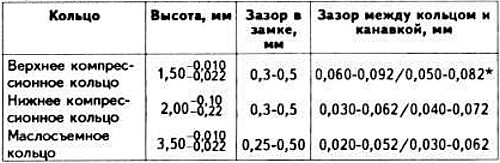
* The numerator shows the values for Mahle brand pistons, the denominator shows the values for KS brand pistons.
Connecting rods
The connecting rod is steel, forged, with replaceable trimetallic liners.
Distance between the axes of the connecting rod head holes, mm: 130±0.1.
Hole diameter, mm:
- lower connecting rod head: 48+0,01+0
- upper connecting rod head: 24+0,021+0
Connecting rod upper head bushing diameter, mm:
- external: 24.060—24.100;
- internal: 22+0,010+0,005
Misalignment of connecting rod head holes when measured at a distance of 150 mm from the connecting rod rod, mm, no more than: 0.04.
Maximum permissible longitudinal bending of the connecting rod: 0°30'.
Difference in weight between connecting rods, g, no more than: +4.
Connecting rod bearing shells
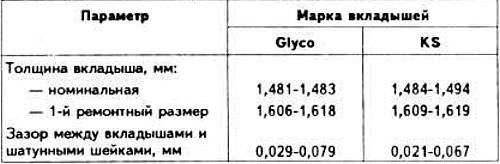
Connecting rod bearing liners are thin-walled, trimetallic, Glyco or KS grade.
Characteristics of connecting rod bearing shells
Crankshaft
The crankshaft is cast from steel. The shaft is seven-support, with 12 counterweights and tri-metallic main bearings. The engines can be equipped with a crankshaft with a red or blue index.
Crankshaft characteristics
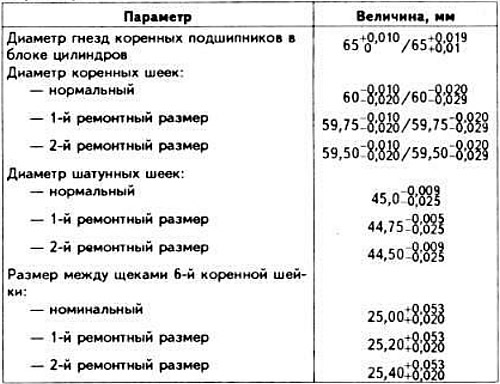
* The numerator shows the values for the crankshaft with a red index, the denominator shows the values for the crankshaft with a blue index.
Permissible crankshaft imbalance, gf cm, no more than: 25.
Crankshaft axial clearance, mm: 0.080—0.163.
Permissible runout of the middle main journal when supported by the outer main journals, mm, no more than: 0.15.
Crankshaft main bearing shells
The main bearing shells are trimetallic, with radial holes for oil passage.
Characteristics of main bearing shells
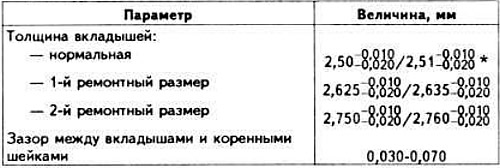
* The numerator shows the values for the crankshaft with a red index, the denominator shows the values for the crankshaft with a blue index.
Flywheel
The flywheel is mounted on the crankshaft on a flange and is secured with eight bolts, and due to the presence of a centering pin, the flywheel can only be installed in one position.
The flywheel is dynamically balanced, the permissible imbalance should be no more than 15 gf cm.
Flywheel runout when measured at a point on a diameter of 90 mm for vehicles with a manual transmission and on a diameter of 93 mm for vehicles with an automatic transmission, mm, no more than: 0.02.
Flywheel runout when measured at a point on a diameter of 233 mm, mm: 0.1.
Maximum thickness of the metal layer removed when grinding the flywheel surface under the driven clutch disc, mm: 0.4+0.1.
Thickness of flywheel surface under clutch driven disk, mm, not less than: 13.5.
Torsional vibration damper
Pulley diameter, mm: 146.
Imbalance at crankshaft speed of 1000 rpm, gf cm, no more than: 8.
Radial runout when measured at a point on a diameter of 200 mm (for "320") and on a diameter of 235 mm (for "323i"), mm, no more than: 0.2.
End runout when measured at a point on a diameter of 200 mm (for "320") and on a diameter of 235 mm (for "323i"), mm, no more than: 0.3.
This article is available at russian, bulgarian, belarusian, ukrainian, serbian, croatian, romanian, polish, slovak, hungarian
Article verified: Polikarpov Saveliy
Share information:
Previous articles
БМВ E21: Engine repair
Next articles
Similar articles on other types of BMW cars:
Crank mechanism parts BMW 5 Series E12 (1972-1981)
Power steering rack and pinion mechanism BMW 7 Series E32 (1986-1994)
Replacing the AT mode switching mechanism bracket BMW 7 Series E38 (1994-2001)
Gas distribution mechanism BMW X3 E83 (2003-2010)
Crank mechanism — description of the design BMW X5 E53 (1999-2006)
Crank mechanism parts BMW 5 Series E12 (1972-1981)
Power steering rack and pinion mechanism BMW 7 Series E32 (1986-1994)
Replacing the AT mode switching mechanism bracket BMW 7 Series E38 (1994-2001)
Gas distribution mechanism BMW X3 E83 (2003-2010)
Crank mechanism — description of the design BMW X5 E53 (1999-2006)
Link in different formats to this page
Visitor comments
No comments yet
- General information
- Manual
- Maintenance
- Power unit
- Engine repair
- Cooling system
- Power system (gasoline)
- Injection system (gasoline)
- Fuel system (diesel)
- Exhaust system
- Ignition system
- Charge and launch systems
- Transmission
- Car gearbox
- Clutch and drive shafts
- Chassis
- Brake system
- Suspension front and rear
- Steering
- Body
- Body care and repair
- Exterior
- Interior
- Electrical equipment
- Troubleshooting
- Lighting and signaling
- Equipment and devices
- Heater and air conditioner
- Electrical circuits
- General information
- Manual
- Repair on the road
- Weekly checks
- Maintenance
- Troubleshooting
- Power unit
- 4 cylinder engines
- 6 cylinder engines
- Engine overhaul
- Cooling and heating
- Fuel and exhaust system
- Starting and charging system
- Ignition system
- Transmission
- Clutch
- Mechanical gearbox
- Automatic gearbox
- Cardan and drive shafts
- Chassis
- Brake system
- Wheel suspension
- Steering
- Body
- Exterior
- Interior
- Electrical equipment
- Equipment and devices
- Electrical circuits
- General information
- Maintenance
- Power unit
- Engine repair
- Cooling system
- Ignition system
- Supply system
- Fuel injection system
- Exhaust system
- Transmission
- Clutch
- Car gearbox
- Front and rear axle
- Chassis
- Steering
- Brake system
- Body
- Exterior
- Interior
- Electrical equipment
- Heating system
- Equipment and devices
- Power devices
- Electrical circuits
- Power unit
- M10/M20 engine
- M40 engine
- Ignition system
- Lubrication system
- Cooling system
- Supply system
- Fuel injection
- Exhaust system
- Transmission
- Clutch
- Manual gearbox
- Front axle
- Rear axle
- Chassis
- Steering
- Brake system
- Body
- Exterior
- Interior
- Electrical equipment
- Heating system
- Equipment and devices
- Electrical circuits
- General information
- Specifications
- Operation and maintenance
- 4-cylinder engine
- Engine repair
- Cooling and lubrication system
- Supply system
- Ignition system
- 6-cylinder engine
- Engine repair
- Cooling and lubrication system
- Supply system
- Fuel injection system
- Ignition system
- Transmission
- Clutch
- 4-speed manual gearbox
- 5-speed manual gearbox
- Automatic gearbox
- Cardan and rear axle
- Chassis
- Steering
- Front suspension
- Rear suspension
- Brake system
- Electrical equipment
- Equipment and devices
- Electrical circuits