
Cars Mazda Cars Mitsubishi Cars Toyota Cars Chevrolet Cars AvtoVAZ Cars Kia Cars Nissan
English Русский
Български
Беларускі
Український
Српски
Hrvatski
Română
Polski
Slovenský
Magyar
| Articles | Contacts | Sitemap |   
BMWman.ru


3 series   5 series   7 series   BMW X3   BMW X5   BMW X6

E46 (1998-2006) E46 (1998-2006, petrol) E36 (1990-2000) E30 (1982-1994) E21 (1975-1983)
  • Home
  • BMW 3 Series
  • E46
  • Chassis
  • Steering
  • Front Wheel Alignment Checking the Wheel Alignment

Front Wheel Alignment Checking the Wheel Alignment (BMW 3 Series E46)

            0

Wheel alignment angles have a significant impact on vehicle stability, tire wear, and fuel consumption. The following wheel alignment angles are distinguished:

Collapse – is the tilt of the wheel in the vertical plane relative to the center line of the car. It can be positive if the wheels are tilted outward or negative if the wheels are tilted inward. The camber angle mainly affects the uniformity of wear of the front tires. If the camber of one wheel is positive and the other is negative, the car will pull to the side when driving straight.

Convergence – the difference in distance between the front and rear edges of the wheels. Positive toe-in means that the front wheels are closer together than the rear wheels when measured at the height of the midpoint of the wheel. Negative toe-in means that the front wheels are further apart than the rear wheels.

Lateral tilt of the wheel pivot axis – this is the angle between the axis of inclination of the steering knuckle and the vertical drawn through the wheel attachment point, looking in the longitudinal direction of the car.

Due to the camber angles and the transverse tilt of the steering axis, the points of contact of the wheels with the road are located closer to the axis of the steering knuckle. This supports the so-called "rolling shoulder", the easier it is to control the car. Also, impacts from uneven surfaces are less transmitted to the steering.

The longitudinal tilt angle of the pivot axis. The axis around which the wheel turns is placed in space so that its lower part is directed forward. Such an angle of longitudinal inclination is called positive. With a positive angle, the self-return of the wheel to the middle position after turning is improved.


Adjusting the toe-in


1. Set the front wheels straight. There are markings on the steering shaft and steering gear housing. Set the steering so that these markings match.
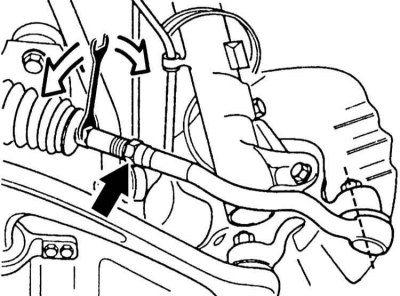
1. Set the front wheels straight. There are markings on the steering shaft and steering gear…


2. Loosen the clamp nut on each steering rod (arrow on the illustration). Adjust the toe-in by rotating the left and right steering rods. In doing so, turn the left and right steering rods by the hexagon by the same amount. Make sure that the ball joints and boots do not twist when adjusting.

3. After completing the toe-in adjustment, tighten the clamp bolts on the steering rods to a torque of 80 N·m.

[The original article is available on the website BMWMAN]

This article is available at russian, bulgarian, belarusian, ukrainian, serbian, croatian, romanian, polish, slovak, hungarian
Article verified: Sevastyanov Nikolay

Share information:
Previous articles
БМВ E46: Steering
Next articles

Filling with fluid and bleeding air from the hydraulic system of the…
Removal and installation the power steering pump
Removal and installation the steering rod
Removal and installation the steering rod end
Removal and installation the steering wheel


Similar articles on other types of BMW cars:
Checking and adjusting the front wheel alignment angles BMW 5 Series E12 (1972-1981)
Removal and installation, checking of front wheel bearings BMW 5 Series E34 (1988-1996)
Front wheel alignment angles BMW 7 Series E32 (1986-1994)
Car Wheel Alignment Angles — General Information BMW 7 Series E38 (1994-2001)
Checking the wheel alignment angles on the KDS under normal loading BMW X3 E83 (2003-2010)
Adjusting the front wheel alignment angles BMW X5 E53 (1999-2006)
Link in different formats to this page


Visitor comments

No comments yet


How much 48 + 39 =


BMW E46 (1998-2006) 
  • General information
  • Manual
  • Maintenance
  • Power unit
  • Engine repair
  • Cooling system
  • Power system (gasoline)
  • Injection system (gasoline)
  • Fuel system (diesel)
  • Exhaust system
  • Ignition system
  • Charge and launch systems
  • Transmission
  • Car gearbox
  • Clutch and drive shafts
  • Chassis
  • Brake system
  • Suspension front and rear
  • Steering
  • Body
  • Body care and repair
  • Exterior
  • Interior
  • Electrical equipment
  • Troubleshooting
  • Lighting and signaling
  • Equipment and devices
  • Heater and air conditioner
  • Electrical circuits
BMW E46 (1998-2006, petrol) 
  • General information
  • Manual
  • Repair on the road
  • Weekly checks
  • Maintenance
  • Troubleshooting
  • Power unit
  • 4 cylinder engines
  • 6 cylinder engines
  • Engine overhaul
  • Cooling and heating
  • Fuel and exhaust system
  • Starting and charging system
  • Ignition system
  • Transmission
  • Clutch
  • Mechanical gearbox
  • Automatic gearbox
  • Cardan and drive shafts
  • Chassis
  • Brake system
  • Wheel suspension
  • Steering
  • Body
  • Exterior
  • Interior
  • Electrical equipment
  • Equipment and devices
  • Electrical circuits
BMW E36 (1990-2000) 
  • General information
  • Maintenance
  • Power unit
  • Engine repair
  • Cooling system
  • Ignition system
  • Supply system
  • Fuel injection system
  • Exhaust system
  • Transmission
  • Clutch
  • Car gearbox
  • Front and rear axle
  • Chassis
  • Steering
  • Brake system
  • Body
  • Exterior
  • Interior
  • Electrical equipment
  • Heating system
  • Equipment and devices
  • Power devices
  • Electrical circuits
BMW E30 (1982-1994) 
  • Power unit
  • M10/M20 engine
  • M40 engine
  • Ignition system
  • Lubrication system
  • Cooling system
  • Supply system
  • Fuel injection
  • Exhaust system
  • Transmission
  • Clutch
  • Manual gearbox
  • Front axle
  • Rear axle
  • Chassis
  • Steering
  • Brake system
  • Body
  • Exterior
  • Interior
  • Electrical equipment
  • Heating system
  • Equipment and devices
  • Electrical circuits
BMW E21 (1975-1983) 
  • General information
  • Specifications
  • Operation and maintenance
  • 4-cylinder engine
  • Engine repair
  • Cooling and lubrication system
  • Supply system
  • Ignition system
  • 6-cylinder engine
  • Engine repair
  • Cooling and lubrication system
  • Supply system
  • Fuel injection system
  • Ignition system
  • Transmission
  • Clutch
  • 4-speed manual gearbox
  • 5-speed manual gearbox
  • Automatic gearbox
  • Cardan and rear axle
  • Chassis
  • Steering
  • Front suspension
  • Rear suspension
  • Brake system
  • Electrical equipment
  • Equipment and devices
  • Electrical circuits
BMWman.ru © 2017-2026 · Mobile version · News and articles · Sitemap: EN BG BY UA RS HR RO PL SK HU · Feedback · Site search
3er E21 · 3er E30 · 3er E36 · 3er E46 [petrol] · 3er E46 · 5er E12 · 5er E28 · 5er E34 · 5er E39 · 7er E32 · 7er E38 · X3 E83 · X5 E53 ·
This site uses cookies 🍪, without them some features simply would not work.