
- Home
- BMW 7 Series
- E38
- Chassis
- Steering
- Car Wheel Alignment Angles — General Information
Car Wheel Alignment Angles — General Information (BMW 7 Series E38)
Only the toe-in of the front wheels can be adjusted.
The geometry of the suspension and its rigidity determine the ability to limit vertical movements of the body and reduce angular oscillations around the transverse and longitudinal axes. The front wheels turn around inclined axes, whose position is determined by the hinges and suspension components of the vehicle. The most important are the following kinematic settings of the wheel assemblies in relation to steering and the transmission of forces between the tires and the road surface. Wheel alignment angles significantly affect vehicle stability, tire wear and fuel consumption. The nominal values of the wheel alignment angles subject to inspection and adjustment for the vehicles considered in this Manual are given in the Specifications at the beginning of Chapter Suspension and steering.
Convergence (convergence) is the projection onto the horizontal plane of the angle between the plane of symmetry of the vehicle and the plane of the wheel assembly passing through the center of the tire of the steering wheel; the difference in distances between the front and rear sides of the wheel rims can also be determined. Toe-in affects the straightness of the vehicle's movement and its controllability, and on front-wheel drive models it compensates for the resulting kinematic changes in the suspension geometry determined by the effect of traction force. At zero toe-in, the distance between the front edges of the wheels is equal to the distance between their rear edges.
Front wheel alignment
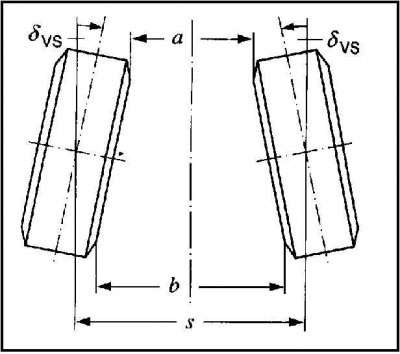
δVS — Wheel alignment angle
a — Distance between the front edges of the wheels
b — Distance between rear edges of wheels
s — Track
b – a — Convergence
Collapse is the angle of the wheel in relation to the road surface in the vertical plane. If the upper part of the wheel is inclined to the axis of symmetry of the car, the camber is called negative, and vice versa. Correct adjustment of the camber determines the size and position of the contact patch of the treads with the road surface and allows to compensate for changes in the geometry of the suspension that occur during turns and when the car is moving on an uneven road surface.
Wheel alignment angles
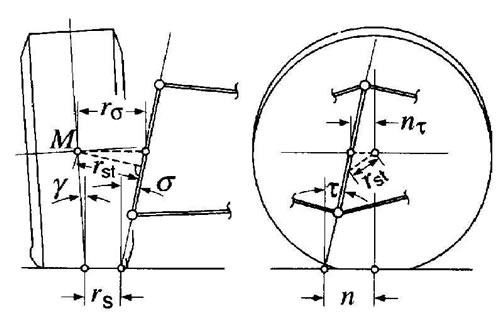
M — Wheel Assembly Center
rst — Kinematic length of the journal
nτ — Longitudinal displacement of the wheel pivot axis
n — Positive stabilization arm
γ — Angle of longitudinal inclination of the wheel rotation axis
rσ — Lateral displacement of the wheel pivot axis
rS — Rolling shoulder
τ — Camber angle
σ — Angle of transverse inclination of the wheel rotation axis
Kinematic length of the journal is the shortest distance between the center of the steering wheel and its axis of rotation.
Shoulder the stabilization moment is the distance between the point of contact of the wheel and the point of intersection of its axis of rotation with the road surface in the side view, which determines the magnitude of the stabilizing moment and affects the directional stability of the car and the distribution of forces in the steering when making turns.
Run-out it's called longitudinal tilt angle of the wheel pivot axis, i.e., the angle between the axis of rotation and the vertical in the side view. Together with the transverse inclination angle of the axis, the coasting affects the change in wheel camber when measuring the steering wheel angle, as well as the stabilizing moment.
Rolling shoulder is defined as the distance between the point of contact of the wheel with the road surface and the point of intersection of its axis of rotation with the road surface in the front view. The shoulder is considered negative when the last of the above-mentioned points is between the center and the top of the wheel. The parameter affects the degree of impact of braking forces on the steering wheel and the magnitude of the stabilizing moment, and a negative shoulder of the rolling increases the latter.
Angle of transverse inclination of the wheel pivot axis is the angle between the axis of rotation of the wheel and the vertical in the plane of the vehicle's cross-section. Along with the coasting and the magnitude of the longitudinal displacement of the axis of rotation, it affects the sensitivity of the steering.
Conditions for checking wheel alignment angles
Checking the vehicle's installation angles requires a specially equipped overpass. Before starting the check, make sure that the following conditions are met:
- The air pressure in the tires corresponds to the nominal;
- The front wheels are mounted in a straight line;
- The car is not loaded, the fuel tank is full;
- The vehicle's suspension elements are forced down;
- The steering gear is adjusted correctly;
- Play in wheel bearings, tie rod ends and suspension ball joints is within acceptable limits;
- The tread depth of tires mounted on wheels of the same axle is the same.
(The original is located on the internet portal: «BMWMAN.ru»)
This article is available at russian, bulgarian, belarusian, ukrainian, serbian, croatian, romanian, polish, slovak, hungarian
Article verified: Polikarpov Saveliy
Share information:
Previous articles
БМВ E38: Steering
Next articles
Similar articles on other types of BMW cars:
Wheel alignment angles — basic information BMW 3 Series E46 (1998-2006, petrol)
Gearbox. General information BMW 3 Series E30 (1982-1994)
General information about setting wheel angles and steering angles BMW 5 Series E28 (1981-1988)
Checking and adjusting the front wheel alignment angles BMW 5 Series E12 (1972-1981)
Checking the wheel alignment angles on the KDS under normal loading BMW X3 E83 (2003-2010)
Adjusting the front wheel alignment angles BMW X5 E53 (1999-2006)
Wheel alignment angles — basic information BMW 3 Series E46 (1998-2006, petrol)
Gearbox. General information BMW 3 Series E30 (1982-1994)
General information about setting wheel angles and steering angles BMW 5 Series E28 (1981-1988)
Checking and adjusting the front wheel alignment angles BMW 5 Series E12 (1972-1981)
Checking the wheel alignment angles on the KDS under normal loading BMW X3 E83 (2003-2010)
Adjusting the front wheel alignment angles BMW X5 E53 (1999-2006)
Link in different formats to this page
Visitor comments
No comments yet
- General information
- Introduction to guide
- Manual
- Maintenance
- Power unit
- Engine M60/1, M60/2 (petrol)
- M62 engine (petrol)
- M57 engine (diesel)
- M67 engine (diesel)
- Cooling system
- Fuel system (petrol)
- Fuel system (diesel)
- Exhaust system
- Ignition and control systems
- Charge and launch systems
- Transmission
- Clutch
- Mechanical gearbox
- Automatic gearbox
- Cardan and drive shafts
- Chassis
- Brake system
- Front suspension
- Rear suspension
- Steering
- Body
- Exterior
- Interior
- Electrical equipment
- Equipment and devices
- Lighting
- Heating and air conditioning
- Electrical circuits
- General information
- Care and maintenance
- Power unit
- Minor engine repair
- Engine overhaul
- Lubrication system
- Cooling system
- Ignition system
- Supply system
- Injection system (petrol)
- Injection system (diesel)
- Exhaust system
- Transmission
- Clutch
- Manual gearbox
- Automatic gearbox
- Cardan gear
- Rear axle and shafts
- Chassis
- Front suspension
- Rear suspension
- Steering
- Wheels and tires
- Brake system
- Body
- Body elements
- Electrical equipment
- Equipment and devices
- Electrical circuits