



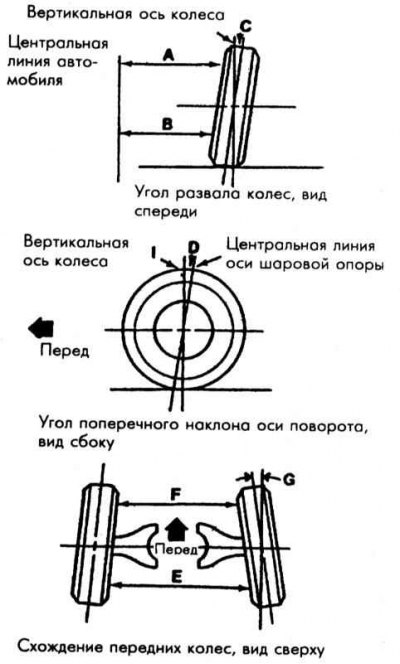
1 - A minus B = C (camber in degrees)
2 - E minus F = wheel alignment (expressed in mm)
3 — G = wheel alignment (expressed in degrees)
Front wheel alignment is an adjustment that is made to the front wheels to ensure that they are at the correct angle to the suspension and the ground. If the front wheel alignment is incorrect, not only will the steering be affected, but it will also increase tire wear. Common measurements for the front wheels include camber, caster angle, and toe (discrepancy) front wheels. Toe-in (discrepancy) front wheel adjustment is adjustable on all models; the lateral tilt angle of the steering axis is not adjustable. The camber of the wheels is adjusted only by replacing the upper support of the suspension strut with a special eccentric model. Toe-in (discrepancy) it can also be adjusted on the rear wheels, but only by replacing the outer bushings of the trailing arm with special eccentric bushings.
Setting the angles of the front wheels is a very precise job that requires complex and expensive equipment to do correctly. Therefore, it is best to call a mechanic with the necessary tools to perform this procedure. However, to help you better understand the process and better interact with the shop performing it, we will give you a basic idea of what it involves.
Convergence angle (discrepancies) - is the inward deviation of the wheels. The purpose of setting a certain angle is to ensure their parallel rotation. If the car has a zero toe angle, the distance between the front edges of the wheels will be equal to the distance between the rear edges of the wheels. The actual value of the toe angle is usually very small. The toe angle of the front wheels is adjusted by the position of the tie rod end relative to the tie rod. The toe angle of the rear wheels can only be adjusted by installing special eccentric bushings on the outer support of the trailing arm. An incorrectly set toe angle will lead to uneven wear of the tires due to them scraping the road surface.
Camber is the deviation of the wheels from the vertical axis when viewed from the front or rear of the vehicle. If the wheels are tilted outward at the top, the camber is called positive (). If the wheels are tilted inward at the top, the camber is called negative (-). The amount of deviation is measured in degrees from the vertical line and is called the camber angle. This angle affects the number of treads that touch the road and is compensated for by changes in suspension geometry when the vehicle turns or travels over rough roads.
Caster Angle is the offset of the front kingpin axis from the vertical. An offset at the top rearward is a positive caster angle, while an offset at the top forward is a negative caster angle. This angle is not adjustable on the vehicles covered by this manual.