
Cars Mazda Cars Mitsubishi Cars Toyota Cars Chevrolet Cars AvtoVAZ Cars Kia Cars Nissan
English Русский
Български
Беларускі
Український
Српски
Hrvatski
Română
Polski
Slovenský
Magyar
| Articles | Contacts | Sitemap |   
BMWman.ru


3 series   5 series   7 series   BMW X3   BMW X5   BMW X6

E39 (1995-2003) E34 (1988-1996) E28 (1981-1988) E12 (1972-1981)
  • Home
  • BMW 5 Series
  • E34
  • Chassis
  • Brake system
  • Checking the thickness of brake discs

Checking the thickness of brake discs (BMW 5 Series E34)

            0

Checking the thickness of brake discs


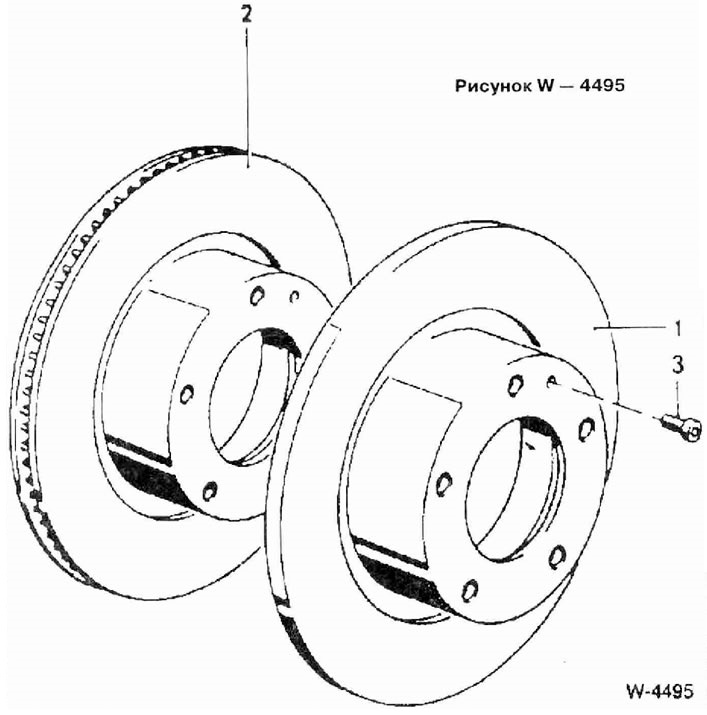
Note: Vehicles with diesel engines and model 5201 have massive brake discs 1. All models with more powerful engines have thicker brake discs 2 with internal blowing, which have better heat dissipation.


Remove the decorative wheel cap.

Mark the position of the wheel rims on the rear wheel hubs with paint. This will ensure that the balanced wheel is subsequently installed in the same position.

Loosen the wheel bolts of the corresponding rear wheel. The vehicle must still be on the ground.

Raise the car and remove the wheel.
Raise the car and remove the wheel.


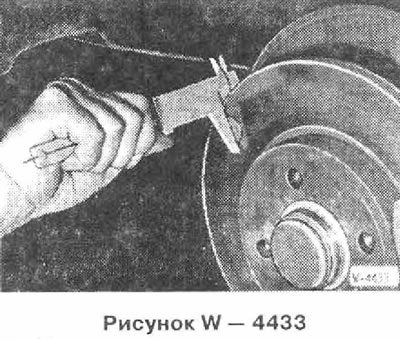
Measure the thickness of the brake discs. At service stations, a special template or micrometer-bracket is used for this, since when worn, a protrusion forms on the edge of the disc. You can also measure the thickness of the disc with a regular caliper, but you should place pads of a known thickness under its cheeks, for example, 2 coins of 10 pfennigs. To obtain the true result, you should subtract 3.3 mm of the thickness of the two coins from the measured value.


Note: Take several measurements around the circumference of the disc.


Table 1. Front brake discs

Table 1. Front brake discs

1) M5, 540i, 525iX: new 28.0mm; wear limit 26.4 mm.

The rear brake discs have the same thickness of 10.0 mm on all cars. The wear limit is reached at a thickness of 8.0 mm.

When the wear limit is reached, the brake disc must be replaced. The wear limit is 0.4 mm less than the minimum thickness allowed when machining the disc. The maximum allowable runout of the surface of the removed disc is 0.05 mm.

If there are significant scratches or grooves deeper than 0.5 mm, replace the brake discs.

Information taken from this resource: «BMWMAN.ru»

This article is available at russian, bulgarian, belarusian, ukrainian, serbian, croatian, romanian, polish, slovak, hungarian
Article verified: Polikarpov Saveliy

Share information:
Previous articles
БМВ E34: Brake system
Next articles

Removal and installation the rear wheel brake disc
Removal and installation rear brake calipers
Removal and installation rear brake pads
Removal and installation front brake discs and brake calipers
Removal and installation front brake pads
Eliminating disc brake squeaks
Brake fluid
Bleeding the brake system
Replacing brake pipes/brake hoses
Checking the power steering


Similar articles on other types of BMW cars:
Checking the thickness of brake discs BMW 3 Series E30 (1982-1994)
Checking the thickness of brake discs BMW 3 Series E36 (1990-2000)
Checking the thickness of the driven clutch disc BMW 7 Series E32 (1986-1994)
Checking the brake system and clutch BMW 7 Series E38 (1994-2001)
Front brake discs BMW X3 E83 (2003-2010)
Checking the thickness of the brake disc BMW X5 E53 (1999-2006)
Link in different formats to this page


Visitor comments

No comments yet


How much 36 + 26 =


BMW E39 (1995-2003) 
  • General information
  • Governing bodies
  • Manual
  • Maintenance
  • Power unit
  • Engine repair
  • Lubrication system
  • Cooling system
  • Ignition system
  • Supply system
  • Injection system (gasoline)
  • Injection system (diesel)
  • Exhaust system
  • Transmission
  • Clutch
  • Car gearbox
  • Front axle
  • Rear axle
  • Chassis
  • Steering
  • Brake system
  • Wheels and tires
  • Body
  • Interior
  • Exterior
  • Heating system
  • Electrical equipment
  • Equipment and devices
  • Power devices
  • Windscreen wipers
  • Electrical circuits
BMW E34 (1988-1996) 
  • General information
  • Manual
  • Maintenance
  • Power unit
  • Engine repair
  • Ignition system
  • Engine lubrication system
  • Cooling system
  • Fuel system (gasoline)
  • Fuel system (diesel)
  • Exhaust system
  • Transmission
  • Clutch
  • Car gearbox
  • Chassis
  • Front and rear suspension
  • Steering
  • Brake system
  • Body
  • Exterior
  • Interior
  • Electrical equipment
  • Heating system
  • Equipment and devices
  • Power devices
  • Electrical circuits
BMW E28 (1981-1988) 
  • General information
  • Manual
  • Maintenance
  • Power unit
  • Engine in a car
  • Engine overhaul
  • Cooling system
  • Supply system
  • Ignition system
  • Control system
  • Transmission
  • Clutch
  • Manual gearbox
  • Automatic gearbox
  • Transmission line
  • Chassis
  • Steering
  • Front suspension
  • Rear suspension
  • Brake system
  • Body
  • Body elements
  • Car care and painting
  • Electrical equipment
  • Heater and air conditioner
  • Equipment and devices
  • Starter and generator
  • Electrical circuits
BMW E12 (1972-1981) 
  • General information
  • Operation and maintenance
  • Specifications
  • Power unit
  • Engine repair
  • Cooling and lubrication system
  • Supply system
  • Ecotronic power supply system
  • Fuel injection system
  • Ignition system
  • Transmission
  • Clutch
  • Gearbox BMW 242/4
  • Gearbox Getrag 262/8
  • Gearbox Getrag 265/6
  • Automatic gearbox
  • Cardan gear
  • Rear axle
  • Chassis
  • Steering
  • Front suspension
  • Rear suspension
  • Brake system
  • Electrical equipment
  • Equipment and devices
  • Electrical circuits
BMWman.ru © 2017-2026 · Mobile version · News and articles · Sitemap: EN BG BY UA RS HR RO PL SK HU · Feedback · Site search
3er E21 · 3er E30 · 3er E36 · 3er E46 [petrol] · 3er E46 · 5er E12 · 5er E28 · 5er E34 · 5er E39 · 7er E32 · 7er E38 · X3 E83 · X5 E53 ·
This site uses cookies 🍪, without them some features simply would not work.