
Note: Models 320i, 325e, 325i are equipped with internally blown brake discs, while other models have solid brake discs.
Mark the position of the wheel rims on the front wheel hubs with paint. This will allow the balanced wheel to be installed in the same position later.
Loosen the wheel bolts of the corresponding rear wheel. The vehicle must still be on the ground.
Raise the car and remove the wheel.
Measure the thickness of the brake discs. At service stations, a special template or micrometer-bracket is used for this, since when worn, a protrusion forms on the edge of the disc. You can also measure the thickness of the disc with a regular caliper, but you should put pads of a known thickness under its cheeks, for example, 2 coins of 10 pfennigs. To get the true result, you should subtract 3.3 mm of the thickness of the two coins from the measured value.
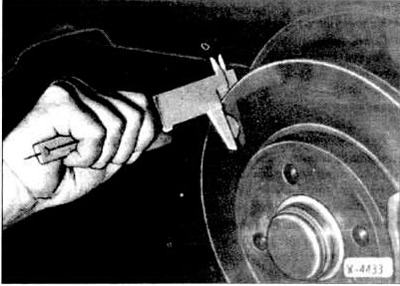
Note: Take several measurements around the circumference of the disc.
Minimum permissible thickness of brake discs:
- Model 316, 316i, 318i, 320i: (With a massive disk) — 11.1 mm
- Model 320i, 323i, 324d/td: - 20.4 mm
- Model 325e, 325i. M3: - 23.4 mm
When the minimum permissible thickness is reached, new brake pads are installed one more time.
When the wear limit is reached, the brake disc must be replaced. The wear limit is 0.4 mm less than the minimum permissible thickness.
If there are significant scratches or grooves deeper than 0.5 mm, replace the brake discs.