
Examination
Mark the position of the wheels relative to the hubs with paint. This will allow the balanced wheel to be installed in its original position. When unscrewing the wheel bolts, the car must stand on its wheels. Raise the car and remove the wheels.
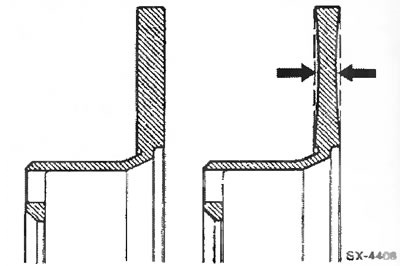
Attention: Welding of the brake disc thickness should be performed in the thinnest places of the "arrow".
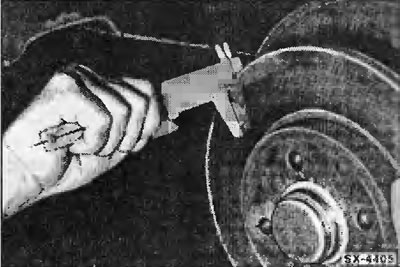
Measure the thickness of the brake disc. Workshops use a special caliper or micrometer for this, since a ridge forms on the brake disc during operation. The thickness of the brake disc can also be measured with a regular caliper, but then a hard gasket must be placed on each side of the disc (for example, one or two coins of 1 ruble each). To obtain the thickness of the brake disc, the thickness of the installed pads must be subtracted from the measured size.
Note: Measure around the perimeter at several points on the brake disc.
Brake disc sizes see here.
If the wear limit is reached, replace the brake discs.
If the brake discs have been ground down to the minimum thickness, a set of brake pads can be installed again.
If there are large cracks or grooves, replace the brake disc with a new one.
Tighten the wheels. Do not lubricate the wheel bolts. Position the wheels so that the marks applied before removing the yoke coincide. Lower the car, tighten the wheel bolts crosswise to 100 Nm.
[The original text can be read on the website: BMWman.ru]