
Cars Mazda Cars Mitsubishi Cars Toyota Cars Chevrolet Cars AvtoVAZ Cars Kia Cars Nissan
English Русский
Български
Беларускі
Український
Српски
Hrvatski
Română
Polski
Slovenský
Magyar
| Articles | Contacts | Sitemap |   
BMWman.ru


3 series   5 series   7 series   BMW X3   BMW X5   BMW X6

E39 (1995-2003) E34 (1988-1996) E28 (1981-1988) E12 (1972-1981)
  • Home
  • BMW 5 Series
  • E39
  • Chassis
  • Brake system
  • Bleeding the brake system

Bleeding the brake system (BMW 5 Series E39)

            0

After each brake repair, during which the hydraulic system was opened, air could get into it. This air must be removed from the brake system. If there is air in the brake system, the brake pedal easily "falls through" when pressed. In this case, it is necessary to eliminate the leak and remove air from the brake system. Air is removed from the brake system by bleeding it using the brake pedal; an assistant is required to perform this work. In addition, a clean polyethylene hose and a ring spanner for opening the air bleed valve, such as the HAZET 196BN spanner with attached hose, are required.

Workshops use a device to remove air, which is connected to the brake fluid expansion tank. The device creates pressure in the brake hydraulic circuit (max 2.0 bar).

If air has to be bled from the entire system, the operation is performed separately for each wheel brake cylinder. This is the case when air has penetrated into each brake cylinder. In the case where only one caliper or wheel brake cylinder has been replaced or repaired, it is usually sufficient to bleed the air from this cylinder.

The sequence of operations for removing air:

1 - rear right brake caliper, 2 - rear left brake caliper, 3 - front right brake caliper, 4 - front right brake caliper.

Remove the dust cap from the brake cylinder bleed valve. Clean the bleed valve, attach a clean hose to it, and insert the other end into a container half filled with brake fluid.

Ask an assistant to press the brake pedal until pressure appears in the brake system. This is felt by increasing resistance when pressing the pedal.


If sufficient pressure has been achieved, press the pedal all the way down and hold it with your foot.
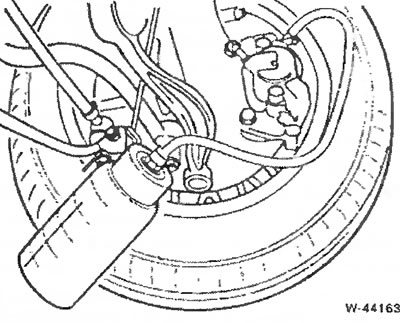
If sufficient pressure has been achieved, press the pedal all the way down and hold it with your…


Open the air bleed valve on the brake caliper with a key about one turn. Collect the leaking brake fluid in a container. Make sure that the end of the hose in the container is always below the level of the liquid poured into it.

Once the brake fluid pressure drops, close the air bleed valve.

Release the brake pedal and repeat the pumping process until the brake fluid pressure increases. Leave the brake pedal pressed, open the air bleed valve until the pressure drops, then close the valve.

The process of removing air from the brake cylinder is repeated until air bubbles stop flowing in along with the brake fluid that flows into the container.

After removing the air, remove the hose from the valve and place the dust cap on the valve.

Caution: When bleeding air, observe the fluid level in the expansion tank. The fluid level must not drop too low, otherwise air will be sucked in through the expansion tank. Always top up with new brake fluid!


Similarly, bleed air from the other brake cylinders.
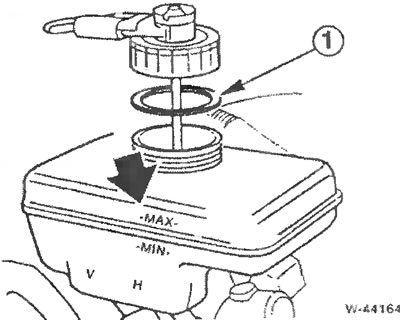
Similarly, bleed air from the other brake cylinders.


After removing the air, top up the fluid level in the expansion tank to the MAX level. Check the rubber sealing gasket "1" for damage. Screw on the tank cap.


Attention: Perform a safety compliance check:
  • Are the brake hoses tightened securely?
  • Is the brake hose in the holder?
  • Are the air bleed valves tightened?
  • Is there enough fluid in the brake system?
  • With the engine running, perform a leak test. To do this, apply a force of 200 to 300 N to the brake pedal for about 10 seconds (from 20 to 30 kg). Do not release the brake pedal. Check all connections for leaks.


After bleeding the air, the brake pedal should not "fall through". If this happens, repeat the procedure for bleeding the air from the brake system.

Note: Handle brake fluid as special waste.

This article is available at russian, bulgarian, belarusian, ukrainian, serbian, croatian, romanian, polish, slovak, hungarian
Article verified: Ilyinsky Matvey

Share information:
Previous articles
БМВ E39: Brake system
Next articles

Brake fluid
Checking the thickness of brake discs
Removal and installation the rear brake disc
Removal and installation the rear brake caliper
Removal and installation rear disc brake pads
Replacing the brake line
Replacing the front brake hose
Checking the brake booster
Parking brake system
Removal and installation of brake columns of the parking brake system


Similar articles on other types of BMW cars:
Bleeding the brake hydraulic system BMW 3 Series E21 (1975-1983)
Bleeding the brake system BMW 3 Series E30 (1982-1994)
Bleeding the brake system BMW 7 Series E32 (1986-1994)
Replacing brake fluid and bleeding the brake system BMW 7 Series E38 (1994-2001)
Bleeding the brake system with DSC BMW X3 E83 (2003-2010)
Bleeding the brake system of the DSC type BMW X5 E53 (1999-2006)
Link in different formats to this page


Visitor comments

No comments yet


How much 14 + 21 =


BMW E39 (1995-2003) 
  • General information
  • Governing bodies
  • Manual
  • Maintenance
  • Power unit
  • Engine repair
  • Lubrication system
  • Cooling system
  • Ignition system
  • Supply system
  • Injection system (gasoline)
  • Injection system (diesel)
  • Exhaust system
  • Transmission
  • Clutch
  • Car gearbox
  • Front axle
  • Rear axle
  • Chassis
  • Steering
  • Brake system
  • Wheels and tires
  • Body
  • Interior
  • Exterior
  • Heating system
  • Electrical equipment
  • Equipment and devices
  • Power devices
  • Windscreen wipers
  • Electrical circuits
BMW E34 (1988-1996) 
  • General information
  • Manual
  • Maintenance
  • Power unit
  • Engine repair
  • Ignition system
  • Engine lubrication system
  • Cooling system
  • Fuel system (gasoline)
  • Fuel system (diesel)
  • Exhaust system
  • Transmission
  • Clutch
  • Car gearbox
  • Chassis
  • Front and rear suspension
  • Steering
  • Brake system
  • Body
  • Exterior
  • Interior
  • Electrical equipment
  • Heating system
  • Equipment and devices
  • Power devices
  • Electrical circuits
BMW E28 (1981-1988) 
  • General information
  • Manual
  • Maintenance
  • Power unit
  • Engine in a car
  • Engine overhaul
  • Cooling system
  • Supply system
  • Ignition system
  • Control system
  • Transmission
  • Clutch
  • Manual gearbox
  • Automatic gearbox
  • Transmission line
  • Chassis
  • Steering
  • Front suspension
  • Rear suspension
  • Brake system
  • Body
  • Body elements
  • Car care and painting
  • Electrical equipment
  • Heater and air conditioner
  • Equipment and devices
  • Starter and generator
  • Electrical circuits
BMW E12 (1972-1981) 
  • General information
  • Operation and maintenance
  • Specifications
  • Power unit
  • Engine repair
  • Cooling and lubrication system
  • Supply system
  • Ecotronic power supply system
  • Fuel injection system
  • Ignition system
  • Transmission
  • Clutch
  • Gearbox BMW 242/4
  • Gearbox Getrag 262/8
  • Gearbox Getrag 265/6
  • Automatic gearbox
  • Cardan gear
  • Rear axle
  • Chassis
  • Steering
  • Front suspension
  • Rear suspension
  • Brake system
  • Electrical equipment
  • Equipment and devices
  • Electrical circuits
BMWman.ru © 2017-2026 · Mobile version · News and articles · Sitemap: EN BG BY UA RS HR RO PL SK HU · Feedback · Site search
3er E21 · 3er E30 · 3er E36 · 3er E46 [petrol] · 3er E46 · 5er E12 · 5er E28 · 5er E34 · 5er E39 · 7er E32 · 7er E38 · X3 E83 · X5 E53 ·
This site uses cookies 🍪, without them some features simply would not work.