
Removal
Remove the rear brake disc.
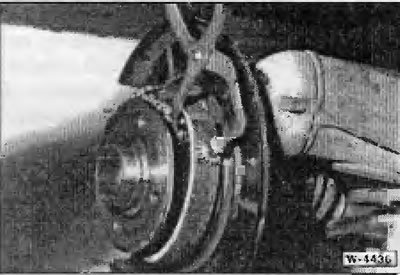
Remove the upper tension spring with tension spring pliers. Replace the spring with traces of corrosion or a twisted one with a new one.
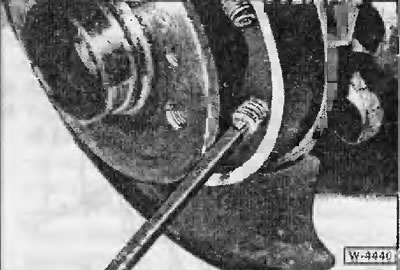
Slightly tighten the expansion pin with a 5 mm Allen key, turn it approximately 90° (¼ turn) and remove the pressure spring from the brake shoe.
Remove the pressure spring from the other brake shoe in a similar manner
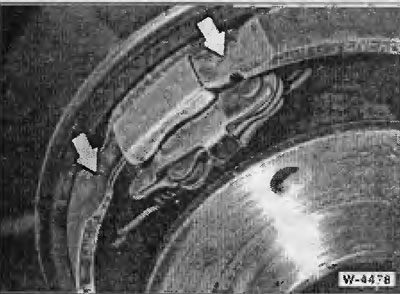
Pull both brake pads at the top in different directions and remove them with a downward movement.
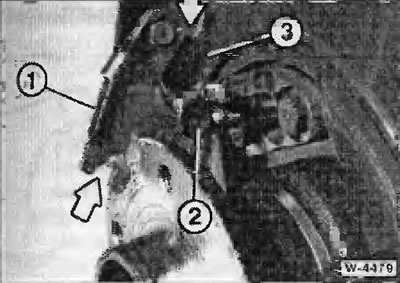
Check the ease of movement of the expansion lock, remove the lock if necessary. To do this, pull part "1" down, press pin "2" and remove part "3" from the cable rod.
Brake pads must be replaced on both sides.
The sliding surfaces and the pin of the expansion lock are very thinly coated with Molykote-Paste G grease.
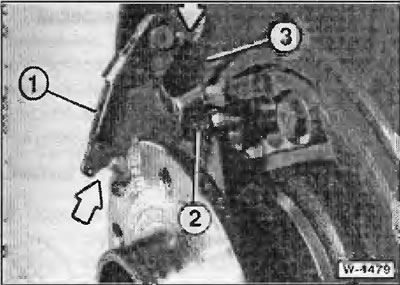
Connect the expansion lock with pin "2" on top to the handbrake cable.
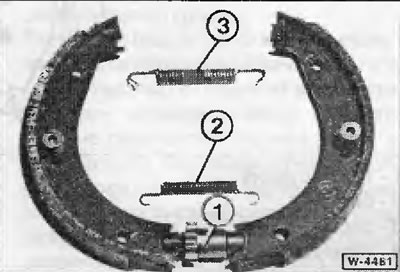
Ensure the mobility of the elements of the device for adjusting the brake pads-1-, lightly treat the thread with Molykote-Paste G grease, connect the threaded elements.
Place the brake shoe adjuster at the bottom in the correct mounting position between the brake shoes. Tension spring "2" (a thinner spring) hang it from below on the brake pads.
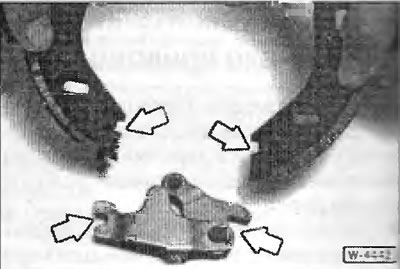
Insert the brake shoes in place. At the same time, the notches at the top of the brake shoes and the expansion lock must enter each other.
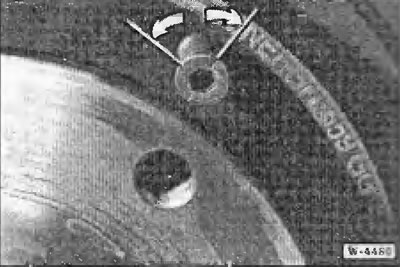
Using a 5 mm Allen key, press both pressure springs through the expansion pins and turn the expansion pins by approximately 90°. In the closed position, the mark on the head of the expansion pin must be directed as shown in the figure.
Using pliers, put on the upper tension spring "3", see figure W-44B1.
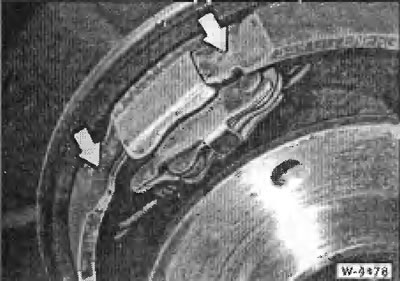
The "arrow" brake pads must be in contact with the brake shield counter support.
Install the brake disc and rear wheel.
Adjust manual (parking) brake, see next chapter.
Note: If the parking brake pads have been replaced, the linings must be run in on an empty street as follows: while driving at a speed of approximately 40 km/h, carefully tighten the handbrake until signs of light braking are detected. While maintaining the vehicle speed, tighten the handbrake handle by one more locking groove and drive approximately another 400 m. Release the handbrake and allow it to cool down. It is recommended to repeat this braking procedure approximately once a quarter, regardless of whether the brake pads have been replaced, in order to remove any corrosion and wear products that may have formed.