Cars Mazda Cars Mitsubishi Cars Toyota Cars Chevrolet Cars AvtoVAZ Cars Kia Cars Nissan
English Русский
Български
Беларускі
Український
Српски
Hrvatski
Română
Polski
Slovenský
Magyar
| Articles | Contacts | Sitemap |   
BMWman.ru


3 series   5 series   7 series   BMW X3   BMW X5   BMW X6

E46 (1998-2006) E46 (1998-2006, petrol) E36 (1990-2000) E30 (1982-1994) E21 (1975-1983)
  • Home
  • BMW 3 Series
  • E46
  • Chassis
  • Brake system
  • Bleeding the brake system

Bleeding the brake system (BMW 3 Series E46)

            0

After repairing the brake system, as a result of which the pipes were hidden, air may enter the system. In this case, the air must be removed. The presence of air in the brake system is indicated by a soft pressing of the brake pedal. In this case, the leak must be eliminated and air must be removed from the system.

If air has entered the ABS hydraulic system, for safety reasons the air should be removed at a service station. This occurs if there is a leak in the hydraulic unit or if the brake fluid reservoir is empty or if fluid was forgotten to be added to the reservoir when removing air.


Air is removed from the brake system by rocking movements of the brake pedal, which requires the help of an assistant.

At the service station, air is removed from the brake system, as a rule, using a special device. With the help of such a device, pressure of up to 2.0 bar is created in the system through the brake fluid reservoir.

If it is necessary to bleed air from the entire system, air is bled separately from each brake.

This is mandatory in cases where air has penetrated into each individual caliper. If only one caliper has been replaced or repaired, it is usually sufficient to bleed the air from the corresponding caliper.

Air removal sequence:
  • Rear right support.
  • Rear left support.
  • Front right support.
  • Front left support.

Front left support.


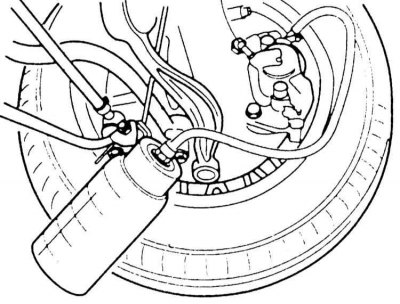
1. Remove the dust cap from the bleed nipple. Clean the nipple, put a clean hose on it, and lower the other end of the hose into a bottle half filled with brake fluid. A suitable hose and container are commercially available.


2. Ask an assistant to press the brake pedal as many times as necessary to create pressure in the system. This is felt by the resistance of the brake pedal.

3. Once the pressure is reached, press the pedal with your foot and do not release it.

4. Loosen the bleed nipple half a turn with a spanner, for example HAZET I968-7. Collect the leaking fluid in a bottle. Make sure that the end of the hose in the bottle is always below the fluid level. If the system is opened, this is noticeable by the pliability of the brake pedal.

5. As soon as the fluid pressure begins to drop, close the nipple.

6. Repeat the pumping process until the system is pressurized. Press the brake pedal and leave your foot on it. Open the air bleed nipple. Open the nipple until the pressure begins to drop. Then close the nipple.

7. Repeat the air removal process until there are no air bubbles in the brake fluid entering the bleeding container.

8. After completing the bleeding process, remove the hose from the fitting and put the protective cap on the fitting.

During the process of bleeding, periodically monitor the brake fluid reservoir. The fluid level should not drop significantly. Otherwise, air may enter the system. Always add new brake fluid to the system!


9. Air from other calipers is removed in a similar manner.
9. Air from other calipers is removed in a similar manner.


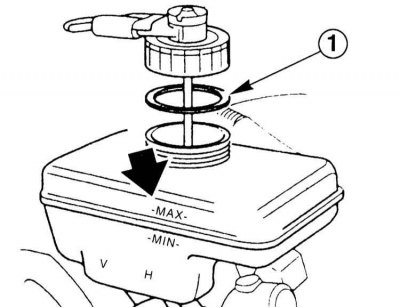
10. After the air removal process is complete, add liquid to the tank up to the "MAX" mark. Check the condition of the sealing gasket "1" of the tank cover.


11. After removing air from the system, when you press the brake pedal, it should not go down smoothly. If this happens, you should repeat the air removal process again.
  • Are the brake hoses secured?
  • Is the brake hose secured in the holder?
  • Are the air bleed nipples tightened?
  • Is there enough brake fluid?
  • With the engine running, check for leaks. To do this, press the brake pedal with a force of 200-300 N (20-30 kg) for 10 s. The pedal should not weaken. Check all connections for leaks.

Brake fluid should never be poured out or thrown away with household waste. Local authorities inform drivers about possible disposal sites.

12. Finally, perform several braking tests on a road with light traffic. At least one hard braking test should be performed using ABS (you will know by the pulsation of the brake pedal).

At the same time, watch carefully for the vehicles following behind you.

This article is available at russian, bulgarian, belarusian, ukrainian, serbian, croatian, romanian, polish, slovak, hungarian
Article verified: Sevastyanov Nikolay

Share information:
Previous articles
БМВ E46: Brake system
Next articles

Brake fluid — basic information and safety precautions
Measuring the thickness of the brake disc
Removal and installation the rear wheel brake disc
Removal and installation the rear brake caliper
Removal and installation disc brake pads
Replacing the brake line
Replacing the front brake hose
Checking the brake booster
Removal and installation parking brake shoes
Adjusting the parking brake


Similar articles on other types of BMW cars:
Bleeding the brake hydraulic system BMW 5 Series E12 (1972-1981)
Bleeding the brake system BMW 5 Series E34 (1988-1996)
Bleeding the brake system BMW 7 Series E32 (1986-1994)
Replacing brake fluid and bleeding the brake system BMW 7 Series E38 (1994-2001)
Bleeding the brake system with DSC BMW X3 E83 (2003-2010)
Bleeding the brake system of the DSC type BMW X5 E53 (1999-2006)
Link in different formats to this page


Visitor comments

No comments yet


How much 30 + 49 =


BMW E46 (1998-2006) 
  • General information
  • Manual
  • Maintenance
  • Power unit
  • Engine repair
  • Cooling system
  • Power system (gasoline)
  • Injection system (gasoline)
  • Fuel system (diesel)
  • Exhaust system
  • Ignition system
  • Charge and launch systems
  • Transmission
  • Car gearbox
  • Clutch and drive shafts
  • Chassis
  • Brake system
  • Suspension front and rear
  • Steering
  • Body
  • Body care and repair
  • Exterior
  • Interior
  • Electrical equipment
  • Troubleshooting
  • Lighting and signaling
  • Equipment and devices
  • Heater and air conditioner
  • Electrical circuits
BMW E46 (1998-2006, petrol) 
  • General information
  • Manual
  • Repair on the road
  • Weekly checks
  • Maintenance
  • Troubleshooting
  • Power unit
  • 4 cylinder engines
  • 6 cylinder engines
  • Engine overhaul
  • Cooling and heating
  • Fuel and exhaust system
  • Starting and charging system
  • Ignition system
  • Transmission
  • Clutch
  • Mechanical gearbox
  • Automatic gearbox
  • Cardan and drive shafts
  • Chassis
  • Brake system
  • Wheel suspension
  • Steering
  • Body
  • Exterior
  • Interior
  • Electrical equipment
  • Equipment and devices
  • Electrical circuits
BMW E36 (1990-2000) 
  • General information
  • Maintenance
  • Power unit
  • Engine repair
  • Cooling system
  • Ignition system
  • Supply system
  • Fuel injection system
  • Exhaust system
  • Transmission
  • Clutch
  • Car gearbox
  • Front and rear axle
  • Chassis
  • Steering
  • Brake system
  • Body
  • Exterior
  • Interior
  • Electrical equipment
  • Heating system
  • Equipment and devices
  • Power devices
  • Electrical circuits
BMW E30 (1982-1994) 
  • Power unit
  • M10/M20 engine
  • M40 engine
  • Ignition system
  • Lubrication system
  • Cooling system
  • Supply system
  • Fuel injection
  • Exhaust system
  • Transmission
  • Clutch
  • Manual gearbox
  • Front axle
  • Rear axle
  • Chassis
  • Steering
  • Brake system
  • Body
  • Exterior
  • Interior
  • Electrical equipment
  • Heating system
  • Equipment and devices
  • Electrical circuits
BMW E21 (1975-1983) 
  • General information
  • Specifications
  • Operation and maintenance
  • 4-cylinder engine
  • Engine repair
  • Cooling and lubrication system
  • Supply system
  • Ignition system
  • 6-cylinder engine
  • Engine repair
  • Cooling and lubrication system
  • Supply system
  • Fuel injection system
  • Ignition system
  • Transmission
  • Clutch
  • 4-speed manual gearbox
  • 5-speed manual gearbox
  • Automatic gearbox
  • Cardan and rear axle
  • Chassis
  • Steering
  • Front suspension
  • Rear suspension
  • Brake system
  • Electrical equipment
  • Equipment and devices
  • Electrical circuits
BMWman.ru © 2017-2026 · Mobile version · News and articles · Sitemap: EN BG BY UA RS HR RO PL SK HU · Feedback · Site search
3er E21 · 3er E30 · 3er E36 · 3er E46 [petrol] · 3er E46 · 5er E12 · 5er E28 · 5er E34 · 5er E39 · 7er E32 · 7er E38 · X3 E83 · X5 E53 ·
This site uses cookies 🍪, without them some features simply would not work.