
- Home
- BMW 3 Series
- E46
- Chassis
- Brake system
- Removal and installation disc brake pads
Removal and installation disc brake pads (BMW 3 Series E46)
Rear Disc Brake Caliper
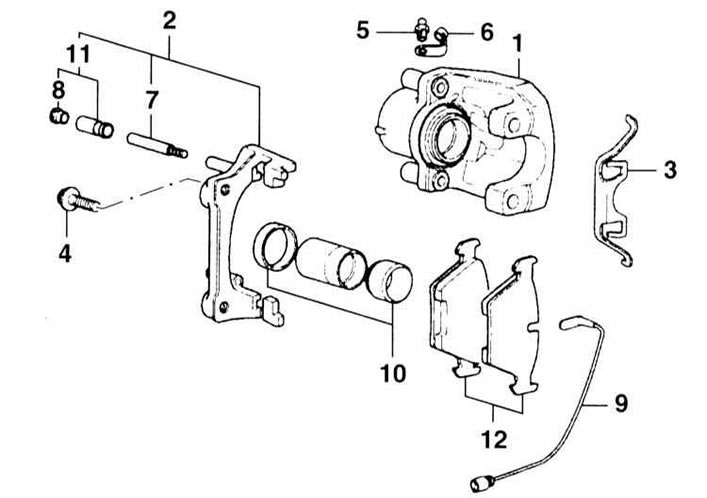
1 — support
2 - brake guide
3 — retaining spring
4 — bolt, 65 Nm
5 — air bleed nipple
6 - dust cap
7 - guide pin
8 - protective plug
9 - wear sensor
10 — Caliper sealing kit
11 - Guide bush repair kit
12 - brake pads (asbestos free)
Removal
1. Mark the position of the rear wheels relative to the hub with paint. This will allow you to install the balanced wheels in their original position during assembly. Loosen the wheel mounting bolts with the car on the ground. Raise the rear of the car, place it on stands and remove the rear wheels.
If the brake pads are to be reused, they must be marked when removed. Do not interchange the pads on the right and left wheels. This may result in uneven braking. Only use BMW pads or pads approved by BMW. Always replace all front disc brake pads at the same time, even if one pad has reached the wear limit.
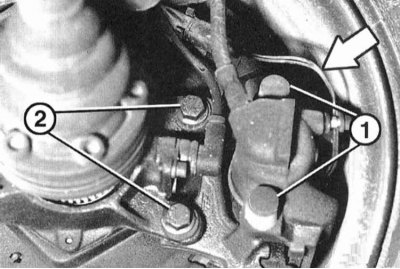
2. Disconnect the wear sensor cable at the right caliper (arrow on the illustration), do not pull on the cable.
3. Remove the plastic caps "1" and unscrew the Allen screws located underneath them. 2 - brake guide mounting screws.
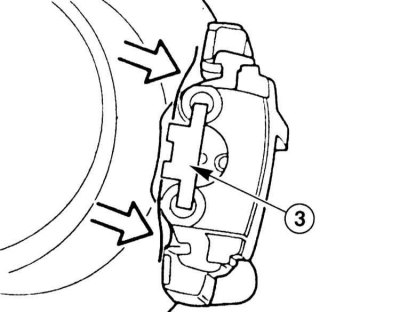
4. Remove the bracket "3" with a screwdriver.
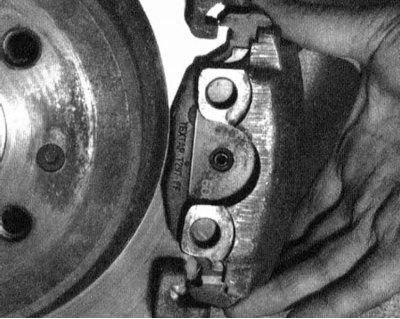
5. Remove the caliper back.
6. Remove the outer brake shoe.
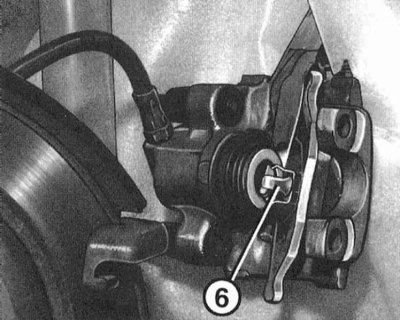
7. The inner brake shoe is secured in the piston by spring "6".
Installation
After removing the brake pads, do not press the brake pedal. Otherwise, the piston may be pressed out of the housing.
8. If the wear sensor contact plate insulation is worn out, the cable insulation is damaged or the plastic element is worn out, the sensor should be replaced.
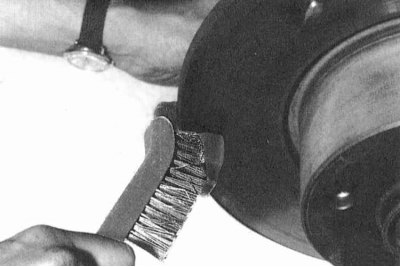
9. Clean the guide surface and the brake pad seat with a light metal brush or wipe with a cloth soaked in alcohol. Do not use solvents containing mineral oils or sharp-edged tools. If the pads are to be used again, they must also be cleaned.
10. Before installing the brake pads, use your fingers to check for scoring on the brake disc. If there are any, the discs must be replaced.
11. Measure the thickness of the brake discs, refer to Section Measuring the thickness of the brake disc.
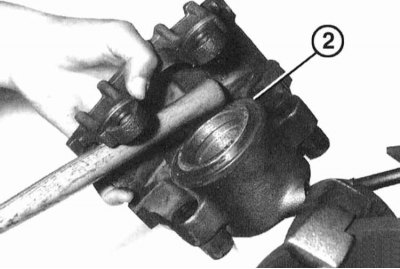
12. Check the dust cap "2" for cracks. If there is any damage, the cap must be replaced immediately, as any dirt that has penetrated will quickly cause the caliper to lose its tightness. To do this, remove the caliper and disassemble it (work of the service station).
13. Press the piston in using a suitable tool. This can be done with a block of hard wood (with a hammer handle). When doing this, pay special attention to ensure that the piston is not warped and that the piston surface and dust cap are not damaged.
- When the pistons are pressed out of the brake cylinders, the level in the brake fluid reservoir rises. Monitor the level, suck out the fluid if necessary.
- To suck out the brake fluid, use a special or plastic bottle that is intended only for this purpose! Do not use drinking water bottles for this! Brake fluid is poisonous and should never be sucked out by mouth through a hose. Use a special device for this. After replacing the brake pads, the fluid level in the reservoir should not be higher than the MAX mark, since the fluid expands when heated. Leaking brake fluid flows down the master cylinder, damaging the paintwork and causing corrosion.
- If the brake pads are heavily worn, check the ease of movement of the piston. To do this, insert a wooden block into the caliper and ask an assistant to slowly press the brake pedal. The brake piston should move in and out easily. All other calipers must be inserted in their places to perform the check. Make sure that the piston does not come out completely. If the piston moves hard, the caliper is subject to repair (work of the service station).
- Cover the adjacent surfaces of the caliper with anti-squeal brake paste.
- To prevent disc brakes from squealing during operation, some areas of the caliper must be coated with a thin layer of a special paste, for example, "Never Seez Compound".
- The paste should not under any circumstances come into contact with the dust seals, friction surfaces of the brake pads or the brake disc. If necessary, wipe the paste off immediately with alcohol and replace the dust seal with a new one. Do not cover the brake pad backing plate with paste.
14. Apply a thin layer of anti-squeal paste to the mating surface of the brake piston against the brake pad.
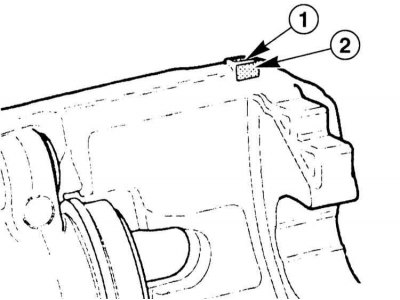
15. Clean the mating surfaces "1" and "2" of the brake pad T-heads at the caliper and coat with a thin layer of anti-squeal paste.
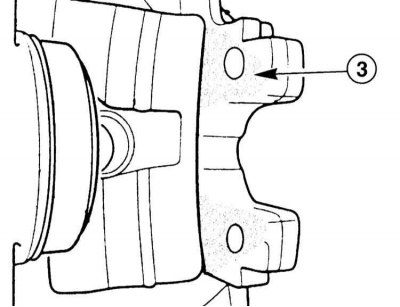
16. Clean the mating surface "3" of the caliper and apply a thin layer of anti-squeal paste in the areas shaded in the illustration.
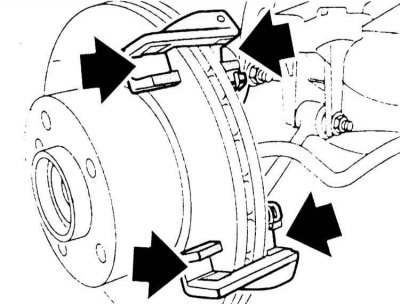
17. Clean the bracket at the T-head guides (arrows in the illustration) and apply a thin layer of anti-squeal brake paste in the areas shaded in the illustration.
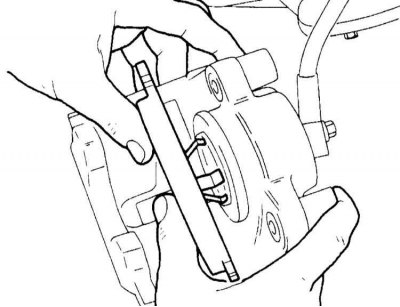
18. Insert the brake head with the spring into the piston.
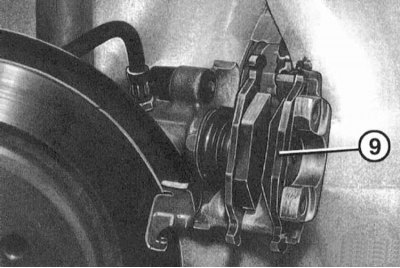
19. Insert the outer pad "9" into the caliper and place the caliper on the guide. Make sure the pads are clean.
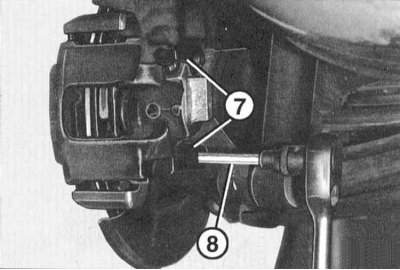
20. Visually inspect the two caliper mounting bolts, clean the bracket from dirt if necessary. If necessary, go through the thread in the bracket with a tap. Replace the bolts with rust or damaged threads. Fasten the bolts "7" with an "8" socket wrench by 7 mm to a torque of 30 N·m.
Just clean the bolts, no need to lubricate them.
21. Replace the protective caps on the mounting bolts.
22. Connect the wear sensor connector to the right side of the vehicle. The wire should pass through the loop of the bleed nipple cover.
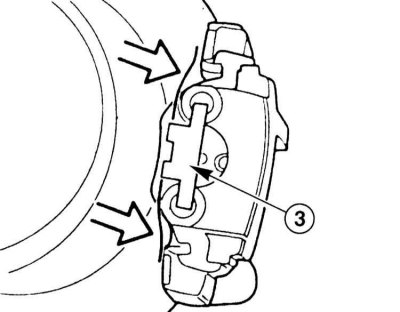
23. Install the caliper retaining spring.
24. Install the rear wheels and tighten the mounting bolts. Do not lubricate the bolts. Install the wheels so that the markings applied during removal match. Lower the car onto the wheels and tighten the bolts to a torque of 100 N·m.
Press the brake pedal hard several times while standing until you feel resistance. This will cause the brake pads to take their working position.
25. Check the fluid level in the reservoir. If necessary, top up to the MAX mark.
- Are the brake hoses secured?
- Is the brake hose secured in the holder?
- Are the air bleed nipples tightened?
- Is there enough brake fluid?
- With the engine running, check for leaks. To do this, press the brake pedal with a force of 200-300 N (20-30 kg) for 10 s. The pedal should not weaken. Check all connections for leaks.
26. Carefully allow the new brake pads to break in. To do this, brake the car several times from 80 to 40 km/h, lightly pressing the pedal. Allow the brake to cool between braking.
After installing new brake pads, they need to be worked in. During the first 200 km of driving, strong unnecessary braking should be avoided.
Brake discs must be disposed of as special material in some regions. Local authorities inform drivers about possible disposal sites.
This article is available at russian, bulgarian, belarusian, ukrainian, serbian, croatian, romanian, polish, slovak, hungarian
Article verified: Sevastyanov Nikolay
Share information:
Previous articles
БМВ E46: Brake system
Next articles
Similar articles on other types of BMW cars:
Removal and installation front disc brake pads BMW 5 Series E39 (1995-2003)
Removal and installation the brake disc BMW 5 Series E12 (1972-1981)
Brake disc — removal and installation BMW 7 Series E32 (1986-1994)
Removal and installation brake discs BMW 7 Series E38 (1994-2001)
Brake pads for front disc brakes BMW X3 E83 (2003-2010)
Rear disc — removal and installation BMW X5 E53 (1999-2006)
Removal and installation front disc brake pads BMW 5 Series E39 (1995-2003)
Removal and installation the brake disc BMW 5 Series E12 (1972-1981)
Brake disc — removal and installation BMW 7 Series E32 (1986-1994)
Removal and installation brake discs BMW 7 Series E38 (1994-2001)
Brake pads for front disc brakes BMW X3 E83 (2003-2010)
Rear disc — removal and installation BMW X5 E53 (1999-2006)
Link in different formats to this page
Visitor comments
No comments yet
- General information
- Manual
- Maintenance
- Power unit
- Engine repair
- Cooling system
- Power system (gasoline)
- Injection system (gasoline)
- Fuel system (diesel)
- Exhaust system
- Ignition system
- Charge and launch systems
- Transmission
- Car gearbox
- Clutch and drive shafts
- Chassis
- Brake system
- Suspension front and rear
- Steering
- Body
- Body care and repair
- Exterior
- Interior
- Electrical equipment
- Troubleshooting
- Lighting and signaling
- Equipment and devices
- Heater and air conditioner
- Electrical circuits
- General information
- Manual
- Repair on the road
- Weekly checks
- Maintenance
- Troubleshooting
- Power unit
- 4 cylinder engines
- 6 cylinder engines
- Engine overhaul
- Cooling and heating
- Fuel and exhaust system
- Starting and charging system
- Ignition system
- Transmission
- Clutch
- Mechanical gearbox
- Automatic gearbox
- Cardan and drive shafts
- Chassis
- Brake system
- Wheel suspension
- Steering
- Body
- Exterior
- Interior
- Electrical equipment
- Equipment and devices
- Electrical circuits
- General information
- Maintenance
- Power unit
- Engine repair
- Cooling system
- Ignition system
- Supply system
- Fuel injection system
- Exhaust system
- Transmission
- Clutch
- Car gearbox
- Front and rear axle
- Chassis
- Steering
- Brake system
- Body
- Exterior
- Interior
- Electrical equipment
- Heating system
- Equipment and devices
- Power devices
- Electrical circuits
- Power unit
- M10/M20 engine
- M40 engine
- Ignition system
- Lubrication system
- Cooling system
- Supply system
- Fuel injection
- Exhaust system
- Transmission
- Clutch
- Manual gearbox
- Front axle
- Rear axle
- Chassis
- Steering
- Brake system
- Body
- Exterior
- Interior
- Electrical equipment
- Heating system
- Equipment and devices
- Electrical circuits
- General information
- Specifications
- Operation and maintenance
- 4-cylinder engine
- Engine repair
- Cooling and lubrication system
- Supply system
- Ignition system
- 6-cylinder engine
- Engine repair
- Cooling and lubrication system
- Supply system
- Fuel injection system
- Ignition system
- Transmission
- Clutch
- 4-speed manual gearbox
- 5-speed manual gearbox
- Automatic gearbox
- Cardan and rear axle
- Chassis
- Steering
- Front suspension
- Rear suspension
- Brake system
- Electrical equipment
- Equipment and devices
- Electrical circuits