
Along with the rim width, the depth of its pressing is also important. The pressing depth is the distance from the middle of the rim to the surface where the wheel disc meets the brake disc.
All disc wheels are made in the form of so-called deep rims with a hump. A hump is a projection pressed onto the rim shelf, which prevents the tubeless tire from coming off the rim even during extremely sharp turns of the car.
If tires or rims are installed that are not specified in the vehicle documents, a corresponding entry must be made in the documents. This usually requires permission from BMW.
Wheel and tire sizes, tire inflation pressure
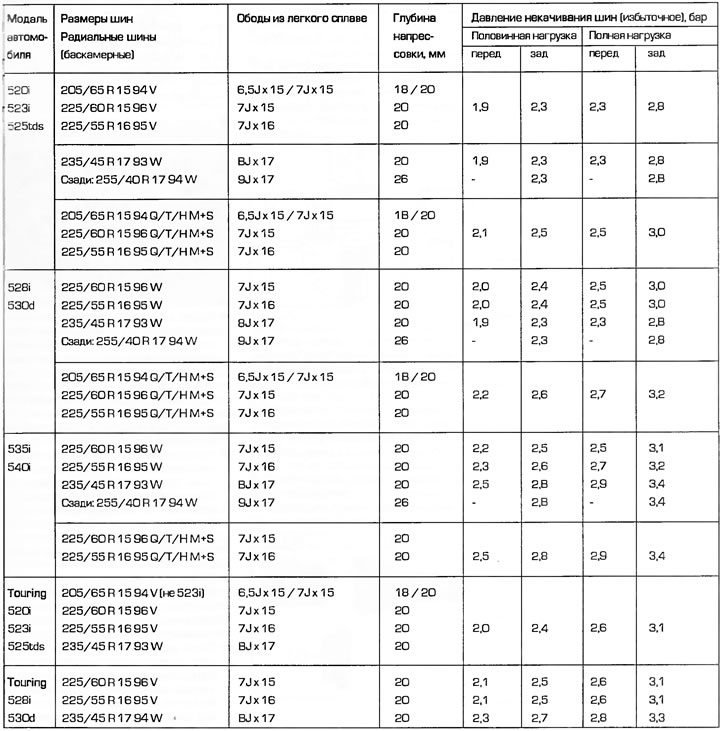
All overpressure data refers to cold tires (at ambient temperature). Higher excess pressure established during long-term driving (by approximately 0.2-0.4 bar) no need to lower it.
Since winter tyres have a maximum speed limit, the instructions on the permissible speed in the driver's field of vision must be followed (§ 36, paragraph 1 of the Technical Requirements for the Operation of Non-Railway Transport StVZO).
Note: Technical progress does not stand still. It may turn out that other tire inflation pressures or other combinations with rims are also permitted for earlier cars. Therefore, it is recommended to obtain up-to-date information on wheel approval for use at a BMW service station.
For sporty driving, it is recommended to increase the excess pressure in the front and rear tires by 0.2 bar. When increasing, it is necessary to proceed from the basic value of excess pressure, standardized for different loads.
If there is a trailer, increase the inflation pressure of the tires to the value specified in the "Full load" column. The inflation pressure of the spare tire corresponds to the maximum inflation pressure of the rear tires.
When inflating tires, follow the instructions on the plate on the driver's side door pillar.
Please note: The Road Traffic Regulations permit the use of tires until the tread pattern profile depth over the entire working surface reaches 1.6 mm. However, for safety reasons, it is recommended to replace summer tires with new ones at a profile depth of 2 mm, and winter tires at a profile depth of 4 mm. The car may be equipped with a tire pressure monitoring system (RDS). The system monitors the tire pressure both when parked and when driving, taking into account the vehicle speed and ambient temperature. For this purpose, a transmitter with temperature and pressure sensors is installed on each wheel, including the spare, powered by a lithium battery designed for 5 years. The transmitter transmits signals to the receiving antenna located in the wheel well and connected to the central control unit. Thanks to RDS, it is possible to avoid dangerous tire destruction, especially during a trip, which occurs due to excessive crumpling of the sidewall due to too low inflation pressure.
[The original source of the article is on the website: «bmwman.ru»]