
- Home
- BMW 3 Series
- E36
- Power unit
- Cooling system
- Removal and installation, checking of the thermostat
Removal and installation, checking of the thermostat (BMW 3 Series E36)
As the engine warms up, the thermostat opens a large cooling circuit. If the thermostat fails, the engine overheats. This is determined by the increased temperature readings on the temperature gauge while the radiator remains cold. But a thermostat defect can also manifest itself in the fact that it remains open even after the liquid has cooled. This is determined by the fact that the engine does not warm up to its operating temperature or the temperature gauge needle deflects more slowly than before or in winter the heating power is insufficient.
Remove the fan shroud.
Drain some of the coolant into a container. Models 316i, 318i, 318tds, 325td/tds:
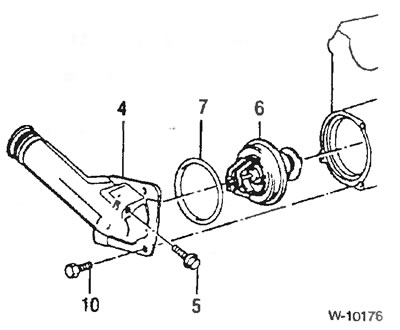
Figure W 10176
4 Thermostat housing
5. Air release bolt
6. Thermostat
7. O-ring
10. Bolt
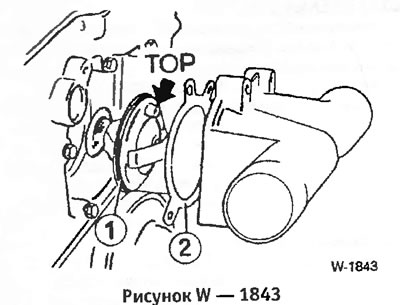
Models 318 is/ti:
1. O-ring
2. Gasket
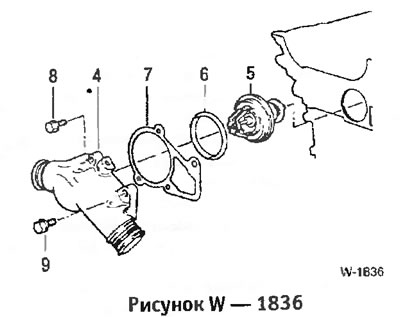
Models 3201, 325i, 328i:
4. Connecting flange
5. Thermostat
6. O-ring
7. Gasket
8. Bolt M6
9. Bolt M8
Unscrew the thermostat housing cover (from the front of the engine).
Mark the installation position of the thermostat and remove the thermostat.
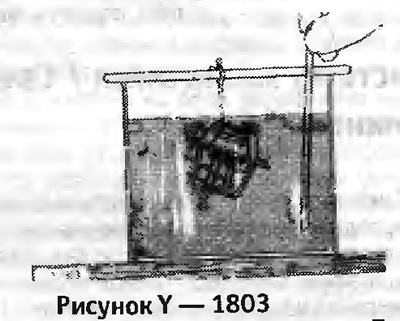
Heat the thermostat in a water bath. The thermostat should not touch the walls of the vessel. Monitor the temperature with an appropriate thermometer.
At a temperature of approximately 80°C, the bimetallic spring of the thermostat begins to expand. The thermostat reaches its maximum opening at approximately 95°C.
Check the opening and closing of the thermostat and the compliance of the opening temperature with the value engraved on the thermostat housing. If there are any deviations, replace the thermostat.
Clean the contact surfaces on the body and cover.
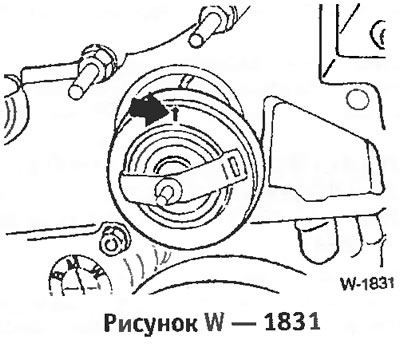
Models 320i, 325i, 328i: Install the thermostat so that the arrow points up, see illustration.
Models 318is/ti, 318tds, 325td/tds: Install the thermostat so that the air outlet is at the top, see Fig. W 1843.
Lightly lubricate the new thermostat O-ring with glycerin and insert it, see the illustrations in the "Removal" subsection.
Models 318is/ti, 320i, 325i, 328i: Be sure to replace the paper gasket.
Install the thermostat housing and tighten the bolts evenly to a torque of 10 Nm.
Install the fan shroud.
Fill with coolant and bleed air from the cooling system.
Warm up the engine until the fan viscous clutch engages. If there are leaks, tighten the bolts slightly.
Caution: If the engine overheats after a short distance, the cause may be limescale deposits in the radiator.
Removal
Remove the fan shroud.
Drain some of the coolant into a container. Models 316i, 318i, 318tds, 325td/tds:
Please note: On models 316i, 318i produced since September 1993, the thermostat is rigidly built into the housing and therefore cannot be removed.
Figure W 10176
4 Thermostat housing
5. Air release bolt
6. Thermostat
7. O-ring
10. Bolt
Models 318 is/ti:
1. O-ring
2. Gasket
Models 3201, 325i, 328i:
4. Connecting flange
5. Thermostat
6. O-ring
7. Gasket
8. Bolt M6
9. Bolt M8
Unscrew the thermostat housing cover (from the front of the engine).
Note: On a six-cylinder petrol engine the bolts are of different lengths, so to facilitate subsequent installation mark the bolt locations. In addition, the suspension bar should be removed beforehand.
Mark the installation position of the thermostat and remove the thermostat.
Examination
Heat the thermostat in a water bath. The thermostat should not touch the walls of the vessel. Monitor the temperature with an appropriate thermometer.
At a temperature of approximately 80°C, the bimetallic spring of the thermostat begins to expand. The thermostat reaches its maximum opening at approximately 95°C.
Check the opening and closing of the thermostat and the compliance of the opening temperature with the value engraved on the thermostat housing. If there are any deviations, replace the thermostat.
Installation
Clean the contact surfaces on the body and cover.
Models 320i, 325i, 328i: Install the thermostat so that the arrow points up, see illustration.
Models 318is/ti, 318tds, 325td/tds: Install the thermostat so that the air outlet is at the top, see Fig. W 1843.
Lightly lubricate the new thermostat O-ring with glycerin and insert it, see the illustrations in the "Removal" subsection.
Models 318is/ti, 320i, 325i, 328i: Be sure to replace the paper gasket.
Install the thermostat housing and tighten the bolts evenly to a torque of 10 Nm.
Caution: Do not overtighten the bolts. On models 3201, 3251 do not forget to install the suspension bar. Tighten the suspension bar bolts (thread M8) to 20 Nm.
Install the fan shroud.
Fill with coolant and bleed air from the cooling system.
Warm up the engine until the fan viscous clutch engages. If there are leaks, tighten the bolts slightly.
This article is available at russian, bulgarian, belarusian, ukrainian, serbian, croatian, romanian, polish, slovak, hungarian
Article verified: Chebotarev Vladislav
Share information:
Previous articles
БМВ E36: Cooling system
Next articles
Similar articles on other types of BMW cars:
Removal and installation, checking of the thermostat BMW 5 Series E34 (1988-1996)
Removal and installation / checking the thermostat BMW 5 Series E39 (1995-2003)
Thermostat — Removal, Installation and Checking BMW 7 Series E32 (1986-1994)
Removal and installation the thermostat BMW 7 Series E38 (1994-2001)
Pistons — removal and installation BMW X3 E83 (2003-2010)
Checking the Thermostat BMW X5 E53 (1999-2006)
Removal and installation, checking of the thermostat BMW 5 Series E34 (1988-1996)
Removal and installation / checking the thermostat BMW 5 Series E39 (1995-2003)
Thermostat — Removal, Installation and Checking BMW 7 Series E32 (1986-1994)
Removal and installation the thermostat BMW 7 Series E38 (1994-2001)
Pistons — removal and installation BMW X3 E83 (2003-2010)
Checking the Thermostat BMW X5 E53 (1999-2006)
Link in different formats to this page
Visitor comments
No comments yet
- General information
- Manual
- Maintenance
- Power unit
- Engine repair
- Cooling system
- Power system (gasoline)
- Injection system (gasoline)
- Fuel system (diesel)
- Exhaust system
- Ignition system
- Charge and launch systems
- Transmission
- Car gearbox
- Clutch and drive shafts
- Chassis
- Brake system
- Suspension front and rear
- Steering
- Body
- Body care and repair
- Exterior
- Interior
- Electrical equipment
- Troubleshooting
- Lighting and signaling
- Equipment and devices
- Heater and air conditioner
- Electrical circuits
- General information
- Manual
- Repair on the road
- Weekly checks
- Maintenance
- Troubleshooting
- Power unit
- 4 cylinder engines
- 6 cylinder engines
- Engine overhaul
- Cooling and heating
- Fuel and exhaust system
- Starting and charging system
- Ignition system
- Transmission
- Clutch
- Mechanical gearbox
- Automatic gearbox
- Cardan and drive shafts
- Chassis
- Brake system
- Wheel suspension
- Steering
- Body
- Exterior
- Interior
- Electrical equipment
- Equipment and devices
- Electrical circuits
- General information
- Maintenance
- Power unit
- Engine repair
- Cooling system
- Ignition system
- Supply system
- Fuel injection system
- Exhaust system
- Transmission
- Clutch
- Car gearbox
- Front and rear axle
- Chassis
- Steering
- Brake system
- Body
- Exterior
- Interior
- Electrical equipment
- Heating system
- Equipment and devices
- Power devices
- Electrical circuits
- Power unit
- M10/M20 engine
- M40 engine
- Ignition system
- Lubrication system
- Cooling system
- Supply system
- Fuel injection
- Exhaust system
- Transmission
- Clutch
- Manual gearbox
- Front axle
- Rear axle
- Chassis
- Steering
- Brake system
- Body
- Exterior
- Interior
- Electrical equipment
- Heating system
- Equipment and devices
- Electrical circuits
- General information
- Specifications
- Operation and maintenance
- 4-cylinder engine
- Engine repair
- Cooling and lubrication system
- Supply system
- Ignition system
- 6-cylinder engine
- Engine repair
- Cooling and lubrication system
- Supply system
- Fuel injection system
- Ignition system
- Transmission
- Clutch
- 4-speed manual gearbox
- 5-speed manual gearbox
- Automatic gearbox
- Cardan and rear axle
- Chassis
- Steering
- Front suspension
- Rear suspension
- Brake system
- Electrical equipment
- Equipment and devices
- Electrical circuits