



Catalytic converter
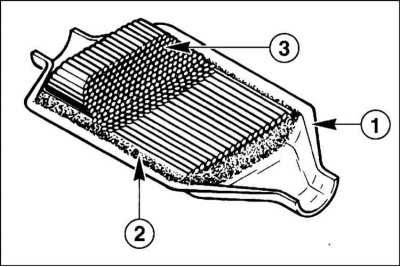
1 — body
2 - seal
3 - honeycomb catalytic converter
All engines are equipped with one or more catalytic converters to clean exhaust gases.
The catalytic converter has a central ceramic part of a honeycomb structure "3" covered with a carrier layer. On the carrier layer are salts of noble metals acting as converters. The catalytic converter is fixed in the housing "1" by means of an insulating support layer "2" that simultaneously compensates for the thermal expansion of the catalytic converter.
In order to reduce harmful emissions with the help of a catalytic converter, the injection system must precisely dose the amount of injected fuel required for combustion. The oxygen sensor is located in the intake pipe before the catalytic converter and is washed by the flow of exhaust gases. The oxygen sensor is an electronic sensor that measures the oxygen content in the exhaust gases and represents it in the form of voltage fluctuations. Information from the oxygen sensor is transmitted to the injection system control unit. The resulting value allows you to adjust the composition of the air-fuel mixture. On the one hand, this is necessary, since operating conditions are constantly changing (idle, full throttle), on the other hand, since optimal afterburning of fuel in the catalytic converter occurs only in this case if the exhaust gases contain a sufficient amount of fuel.
In order for the fuel to be burned in the catalytic converter, a temperature of 300-800°C is required. This requires a higher fuel content in the mixture than for clean combustion.
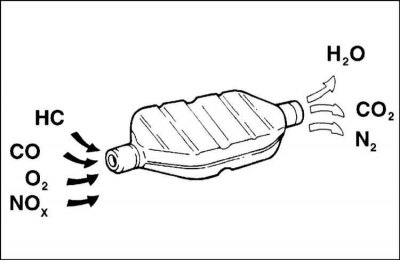
The catalytic converters used in gasoline engines are so-called three-functional devices. In the controlled conversion process, carbon monoxide (CO) and hydrocarbon (HC) are oxidized, and the concentration of nitrogen oxides (NOx) is reduced.