
Table of contents: Petrol engines ↓ Diesel engines ↓
- Home
- BMW 5 Series
- E39
- Power unit
- Exhaust system
- Operation of the catalytic converter
Operation of the catalytic converter (BMW 5 Series E39)
All car engines are equipped with a catalytic converter to clean exhaust gases.
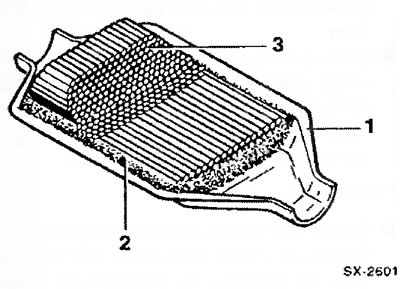
The catalytic converter consists of a ceramic honeycomb body "3" covered with a carrier layer. The carrier layer contains salts of noble metals that have an effect on the conversion processes. To attach the impact-sensitive ceramic body to the outer body "1", an elastic and heat-resistant wire mesh "2" is used, which also compensates for temperature expansion.
The connection of the electronic injection system and the oxygen sensor allows precise dosing of the amount of fuel for combustion so that the catalytic converter can reduce the emission of harmful substances. The oxygen sensor is located in the exhaust pipe in front of the catalytic converter and is washed by the flow of exhaust gases. An oxygen sensor is an electrical sensor that indicates the residual oxygen content in the exhaust gases through fluctuations in electrical voltage and allows conclusions to be drawn about the composition of the fuel-air mixture. In a split second, the oxygen sensor can transmit a corresponding signal to the injection system control unit and thus constantly change the quality of the mixture. Firstly, this is necessary because the operating conditions are constantly changing (idle, full load), secondly, optimal combustion in the catalytic converter occurs only when there is still a sufficient proportion of gasoline in the exhaust gases.
So, in order for combustion to occur at all in the catalytic converter at temperatures from +300°C to +800°C, the fuel-air mixture must contain more fuel than is needed for its complete combustion in the engine cylinder.
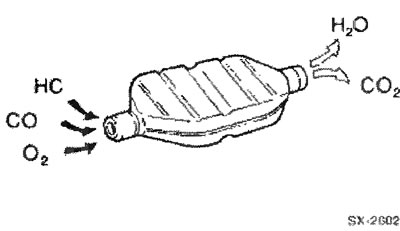
The catalytic converter in question is a three-component one.
This means that in this catalytic converter, due to the regulation of the excess air coefficient, the oxidation of carbon monoxide (CO) and hydrocarbons (CH) is simultaneously carried out, as well as the reduction of nitrogen oxides (NOx),
A catalytic converter is also installed as standard on vehicles with diesel engines. First of all, no adjustment of the mixture composition is possible here, as is the case with a petrol engine. However, the catalytic converter reduces the emission of carbon monoxide and hydrocarbons, which are harmful to the environment, to a level that is significantly lower than that of petrol engines with a regulated catalytic converter. In addition, the smoke of the exhaust gases typical of diesel engines is reduced. The higher content of nitrogen oxides in the exhaust gases of conventional diesel engines is kept low by installing an exhaust gas recirculation system.
The catalytic converter consists of a ceramic honeycomb body "3" covered with a carrier layer. The carrier layer contains salts of noble metals that have an effect on the conversion processes. To attach the impact-sensitive ceramic body to the outer body "1", an elastic and heat-resistant wire mesh "2" is used, which also compensates for temperature expansion.
Petrol engines
The connection of the electronic injection system and the oxygen sensor allows precise dosing of the amount of fuel for combustion so that the catalytic converter can reduce the emission of harmful substances. The oxygen sensor is located in the exhaust pipe in front of the catalytic converter and is washed by the flow of exhaust gases. An oxygen sensor is an electrical sensor that indicates the residual oxygen content in the exhaust gases through fluctuations in electrical voltage and allows conclusions to be drawn about the composition of the fuel-air mixture. In a split second, the oxygen sensor can transmit a corresponding signal to the injection system control unit and thus constantly change the quality of the mixture. Firstly, this is necessary because the operating conditions are constantly changing (idle, full load), secondly, optimal combustion in the catalytic converter occurs only when there is still a sufficient proportion of gasoline in the exhaust gases.
So, in order for combustion to occur at all in the catalytic converter at temperatures from +300°C to +800°C, the fuel-air mixture must contain more fuel than is needed for its complete combustion in the engine cylinder.
The catalytic converter in question is a three-component one.
This means that in this catalytic converter, due to the regulation of the excess air coefficient, the oxidation of carbon monoxide (CO) and hydrocarbons (CH) is simultaneously carried out, as well as the reduction of nitrogen oxides (NOx),
Diesel engines
A catalytic converter is also installed as standard on vehicles with diesel engines. First of all, no adjustment of the mixture composition is possible here, as is the case with a petrol engine. However, the catalytic converter reduces the emission of carbon monoxide and hydrocarbons, which are harmful to the environment, to a level that is significantly lower than that of petrol engines with a regulated catalytic converter. In addition, the smoke of the exhaust gases typical of diesel engines is reduced. The higher content of nitrogen oxides in the exhaust gases of conventional diesel engines is kept low by installing an exhaust gas recirculation system.
This article is available at russian, bulgarian, belarusian, ukrainian, serbian, croatian, romanian, polish, slovak, hungarian
Article verified: Ilyinsky Matvey
Share information:
Previous articles
БМВ E39: Exhaust system
Next articles
Similar articles on other types of BMW cars:
Operation of vehicles with a catalytic converter BMW 3 Series E36 (1990-2000)
Operation of the catalytic converter BMW 3 Series E46 (1998-2006)
Features of operation of cars with a catalytic converter BMW 7 Series E38 (1994-2001)
Operation of the injection system BMW 7 Series E32 (1986-1994)
Table of causes of malfunctions in vehicle operation BMW X3 E83 (2003-2010)
Features of winter operation of a diesel engine BMW X5 E53 (1999-2006)
Operation of vehicles with a catalytic converter BMW 3 Series E36 (1990-2000)
Operation of the catalytic converter BMW 3 Series E46 (1998-2006)
Features of operation of cars with a catalytic converter BMW 7 Series E38 (1994-2001)
Operation of the injection system BMW 7 Series E32 (1986-1994)
Table of causes of malfunctions in vehicle operation BMW X3 E83 (2003-2010)
Features of winter operation of a diesel engine BMW X5 E53 (1999-2006)
Link in different formats to this page
Visitor comments
No comments yet
- General information
- Governing bodies
- Manual
- Maintenance
- Power unit
- Engine repair
- Lubrication system
- Cooling system
- Ignition system
- Supply system
- Injection system (gasoline)
- Injection system (diesel)
- Exhaust system
- Transmission
- Clutch
- Car gearbox
- Front axle
- Rear axle
- Chassis
- Steering
- Brake system
- Wheels and tires
- Body
- Interior
- Exterior
- Heating system
- Electrical equipment
- Equipment and devices
- Power devices
- Windscreen wipers
- Electrical circuits
- General information
- Manual
- Maintenance
- Power unit
- Engine repair
- Ignition system
- Engine lubrication system
- Cooling system
- Fuel system (gasoline)
- Fuel system (diesel)
- Exhaust system
- Transmission
- Clutch
- Car gearbox
- Chassis
- Front and rear suspension
- Steering
- Brake system
- Body
- Exterior
- Interior
- Electrical equipment
- Heating system
- Equipment and devices
- Power devices
- Electrical circuits
- General information
- Manual
- Maintenance
- Power unit
- Engine in a car
- Engine overhaul
- Cooling system
- Supply system
- Ignition system
- Control system
- Transmission
- Clutch
- Manual gearbox
- Automatic gearbox
- Transmission line
- Chassis
- Steering
- Front suspension
- Rear suspension
- Brake system
- Body
- Body elements
- Car care and painting
- Electrical equipment
- Heater and air conditioner
- Equipment and devices
- Starter and generator
- Electrical circuits
- General information
- Operation and maintenance
- Specifications
- Power unit
- Engine repair
- Cooling and lubrication system
- Supply system
- Ecotronic power supply system
- Fuel injection system
- Ignition system
- Transmission
- Clutch
- Gearbox BMW 242/4
- Gearbox Getrag 262/8
- Gearbox Getrag 265/6
- Automatic gearbox
- Cardan gear
- Rear axle
- Chassis
- Steering
- Front suspension
- Rear suspension
- Brake system
- Electrical equipment
- Equipment and devices
- Electrical circuits