
Table of contents: Removal ↓ Installation ↓
- Home
- BMW 5 Series
- E39
- Power unit
- Exhaust system
- Removal and installation of the exhaust system
Removal and installation of the exhaust system (BMW 5 Series E39)
All parts of the exhaust system can be replaced individually.
Self-locking nuts and sealing gaskets must be replaced with new ones after removal. Retaining rings and rubber buffers must be checked for porosity and damage, and parts with defects must be replaced with new ones.
When installing a new exhaust system, it is recommended that all fastening parts are also replaced with new ones.
Raise and remove the car lower engine compartment cover.
Spray all bolts and nuts of the exhaust system with rust remover. Leave the product on the surfaces of the parts for a while to show its effect.
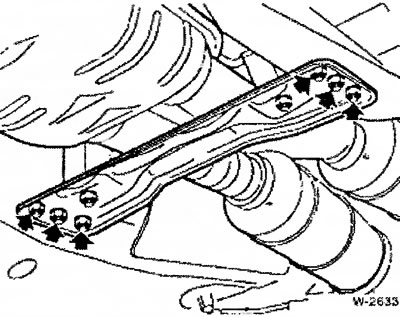
Unscrew the crossmember mount from the bottom side of the catalytic converter.
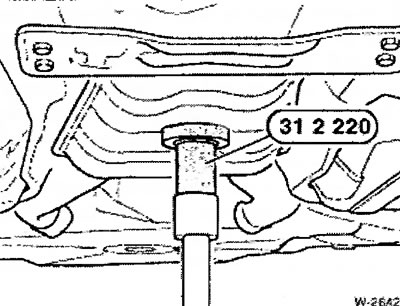
Support the exhaust system with a garage jack and suitable wooden blocks. The supported weight can be between 35 and 45 kg.
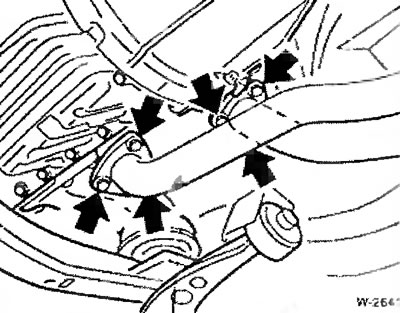
Unscrew the front exhaust pipe fastening from the exhaust manifold (the figure shows the exhaust system of a gasoline engine) or, respectively, from the turbocharger.
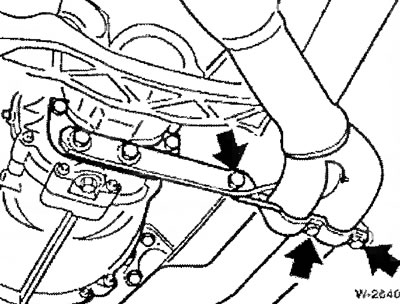
Unscrew the exhaust system mount from the gearbox bracket.
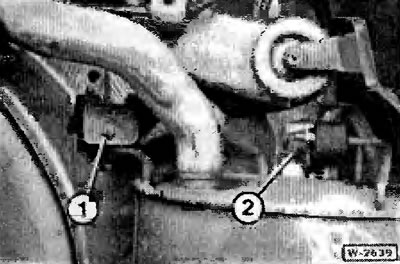
Unscrew hex nuts "1" and "2" on the bracket for the subsequent muffler.
Disconnect the exhaust system from the rubber holders and remove.
Before installing the exhaust system, check that the flange is not skewed in relation to the exhaust manifold; if necessary, straighten the flange.
Install the exhaust system and screw it to the brackets without tightening the mounting bolts too much.
Straighten the exhaust system so that there is a minimum distance of 25 mm to the body at all sections. In addition, the end pipe must be evenly spaced from the walls of the body recess at the rear of the car.
Diesel Engine: Bolt the front exhaust pipe to the turbocharger flange. Pre-check and replace the O-ring if necessary. Apply high-temperature copper grease to the O-ring.
Petrol engine: Place the front exhaust pipe with a new sealing gasket on the exhaust manifold and tighten evenly with new self-locking hex nuts. Tighten the mounting bolts to 30 Nm. Then tighten the bolts a second time to 50 Nm.
Tighten all bolts and nuts securely. Tighten the exhaust pipe bracket at the gearbox last so that it does not experience stress.
Tightening torques for bolted connections of the exhaust system, Nm:
Install the cross member and tighten the mounting bolts to 20 Nm.
Start the engine and check the exhaust system for leaks by covering the outlet of the final exhaust pipe with a rag. Ask an assistant to check all sealing flanges for gas leaks (hissing noise, leak can be felt by hand).
Install the lower engine compartment cover.
Lower the car.
Caution: When installing exhaust system components, ensure that the components are tightly joined. Otherwise, incorrect results may be obtained when measuring the emissions of harmful components in the exhaust gases.
Self-locking nuts and sealing gaskets must be replaced with new ones after removal. Retaining rings and rubber buffers must be checked for porosity and damage, and parts with defects must be replaced with new ones.
When installing a new exhaust system, it is recommended that all fastening parts are also replaced with new ones.
Removal
Raise and remove the car lower engine compartment cover.
Spray all bolts and nuts of the exhaust system with rust remover. Leave the product on the surfaces of the parts for a while to show its effect.
Unscrew the crossmember mount from the bottom side of the catalytic converter.
Support the exhaust system with a garage jack and suitable wooden blocks. The supported weight can be between 35 and 45 kg.
Unscrew the front exhaust pipe fastening from the exhaust manifold (the figure shows the exhaust system of a gasoline engine) or, respectively, from the turbocharger.
Unscrew the exhaust system mount from the gearbox bracket.
Unscrew hex nuts "1" and "2" on the bracket for the subsequent muffler.
Disconnect the exhaust system from the rubber holders and remove.
Caution: The catalytic converter is sensitive to impacts and should not be allowed to fall to the ground.
Installation
Before installing the exhaust system, check that the flange is not skewed in relation to the exhaust manifold; if necessary, straighten the flange.
Note: To make it easier to loosen the exhaust system nuts and bolts later, it is recommended to lubricate them with heat-resistant copper grease, such as Liqui Moly LM-508-ASC or CRC paste from BMW.
Install the exhaust system and screw it to the brackets without tightening the mounting bolts too much.
Straighten the exhaust system so that there is a minimum distance of 25 mm to the body at all sections. In addition, the end pipe must be evenly spaced from the walls of the body recess at the rear of the car.
Diesel Engine: Bolt the front exhaust pipe to the turbocharger flange. Pre-check and replace the O-ring if necessary. Apply high-temperature copper grease to the O-ring.
Petrol engine: Place the front exhaust pipe with a new sealing gasket on the exhaust manifold and tighten evenly with new self-locking hex nuts. Tighten the mounting bolts to 30 Nm. Then tighten the bolts a second time to 50 Nm.
Tighten all bolts and nuts securely. Tighten the exhaust pipe bracket at the gearbox last so that it does not experience stress.
Tightening torques for bolted connections of the exhaust system, Nm:
- exhaust pipe to exhaust manifold - 50;
- triangular flange joints - 20;
- exhaust pipe bracket at gearbox, thread M6 -10; thread M8-20;
- retaining pads - 20;
- subsequent muffler clamp - max. 15.
Install the cross member and tighten the mounting bolts to 20 Nm.
Start the engine and check the exhaust system for leaks by covering the outlet of the final exhaust pipe with a rag. Ask an assistant to check all sealing flanges for gas leaks (hissing noise, leak can be felt by hand).
Install the lower engine compartment cover.
Lower the car.
This article is available at russian, bulgarian, belarusian, ukrainian, serbian, croatian, romanian, polish, slovak, hungarian
Article verified: Ilyinsky Matvey
Share information:
Previous articles
БМВ E39: Exhaust system
Next articles
Similar articles on other types of BMW cars:
Removal and installation of the exhaust system BMW 3 Series E30 (1982-1994)
Removal and installation of the exhaust system BMW 3 Series E36 (1990-2000)
Removal and installation of the exhaust system BMW 7 Series E38 (1994-2001)
Exhaust system components — removal and installation BMW 7 Series E32 (1986-1994)
Removal and installation the airbag system module in the left or… BMW X3 E83 (2003-2010)
Removal and installation the engine BMW X5 E53 (1999-2006)
Removal and installation of the exhaust system BMW 3 Series E30 (1982-1994)
Removal and installation of the exhaust system BMW 3 Series E36 (1990-2000)
Removal and installation of the exhaust system BMW 7 Series E38 (1994-2001)
Exhaust system components — removal and installation BMW 7 Series E32 (1986-1994)
Removal and installation the airbag system module in the left or… BMW X3 E83 (2003-2010)
Removal and installation the engine BMW X5 E53 (1999-2006)
Link in different formats to this page
Visitor comments
No comments yet
- General information
- Governing bodies
- Manual
- Maintenance
- Power unit
- Engine repair
- Lubrication system
- Cooling system
- Ignition system
- Supply system
- Injection system (gasoline)
- Injection system (diesel)
- Exhaust system
- Transmission
- Clutch
- Car gearbox
- Front axle
- Rear axle
- Chassis
- Steering
- Brake system
- Wheels and tires
- Body
- Interior
- Exterior
- Heating system
- Electrical equipment
- Equipment and devices
- Power devices
- Windscreen wipers
- Electrical circuits
- General information
- Manual
- Maintenance
- Power unit
- Engine repair
- Ignition system
- Engine lubrication system
- Cooling system
- Fuel system (gasoline)
- Fuel system (diesel)
- Exhaust system
- Transmission
- Clutch
- Car gearbox
- Chassis
- Front and rear suspension
- Steering
- Brake system
- Body
- Exterior
- Interior
- Electrical equipment
- Heating system
- Equipment and devices
- Power devices
- Electrical circuits
- General information
- Manual
- Maintenance
- Power unit
- Engine in a car
- Engine overhaul
- Cooling system
- Supply system
- Ignition system
- Control system
- Transmission
- Clutch
- Manual gearbox
- Automatic gearbox
- Transmission line
- Chassis
- Steering
- Front suspension
- Rear suspension
- Brake system
- Body
- Body elements
- Car care and painting
- Electrical equipment
- Heater and air conditioner
- Equipment and devices
- Starter and generator
- Electrical circuits
- General information
- Operation and maintenance
- Specifications
- Power unit
- Engine repair
- Cooling and lubrication system
- Supply system
- Ecotronic power supply system
- Fuel injection system
- Ignition system
- Transmission
- Clutch
- Gearbox BMW 242/4
- Gearbox Getrag 262/8
- Gearbox Getrag 265/6
- Automatic gearbox
- Cardan gear
- Rear axle
- Chassis
- Steering
- Front suspension
- Rear suspension
- Brake system
- Electrical equipment
- Equipment and devices
- Electrical circuits