
Table of contents: General description ↓ Examination ↓ Replacement of components ↓ Precautionary measures ↓
- Home
- BMW 5 Series
- E28
- Power unit
- Control system
- Catalytic converter
Catalytic converter (BMW 5 Series E28)
Although the catalytic converter is an emission control component, it is discussed here because it is structurally part of the exhaust system. Always inspect the converter when raising the vehicle to inspect or service the exhaust system.
To reduce emissions of unburned hydrocarbons (HC), carbon monoxide (CO), and nitrogen oxides (NOx), the late model vehicles covered in this manual are equipped with a catalytic converter. The converter contains a ceramic honeycomb accumulator coated with precious metals that accelerate the reaction between the pollutants listed above and the oxygen in the exhaust gas. The pollutants are oxidized to form water (H2O), nitrogen monoxide (CO₂).
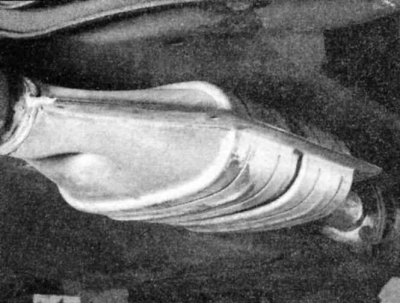
Typical catalytic converter (shown for engine M10, others are similar).
1. Visually inspect the converter (converters) for cracks or damage. Make sure all gulls and turns are tight.
2. Check the insulating cover (if installed), welded to the converter - it must be securely fastened.
3. Start the engine and let it idle.
4. Check for exhaust leaks through the converter flanges. Check for holes in the housings of all converters.
1. Raise the vehicle and support it on stands.
2. Inspect the catalytic converter for cracks or damage.
3. Check the tightness of the converter connections.
4. Check the insulating boot welded over the catalytic converter to protect it from damage and reduce mounting stress.
5. Start the engine and let it idle. Check all exhaust connections for exhaust leaks.
The catalytic converter is a reliable and simple device that does not require maintenance itself, but there are some circumstances that you need to be familiar with if you are interested in the correct operation of the converter throughout its service life.
General description
To reduce emissions of unburned hydrocarbons (HC), carbon monoxide (CO), and nitrogen oxides (NOx), the late model vehicles covered in this manual are equipped with a catalytic converter. The converter contains a ceramic honeycomb accumulator coated with precious metals that accelerate the reaction between the pollutants listed above and the oxygen in the exhaust gas. The pollutants are oxidized to form water (H2O), nitrogen monoxide (CO₂).
Typical catalytic converter (shown for engine M10, others are similar).
Examination
1. Visually inspect the converter (converters) for cracks or damage. Make sure all gulls and turns are tight.
2. Check the insulating cover (if installed), welded to the converter - it must be securely fastened.
If the insulating cover is dented so that it touches the converter body, overheating of the floor may occur.
3. Start the engine and let it idle.
4. Check for exhaust leaks through the converter flanges. Check for holes in the housings of all converters.
Replacement of components
1. Raise the vehicle and support it on stands.
2. Inspect the catalytic converter for cracks or damage.
3. Check the tightness of the converter connections.
4. Check the insulating boot welded over the catalytic converter to protect it from damage and reduce mounting stress.
If the insulating casing is dented so that it touches the inner housing of the converter, excess heat may be transferred to the floor.
5. Start the engine and let it idle. Check all exhaust connections for exhaust leaks.
Precautionary measures
The catalytic converter is a reliable and simple device that does not require maintenance itself, but there are some circumstances that you need to be familiar with if you are interested in the correct operation of the converter throughout its service life.
- Do not use leaded gasoline in a vehicle with a catalytic converter - the lead will settle on the precious metals, reducing efficiency and destroying the converter.
- Always maintain the ignition system and fuel system in accordance with the manufacturer's requirements as specified in Chapter Routine car maintenance. In particular, do not forget to replace the air cleaner filter element and fuel filter in time (if installed) and spark plugs. If the air/fuel mixture is too rich, unburned fuel will enter the catalytic converter, overheating the element and destroying the converter.
- If the engine is misfiring, do not drive the car at all (or as little as possible), until the problem is corrected - the missed flash results in unburned fuel entering the converter, which leads to the overheating described above.
- Do not tow or push start the vehicle - this will introduce unburned fuel into the catalytic converter, causing the engine to overheat after starting - see (b) and (c).
- Do not turn off the ignition at high engine speeds, i.e. do not press the throttle pedal before stopping the engine. If the ignition is turned off at anything other than idle speed, unburned fuel will get into the (very hot) catalytic converter with the possibility of its ignition and damage to the converter.
- Do not use fuel or engine oil additives - they may contain substances harmful to the catalytic converter.
- Do not operate the vehicle if noticeable amounts of blue smoke are emitted due to hot engine oil - unburned carbon deposits will clog the converter channels and reduce its efficiency; in some cases the element will overheat.
- Remember that the catalytic converter operates at very high temperatures, so heat is reflected off the floor of the car - the cover becomes hot enough to ignite materials stuck to it. Therefore, do not park the car on dry grass, piles of dry leaves or in tall grass.
- Remember that the catalytic converter is fragile - do not hit it with tools when working on the exhaust system. Make sure the converter is well away from jacks or other lifting devices and do not drive the car on rough roads, potholes or other places where the converter can catch on the ground.
- In some cases, particularly when the vehicle is new and/or used in stop/start mode, a sulfur smell may appear in the exhaust gases (rotten egg smell). This often happens to vehicles equipped with catalytic converters and is due to small amounts of sulfur in some gasoline grades, which reacts with the hydrogen in the exhaust gases to form hydrogen sulfide (H2S); - although this gas is toxic, it is not produced in such significant quantities as to be a problem. After the car has driven the first few thousand kilometers, the phenomenon should disappear - otherwise, changing your driving style or the brand of gasoline may solve the problem.
- A catalytic converter on a well-maintained and properly used car will last between 90,000 and 180,000 kilometers - after which CO levels should be checked regularly to monitor the converter's efficiency. If the converter loses efficiency, it should be replaced.
This article is available at russian, bulgarian, belarusian, ukrainian, serbian, croatian, romanian, polish, slovak, hungarian
Article verified: Zhuravleva Isolda
Share information:
Previous articles
БМВ E28: Control system
Next articles
Similar articles on other types of BMW cars:
Cars with a catalytic converter BMW 3 Series E30 (1982-1994)
Operation of vehicles with a catalytic converter BMW 3 Series E36 (1990-2000)
Features of operation of cars with a catalytic converter BMW 7 Series E38 (1994-2001)
Rules for operating vehicles with catalytic converters BMW 7 Series E32 (1986-1994)
Replacing the EGR valve pressure converter BMW X5 E53 (1999-2006)
Cars with a catalytic converter BMW 3 Series E30 (1982-1994)
Operation of vehicles with a catalytic converter BMW 3 Series E36 (1990-2000)
Features of operation of cars with a catalytic converter BMW 7 Series E38 (1994-2001)
Rules for operating vehicles with catalytic converters BMW 7 Series E32 (1986-1994)
Replacing the EGR valve pressure converter BMW X5 E53 (1999-2006)
Link in different formats to this page
Visitor comments
No comments yet
- General information
- Governing bodies
- Manual
- Maintenance
- Power unit
- Engine repair
- Lubrication system
- Cooling system
- Ignition system
- Supply system
- Injection system (gasoline)
- Injection system (diesel)
- Exhaust system
- Transmission
- Clutch
- Car gearbox
- Front axle
- Rear axle
- Chassis
- Steering
- Brake system
- Wheels and tires
- Body
- Interior
- Exterior
- Heating system
- Electrical equipment
- Equipment and devices
- Power devices
- Windscreen wipers
- Electrical circuits
- General information
- Manual
- Maintenance
- Power unit
- Engine repair
- Ignition system
- Engine lubrication system
- Cooling system
- Fuel system (gasoline)
- Fuel system (diesel)
- Exhaust system
- Transmission
- Clutch
- Car gearbox
- Chassis
- Front and rear suspension
- Steering
- Brake system
- Body
- Exterior
- Interior
- Electrical equipment
- Heating system
- Equipment and devices
- Power devices
- Electrical circuits
- General information
- Manual
- Maintenance
- Power unit
- Engine in a car
- Engine overhaul
- Cooling system
- Supply system
- Ignition system
- Control system
- Transmission
- Clutch
- Manual gearbox
- Automatic gearbox
- Transmission line
- Chassis
- Steering
- Front suspension
- Rear suspension
- Brake system
- Body
- Body elements
- Car care and painting
- Electrical equipment
- Heater and air conditioner
- Equipment and devices
- Starter and generator
- Electrical circuits
- General information
- Operation and maintenance
- Specifications
- Power unit
- Engine repair
- Cooling and lubrication system
- Supply system
- Ecotronic power supply system
- Fuel injection system
- Ignition system
- Transmission
- Clutch
- Gearbox BMW 242/4
- Gearbox Getrag 262/8
- Gearbox Getrag 265/6
- Automatic gearbox
- Cardan gear
- Rear axle
- Chassis
- Steering
- Front suspension
- Rear suspension
- Brake system
- Electrical equipment
- Equipment and devices
- Electrical circuits