
Table of contents: Basic information ↓ Pumping ↓
- Home
- BMW 3 Series
- E46
- Transmission
- Clutch
- Clutch hydraulic system — bleeding
Clutch hydraulic system — bleeding (BMW 3 Series E46)
Warning! Hydraulic fluid is poisonous. If the fluid comes into contact with your skin, rinse it off immediately with water. If the fluid gets into your eyes, seek medical attention immediately. Some types of fluid are flammable and ignite when in contact with hot objects. Observe fire safety precautions when working with the hydraulic system. In addition, hydraulic fluid can damage the paintwork of your car and dissolve some plastics. If the fluid bursts onto plastic or paint, rinse it off immediately with water. Finally, this fluid is hygroscopic (absorbs moisture from the air), therefore, do not use old fluid. When replacing or adding fluid, use only the recommended type of fluid and store it in a sealed container.
Note: BMW recommends using a pressure bleeding device to bleed the hydraulic system.
Basic information
1. Any hydraulic system can only operate if there is no air in its circuit. This is achieved by removing air (pumping) the hydraulic system.
2. When bleeding the hydraulic system, add only clean, fresh fluid of the recommended type. Never reuse fluid. Purchase the required amount of fluid before starting work.
3. If there is even a slight possibility that the clutch or brake hydraulic system contains a different type of fluid, the brake system and clutch drive components must be flushed with the recommended type of fluid and all hydraulic system seals and cuffs must be replaced.
4. If the fluid level in the reservoir is excessively low due to leaks and air has entered the hydraulic system, eliminate the fluid leak before bleeding.
5. For ease of access, apply the parking brake, then raise the front of the vehicle and support it securely (see "Lifting and installing the car on supports").
6. Remove the screws and engine crankcase guard to facilitate access to the gearbox housing.
7. Make sure that the clutch hoses and lines are securely fastened and that the bleed screw is tightened. The bleed screw is located on the rear side of the clutch slave cylinder. The screw is accessible from underneath the vehicle, on the left side. Clean the screw and the area around it from dirt (Fig. 6.7).
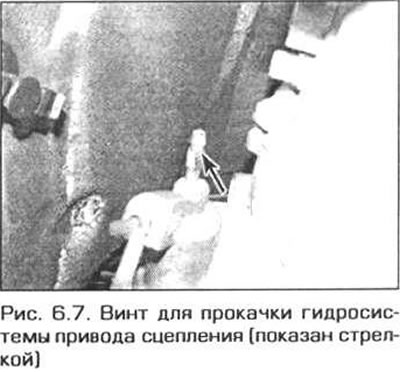
8. Remove the cap from the hydraulic fluid reservoir and add fluid up to the MAX mark. Replace the cap and tighten it slightly. Make sure that the fluid level in the reservoir does not fall below the MIN mark during bleeding. Keep in mind that the reservoir supplies both the clutch hydraulic drive and the brake system.
9. A pressure bleeding device is recommended for bleeding the system. Alternatively, you can use any device for bleeding the brake system without an assistant (this device can be purchased at an auto parts store). Such devices significantly facilitate the bleeding process, and also reduce the risk of air entering the hydraulic system during bleeding. If you do not have such a device, you can use the method of bleeding the hydraulic system together (this method is described in more detail below).
10. If you are using a pressure bleeder or other device, prepare the vehicle (as described above) and bleed the system following the device manufacturer's instructions, as the bleeding procedure varies depending on the type of device used. Bleeding methods using the most common devices are described below.
Pumping
Basic method (pumping together)
12. Prepare a transparent glass container and a piece of rubber tube that fits tightly onto the bleed screw, as well as a wrench to unscrew the screw. You will need an assistant for this work.
13. Remove the cap from the bleed screw (if it exists). Place the wrench and tube on the screw and lower the other end of the tube into the glass container. Pour clean liquid into the container so that the end of the tube is immersed in it.
14. During the entire bleeding procedure, monitor the fluid level in the master cylinder reservoir and do not allow it to drop below the MIN mark.
15. Ask an assistant to press the clutch pedal several times, then press the pedal and hold it down.
16. With the clutch pedal depressed, loosen the bleed screw approximately one turn and allow the fluid and air to drain into the container. Have your assistant hold the clutch pedal depressed and not release it without your command. Once the fluid stops flowing, tighten the screw and have your assistant slowly release the pedal. Add fluid to the master cylinder reservoir.
17. Repeat the procedure described in points 15 and 16 until the liquid flowing out of the tube no longer contains air bubbles.
18. After finishing bleeding, tighten the screw securely. Do not overtighten it.
19. Temporarily remove the hose from the screw and set the container aside.
20. Loosen the two mounting nuts and remove the clutch slave cylinder from the gearbox housing, avoiding excessive tension on the hose.
21. Place the tube back on the bleed screw and immerse the other end of the tube in a container of liquid.
22. Position the cylinder so that the screw is facing vertically upwards and turn it out approximately one turn. Slowly push the plunger into the cylinder until all air bubbles are released from the cylinder.
23. While holding the plunger in the depressed position, tighten the bleed screw.
24. Allow the tappet to return slowly to its original position. Do not allow the tappet to move quickly, as this may cause air to enter the slave cylinder.
25. Remove the tube and wrench from the screw and place the protective cap on the screw.
26. Install the slave cylinder in place and tighten the mounting nuts to the required torque.
Bleeding with a device with a shut-off valve
27. As their name suggests, these devices consist of a hose that has a check valve built into it to prevent air and fluid from getting back into the hydraulic system. Some of these devices come with a clear container that makes it easy to see the air bubbles escaping from the hydraulic system.
28. The device is put on the bleed screw, which is then unscrewed. After this, you need to sit in the driver's seat and slowly press and release the clutch pedal until air stops coming out of the hydraulic system.
29. Keep in mind that the bleeding process with this device becomes so simple that it is very easy to forget about the need to maintain the fluid level in the master cylinder reservoir.
Pumping under pressure
30. Such devices usually use compressed air from the spare tire for their work. In some cases, the air pressure in the tire must be reduced compared to the normal one. Carefully study the instructions for using this device.
31. The device includes a container with pressurized liquid. After the container with liquid is connected to the master cylinder reservoir, it is necessary to unscrew the bleed screw and allow the liquid to flow out until air bubbles stop coming out.
32. This method is preferred because the device has a large fluid reservoir, which prevents the fluid level in the master cylinder reservoir from dropping.
All methods
33. If after bleeding there is still air left in the system, remove the slave cylinder (see paragraph 4), without disconnecting the hose from it, push the piston in and turn the cylinder so that the bleed screw is facing up. Repeat the bleeding procedure.
Note: Secure the working cylinder piston so that it cannot move out of the cylinder.
34. After bleeding, remove all traces of spilled liquid with a rag, make sure the bleeding screw is securely tightened and put the protective cap on the screw.
35. Check the fluid level in the master cylinder reservoir and bring it to the required level (see "Weekly checks").
36. Discard any fluid remaining after bleeding. Never reuse this fluid.
37. Check the operation of the clutch pedal. If you feel elastic resistance when pressing the pedal, this indicates the presence of air in the hydraulic system and the need for additional bleeding. If the hydraulic system does not bleed after several attempts, this indicates excessive wear of the seals of the master or slave cylinder.
38. After finishing the work, install the engine crankcase guard and lower the vehicle.
This article is available at russian, bulgarian, belarusian, ukrainian, serbian, croatian, romanian, polish, slovak, hungarian
Article verified: Ilyinsky Matvey
Share information:
Previous articles
БМВ E46: Clutch
Next articles
Similar articles on other types of BMW cars:
Bleeding the hydraulic clutch system BMW 5 Series E28 (1981-1988)
Bleeding the clutch hydraulic drive BMW 5 Series E12 (1972-1981)
Bleeding the Clutch Hydraulic System BMW 7 Series E32 (1986-1994)
Checking the brake system and clutch BMW 7 Series E38 (1994-2001)
Bleeding the clutch hydraulic drive BMW X3 E83 (2003-2010)
Hydraulic clutch system BMW X5 E53 (1999-2006)
Bleeding the hydraulic clutch system BMW 5 Series E28 (1981-1988)
Bleeding the clutch hydraulic drive BMW 5 Series E12 (1972-1981)
Bleeding the Clutch Hydraulic System BMW 7 Series E32 (1986-1994)
Checking the brake system and clutch BMW 7 Series E38 (1994-2001)
Bleeding the clutch hydraulic drive BMW X3 E83 (2003-2010)
Hydraulic clutch system BMW X5 E53 (1999-2006)
Link in different formats to this page
Visitor comments
No comments yet
- General information
- Manual
- Maintenance
- Power unit
- Engine repair
- Cooling system
- Power system (gasoline)
- Injection system (gasoline)
- Fuel system (diesel)
- Exhaust system
- Ignition system
- Charge and launch systems
- Transmission
- Car gearbox
- Clutch and drive shafts
- Chassis
- Brake system
- Suspension front and rear
- Steering
- Body
- Body care and repair
- Exterior
- Interior
- Electrical equipment
- Troubleshooting
- Lighting and signaling
- Equipment and devices
- Heater and air conditioner
- Electrical circuits
- General information
- Manual
- Repair on the road
- Weekly checks
- Maintenance
- Troubleshooting
- Power unit
- 4 cylinder engines
- 6 cylinder engines
- Engine overhaul
- Cooling and heating
- Fuel and exhaust system
- Starting and charging system
- Ignition system
- Transmission
- Clutch
- Mechanical gearbox
- Automatic gearbox
- Cardan and drive shafts
- Chassis
- Brake system
- Wheel suspension
- Steering
- Body
- Exterior
- Interior
- Electrical equipment
- Equipment and devices
- Electrical circuits
- General information
- Maintenance
- Power unit
- Engine repair
- Cooling system
- Ignition system
- Supply system
- Fuel injection system
- Exhaust system
- Transmission
- Clutch
- Car gearbox
- Front and rear axle
- Chassis
- Steering
- Brake system
- Body
- Exterior
- Interior
- Electrical equipment
- Heating system
- Equipment and devices
- Power devices
- Electrical circuits
- Power unit
- M10/M20 engine
- M40 engine
- Ignition system
- Lubrication system
- Cooling system
- Supply system
- Fuel injection
- Exhaust system
- Transmission
- Clutch
- Manual gearbox
- Front axle
- Rear axle
- Chassis
- Steering
- Brake system
- Body
- Exterior
- Interior
- Electrical equipment
- Heating system
- Equipment and devices
- Electrical circuits
- General information
- Specifications
- Operation and maintenance
- 4-cylinder engine
- Engine repair
- Cooling and lubrication system
- Supply system
- Ignition system
- 6-cylinder engine
- Engine repair
- Cooling and lubrication system
- Supply system
- Fuel injection system
- Ignition system
- Transmission
- Clutch
- 4-speed manual gearbox
- 5-speed manual gearbox
- Automatic gearbox
- Cardan and rear axle
- Chassis
- Steering
- Front suspension
- Rear suspension
- Brake system
- Electrical equipment
- Equipment and devices
- Electrical circuits