
Cars Mazda Cars Mitsubishi Cars Toyota Cars Chevrolet Cars AvtoVAZ Cars Kia Cars Nissan
English Русский
Български
Беларускі
Український
Српски
Hrvatski
Română
Polski
Slovenský
Magyar
| Articles | Contacts | Sitemap |   
BMWman.ru


3 series   5 series   7 series   BMW X3   BMW X5   BMW X6

E39 (1995-2003) E34 (1988-1996) E28 (1981-1988) E12 (1972-1981)
  • Home
  • BMW 5 Series
  • E28
  • General information
  • Manual
  • Working conditions and tools

Working conditions and tools (BMW 5 Series E28)

            0

To carry out repair work, a clean, well-lit work area is required, which is equipped with a workbench and a vice. There should be enough space to lay out the parts and arrange them so that they do not have to be constantly cleaned. Working in a well-equipped room is a pleasure, the car can be disassembled and reassembled. Unfortunately, not everyone has such an ideal work area and therefore is forced to improvise. To compensate for this shortcoming, more time and accuracy are required.

An essential component of a repair is a complete set of quality tools. Quality is the most important requirement here, as a cheap tool can become very expensive because it jumps off and destroys expensive parts. A good quality tool can be used for a long time and ultimately compensates for the cost of its purchase. The basis of the tool set is a set of wrenches that can be installed in any easily accessible place. A set of open-end wrenches is an excellent addition to the previous set, especially in the case of tightly seated bolts and nuts or when there is a lack of space. To reduce costs, you can also use a set of combination wrenches, which have a regular open-end wrench on one end and an open-end wrench of the same size on the other. The picture below shows what these wrenches look like.
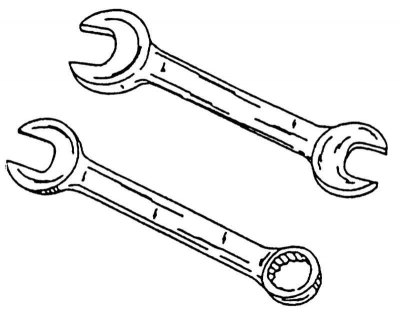
An essential component of a repair is a complete set of quality tools. Quality is the most…


The appearance of regular (top) and combination wrenches (bottom).


You will also need a set of socket heads. They can be used to loosen deep-set bolts and nuts. The next necessary item is a set of Phillips screwdrivers, pliers and a hammer. In addition to the basic set, you can add several special tools, which in most cases are invaluable, especially if certain jobs need to be done quite often. This saves a lot of time. An example is an impact screwdriver, without which it is hardly possible to loosen industrially tightened Phillips bolts without damaging them. Of course, it can be used to tighten sealed connections. Also often needed are pliers for retaining rings, which secure gearbox gears, shafts and similar parts, and it is quite difficult to remove retaining rings with a regular screwdriver. There are two types of pliers for retaining rings, one for outer rings, the other for inner ones. They have straight or curved grips. One of the most useful tools is a torque wrench, a type of wrench that can be adjusted so that it will turn freely when a certain torque is reached. There are similar wrenches with a dial indicator that shows the torque reached. Torque values are specified in any modern repair manual, so that complex components such as cylinder heads can be tightened without the risk of damage from overtightening.

The more modern the car model, the more tools are required to keep the car in a state ready for use. Unfortunately, some specific jobs cannot be done without the use of special equipment, and can seriously undermine your budget if not entrusted to specialists. There are also simple jobs that are also best left to specialists. Although a universal measuring device is of great help, in the wrong hands it can cause major damage to electrical equipment.

Although this guide shows how to perform various jobs without special tools (when its use is not necessary), it is still better to work with a special tool. This is especially worth doing if the car has a high mileage. Various parts can also be removed and installed using improvised methods and tools without the risk of damaging them. However, using a special tool prescribed by the company will in any case save a lot of time and nerves.

[The original article is located on BMWMAN.RU]

This article is available at russian, bulgarian, belarusian, ukrainian, serbian, croatian, romanian, polish, slovak, hungarian
Article verified: Zhuravleva Isolda

Share information:
Previous articles
БМВ E28: Manual
Next articles

Vehicle Identification Numbers
Jacking, towing and changing wheels
Purchase of spare parts
Starting the engine from an auxiliary source
Anti-theft audio system and instrument cluster language
Main controls


Similar articles on other types of BMW cars:
Safety precautions when working with the ignition system BMW 3 Series E30 (1982-1994)
Tools and accessories BMW 3 Series E46 (1998-2006, petrol)
Precautions when working with the ignition system BMW 7 Series E32 (1986-1994)
Service technology, tools and workplace equipment BMW 7 Series E38 (1994-2001)
Safety precautions and rules when working on a vehicle BMW X3 E83 (2003-2010)
Safety precautions when working with the fuel system BMW X5 E53 (1999-2006)
Link in different formats to this page


Visitor comments

No comments yet


How much 23 + 48 =


BMW E39 (1995-2003) 
  • General information
  • Governing bodies
  • Manual
  • Maintenance
  • Power unit
  • Engine repair
  • Lubrication system
  • Cooling system
  • Ignition system
  • Supply system
  • Injection system (gasoline)
  • Injection system (diesel)
  • Exhaust system
  • Transmission
  • Clutch
  • Car gearbox
  • Front axle
  • Rear axle
  • Chassis
  • Steering
  • Brake system
  • Wheels and tires
  • Body
  • Interior
  • Exterior
  • Heating system
  • Electrical equipment
  • Equipment and devices
  • Power devices
  • Windscreen wipers
  • Electrical circuits
BMW E34 (1988-1996) 
  • General information
  • Manual
  • Maintenance
  • Power unit
  • Engine repair
  • Ignition system
  • Engine lubrication system
  • Cooling system
  • Fuel system (gasoline)
  • Fuel system (diesel)
  • Exhaust system
  • Transmission
  • Clutch
  • Car gearbox
  • Chassis
  • Front and rear suspension
  • Steering
  • Brake system
  • Body
  • Exterior
  • Interior
  • Electrical equipment
  • Heating system
  • Equipment and devices
  • Power devices
  • Electrical circuits
BMW E28 (1981-1988) 
  • General information
  • Manual
  • Maintenance
  • Power unit
  • Engine in a car
  • Engine overhaul
  • Cooling system
  • Supply system
  • Ignition system
  • Control system
  • Transmission
  • Clutch
  • Manual gearbox
  • Automatic gearbox
  • Transmission line
  • Chassis
  • Steering
  • Front suspension
  • Rear suspension
  • Brake system
  • Body
  • Body elements
  • Car care and painting
  • Electrical equipment
  • Heater and air conditioner
  • Equipment and devices
  • Starter and generator
  • Electrical circuits
BMW E12 (1972-1981) 
  • General information
  • Operation and maintenance
  • Specifications
  • Power unit
  • Engine repair
  • Cooling and lubrication system
  • Supply system
  • Ecotronic power supply system
  • Fuel injection system
  • Ignition system
  • Transmission
  • Clutch
  • Gearbox BMW 242/4
  • Gearbox Getrag 262/8
  • Gearbox Getrag 265/6
  • Automatic gearbox
  • Cardan gear
  • Rear axle
  • Chassis
  • Steering
  • Front suspension
  • Rear suspension
  • Brake system
  • Electrical equipment
  • Equipment and devices
  • Electrical circuits
BMWman.ru © 2017-2026 · Mobile version · News and articles · Sitemap: EN BG BY UA RS HR RO PL SK HU · Feedback · Site search
3er E21 · 3er E30 · 3er E36 · 3er E46 [petrol] · 3er E46 · 5er E12 · 5er E28 · 5er E34 · 5er E39 · 7er E32 · 7er E38 · X3 E83 · X5 E53 ·
This site uses cookies 🍪, without them some features simply would not work.