



Table of contents: Removal ↓ Installation ↓
- Home
- BMW 5 Series
- E34
- General information
- Maintenance
- Checking and replacing spark plugs
Checking and replacing spark plugs (BMW 5 Series E34)
Special tool required:
The following wearing parts must be purchased:
Spark plugs should be replaced every 20,000 km. Platinum spark plugs generally have a longer service life. They should be replaced when the central electrode is no longer visible in the insulator leg.
Remove the oil filler cap.
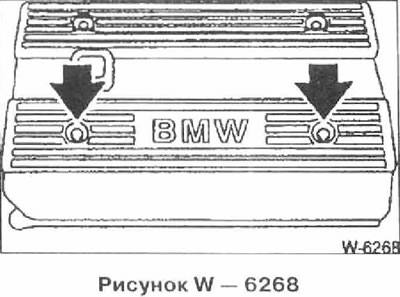
Remove the caps from the mounting bolts, unscrew the two bolts located under the caps. Remove the cylinder head cover.
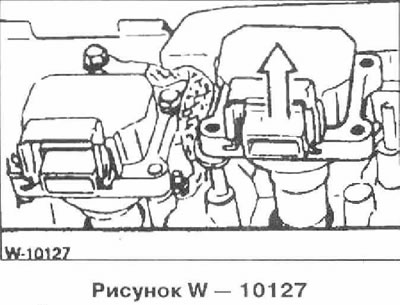
Remove the connectors from all ignition coils by moving the connector brackets away.
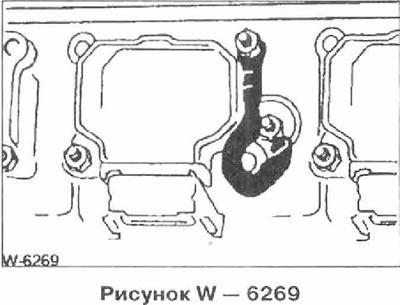
Loosen the mounting bolts of all ignition coils and remove the ignition coils.
Remove all the sowing tips, pulling not by the wire, but by the tip. The mentioned pliers make removal easier.
Blow out the spark plug recesses in the cylinder head with compressed air to prevent dirt from getting into the threaded holes when the spark plugs are removed.
Using a special spark plug wrench, remove all spark plugs.
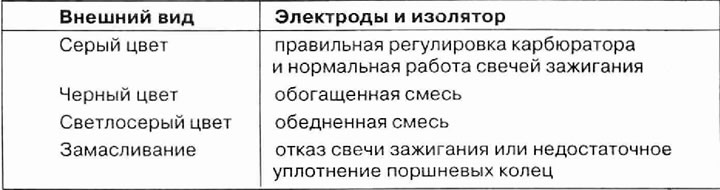
Inspect the spark plugs. With some experience, you can tell how the engine is running by looking at the spark plug.
Table 1
Check the spark plug insulators for leakage currents. Leakage currents leave thin, uneven marks on the surface. If traces of leakage currents cannot be completely removed, replace the spark plug.
Clean the spark plugs with a brass brush or sandblast.
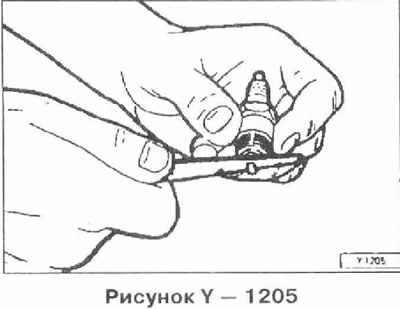
All engines except four-valve: Check the interelectrode distance using feeler gauges. Specified value: 0.7-0.8 mm. On new spark plugs, the interelectrode distance is usually set correctly.
If it is necessary to bend the central electrode at a right angle to compensate for burning.
To adjust the distance between the electrodes, bend the ground electrode. There is a simple, practical tool for this, in the absence of which you can lightly hit the electrode from the side. When bending, rest a small screwdriver on the edge of the spark plug thread, but not on the central electrode, so as not to damage it.
Clean the threads on the spark plugs and in the cylinder head.
Screw the spark plugs into the cylinder head by hand until they stop.
Tighten the spark plugs to 25 Nm.
Connect the spark plug caps in accordance with the firing sequence 1-5-3-6-2-4.
Check the reliability of the spark plug caps by rocking them.
Four-valve engines: Install the ignition coils and housings. Installation is performed in the reverse order. Check the reliability of the connectors and ground jumpers.
(The original article is available on the website «bmwman»)
- A spark plug wrench, included in the on-board tool kit or available commercially.
- Additionally, it is recommended to purchase special pliers, such as HAZET 1849, which make it easier to remove spark plug tips.
The following wearing parts must be purchased:
- Spark plugs of the recommended type.
Spark plugs should be replaced every 20,000 km. Platinum spark plugs generally have a longer service life. They should be replaced when the central electrode is no longer visible in the insulator leg.
Removal
Only 520i/525i models produced since May 1990. (four-valve engines)
Remove the oil filler cap.
Remove the caps from the mounting bolts, unscrew the two bolts located under the caps. Remove the cylinder head cover.
Remove the connectors from all ignition coils by moving the connector brackets away.
Loosen the mounting bolts of all ignition coils and remove the ignition coils.
Note: There are ground jumpers on the ignition coils of the 3rd and 6th cylinders. When installing them, they should be screwed into the same places.
Remove all the sowing tips, pulling not by the wire, but by the tip. The mentioned pliers make removal easier.
Blow out the spark plug recesses in the cylinder head with compressed air to prevent dirt from getting into the threaded holes when the spark plugs are removed.
Using a special spark plug wrench, remove all spark plugs.
Inspect the spark plugs. With some experience, you can tell how the engine is running by looking at the spark plug.
Table 1
Check the spark plug insulators for leakage currents. Leakage currents leave thin, uneven marks on the surface. If traces of leakage currents cannot be completely removed, replace the spark plug.
Clean the spark plugs with a brass brush or sandblast.
Installation
All engines except four-valve: Check the interelectrode distance using feeler gauges. Specified value: 0.7-0.8 mm. On new spark plugs, the interelectrode distance is usually set correctly.
If it is necessary to bend the central electrode at a right angle to compensate for burning.
To adjust the distance between the electrodes, bend the ground electrode. There is a simple, practical tool for this, in the absence of which you can lightly hit the electrode from the side. When bending, rest a small screwdriver on the edge of the spark plug thread, but not on the central electrode, so as not to damage it.
Clean the threads on the spark plugs and in the cylinder head.
Screw the spark plugs into the cylinder head by hand until they stop.
Caution: Do not allow the spark plugs to become tilted.
Tighten the spark plugs to 25 Nm.
Attention: If you do not have a torque wrench available, then you must turn the candle with a flat seat A with the candle wrench approximately 90° (¼ turn. Candles with a conical seat should be rotated approximately 15 degrees, as well as used candles with a flat seat. If the spark plugs are too tight, they may break off when they are turned out, or the threads in the cylinder head may be damaged. In this case, it is necessary to repair the candle holes using UTC or Heli-Coli inserts.
Connect the spark plug caps in accordance with the firing sequence 1-5-3-6-2-4.
Check the reliability of the spark plug caps by rocking them.
Four-valve engines: Install the ignition coils and housings. Installation is performed in the reverse order. Check the reliability of the connectors and ground jumpers.
(The original article is available on the website «bmwman»)
This article is available at russian, bulgarian, belarusian, ukrainian, serbian, croatian, romanian, polish, slovak, hungarian
Article verified: Polikarpov Saveliy
Share information:
Previous articles
БМВ E34: Maintenance
Next articles
Similar articles on other types of BMW cars:
Replacing spark plugs/checking electrical connections BMW 3 Series E36 (1990-2000)
Checking and replacing spark plugs BMW X5 E53 (1999-2006)
Replacing spark plugs BMW 7 Series E38 (1994-2001)
Identifying engine faults by the condition of spark plugs BMW X3 E83 (2003-2010)
Replacing spark plugs/checking electrical connections BMW 3 Series E36 (1990-2000)
Checking and replacing spark plugs BMW X5 E53 (1999-2006)
Replacing spark plugs BMW 7 Series E38 (1994-2001)
Identifying engine faults by the condition of spark plugs BMW X3 E83 (2003-2010)
Link in different formats to this page
Visitor comments
No comments yet
- General information
- Governing bodies
- Manual
- Maintenance
- Power unit
- Engine repair
- Lubrication system
- Cooling system
- Ignition system
- Supply system
- Injection system (gasoline)
- Injection system (diesel)
- Exhaust system
- Transmission
- Clutch
- Car gearbox
- Front axle
- Rear axle
- Chassis
- Steering
- Brake system
- Wheels and tires
- Body
- Interior
- Exterior
- Heating system
- Electrical equipment
- Equipment and devices
- Power devices
- Windscreen wipers
- Electrical circuits
- General information
- Manual
- Maintenance
- Power unit
- Engine repair
- Ignition system
- Engine lubrication system
- Cooling system
- Fuel system (gasoline)
- Fuel system (diesel)
- Exhaust system
- Transmission
- Clutch
- Car gearbox
- Chassis
- Front and rear suspension
- Steering
- Brake system
- Body
- Exterior
- Interior
- Electrical equipment
- Heating system
- Equipment and devices
- Power devices
- Electrical circuits
- General information
- Manual
- Maintenance
- Power unit
- Engine in a car
- Engine overhaul
- Cooling system
- Supply system
- Ignition system
- Control system
- Transmission
- Clutch
- Manual gearbox
- Automatic gearbox
- Transmission line
- Chassis
- Steering
- Front suspension
- Rear suspension
- Brake system
- Body
- Body elements
- Car care and painting
- Electrical equipment
- Heater and air conditioner
- Equipment and devices
- Starter and generator
- Electrical circuits
- General information
- Operation and maintenance
- Specifications
- Power unit
- Engine repair
- Cooling and lubrication system
- Supply system
- Ecotronic power supply system
- Fuel injection system
- Ignition system
- Transmission
- Clutch
- Gearbox BMW 242/4
- Gearbox Getrag 262/8
- Gearbox Getrag 265/6
- Automatic gearbox
- Cardan gear
- Rear axle
- Chassis
- Steering
- Front suspension
- Rear suspension
- Brake system
- Electrical equipment
- Equipment and devices
- Electrical circuits