
- Home
- BMW 5 Series
- E39
- General information
- Governing bodies
- Specifications and technical characteristics of cars
Specifications and technical characteristics of cars (BMW 5 Series E39)
Fuel
Petrol engines
Unleaded gasoline is not worse than AI-95 (engines with catalytic converter).
Unleaded or leaded gasoline no worse than AI-95 (engines without catalytic converter).
It is permissible to use gasoline no worse than AI-91, but in this case engine power decreases and fuel consumption increases.
Diesel engines
Automotive (not marine or boiler) summer or winter diesel fuel with a sulfur content of no more than 0.5%. Do not use biodiesel fuel and rapeseed oil methyl ester.
Preheating the fuel in the filter prevents the fuel from thickening while the vehicle is moving.
Do not use special means to reduce fuel viscosity.
When the outside air temperature drops below -9°C, kerosene is added to the summer diesel fuel (in % of the total volume):
- From -9 to -15°C — 10%
- From -15 to -25°C — 30%
- Below -25°C — 50%
When the outside air temperature drops below -20°C, add a viscosity reducer or kerosene to winter diesel fuel (in % of the total volume):
- From -20 to -26°C — 10%
- From -26 to -31°C — 30%
- Below -31°C — 50%
As an exception, the addition of up to 30% low-octane gasoline is permitted (unleaded for vehicles with catalytic converter) to diesel fuel.
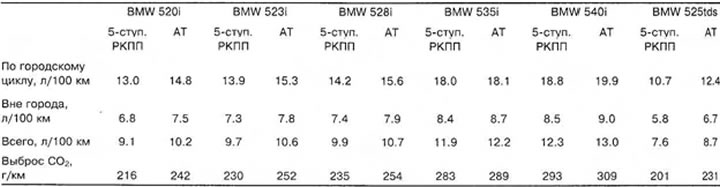
Fuel consumption, CO₂ emissions
Fuel consumption is determined according to a uniform test method (93/116/EC) and is not identical to average operating consumption, which depends on many different factors, in particular driving style, vehicle load, road conditions, traffic volume, presence of traffic flow, weather, tire pressure, etc. Engine power or its share expended when the vehicle is moving (in serial configuration), measured under the conditions defined by the standards 80/1269 EG or DIN 70 020, which also specify the permissible deviations. Some elements of additional equipment (roof rack, wide-profile tires, additional mirrors, etc.) sometimes have a significant impact on fuel consumption, as they tend to change the weight and drag coefficient of the vehicle.
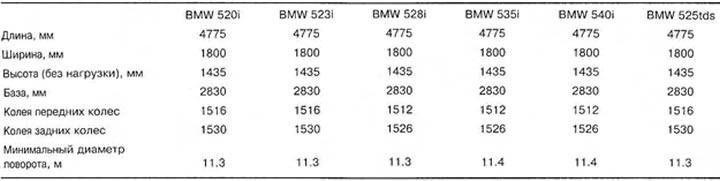
Overall dimensions of the car
Weight characteristics
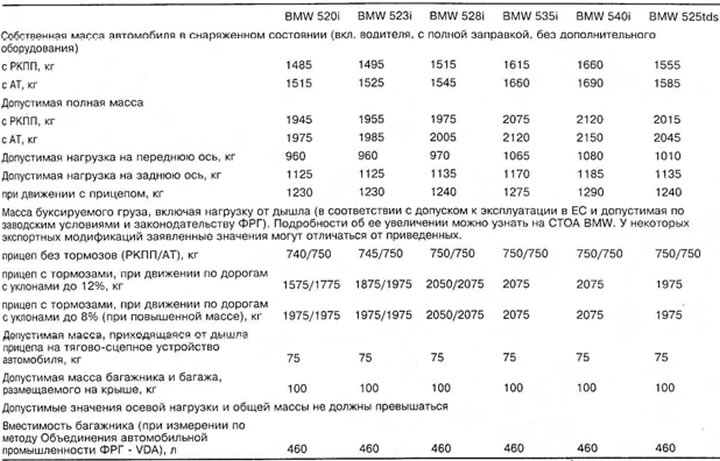
If you use the specified permissible towing weight when driving on roads with a slope of up to 12% and at the same time want to load the vehicle to the permissible total weight limit, it is recommended not to overcome slopes greater than 10%.
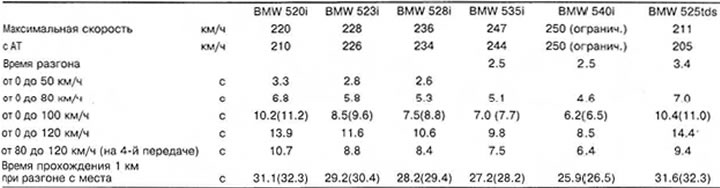
Traction and dynamic characteristics
Tires and wheel rims
Warning: The required tire pressure is also indicated on a plate on the driver's door pillar.
The pressure given applies to cold tires. As a result of a long journey, the air pressure in the tires increases by 0.2-0.4 bar. This should be taken into account and the air should not be released from the tires. The air pressure in winter tires is usually set higher by 0.2 bar. When using a car with winter tires, the speed may be limited. The driver should be aware of this.
Wheel mounting bolts for light alloy wheels should not be used to mount steel wheels and vice versa.
This article is available at russian, bulgarian, belarusian, ukrainian, serbian, croatian, romanian, polish, slovak, hungarian
Article verified: Ilyinsky Matvey
Share information:
Previous articles
БМВ E39: Governing bodies
Next articles
Similar articles on other types of BMW cars:
Main technical characteristics BMW 3 Series E21 (1975-1983)
Technical support BMW 7 Series E32 (1986-1994)
BMW E38 cars — abstract BMW 7 Series E38 (1994-2001)
Brake system — technical characteristics BMW X3 E83 (2003-2010)
Design and technical characteristics of diesel engines BMW X5 E53 (1999-2006)
Main technical characteristics BMW 3 Series E21 (1975-1983)
Technical support BMW 7 Series E32 (1986-1994)
BMW E38 cars — abstract BMW 7 Series E38 (1994-2001)
Brake system — technical characteristics BMW X3 E83 (2003-2010)
Design and technical characteristics of diesel engines BMW X5 E53 (1999-2006)
Link in different formats to this page
Visitor comments
No comments yet
- General information
- Governing bodies
- Manual
- Maintenance
- Power unit
- Engine repair
- Lubrication system
- Cooling system
- Ignition system
- Supply system
- Injection system (gasoline)
- Injection system (diesel)
- Exhaust system
- Transmission
- Clutch
- Car gearbox
- Front axle
- Rear axle
- Chassis
- Steering
- Brake system
- Wheels and tires
- Body
- Interior
- Exterior
- Heating system
- Electrical equipment
- Equipment and devices
- Power devices
- Windscreen wipers
- Electrical circuits
- General information
- Manual
- Maintenance
- Power unit
- Engine repair
- Ignition system
- Engine lubrication system
- Cooling system
- Fuel system (gasoline)
- Fuel system (diesel)
- Exhaust system
- Transmission
- Clutch
- Car gearbox
- Chassis
- Front and rear suspension
- Steering
- Brake system
- Body
- Exterior
- Interior
- Electrical equipment
- Heating system
- Equipment and devices
- Power devices
- Electrical circuits
- General information
- Manual
- Maintenance
- Power unit
- Engine in a car
- Engine overhaul
- Cooling system
- Supply system
- Ignition system
- Control system
- Transmission
- Clutch
- Manual gearbox
- Automatic gearbox
- Transmission line
- Chassis
- Steering
- Front suspension
- Rear suspension
- Brake system
- Body
- Body elements
- Car care and painting
- Electrical equipment
- Heater and air conditioner
- Equipment and devices
- Starter and generator
- Electrical circuits
- General information
- Operation and maintenance
- Specifications
- Power unit
- Engine repair
- Cooling and lubrication system
- Supply system
- Ecotronic power supply system
- Fuel injection system
- Ignition system
- Transmission
- Clutch
- Gearbox BMW 242/4
- Gearbox Getrag 262/8
- Gearbox Getrag 265/6
- Automatic gearbox
- Cardan gear
- Rear axle
- Chassis
- Steering
- Front suspension
- Rear suspension
- Brake system
- Electrical equipment
- Equipment and devices
- Electrical circuits